Department of Molecular and Integrative Physiology, University of Kansas Medical Center, Kansas City, Kansas.
Department of Molecular and Integrative Physiology, University of Kansas Medical Center, Kansas City, Kansas.
J Pain. 2018 Mar;19(3):264-277. doi: 10.1016/j.jpain.2017.10.006. Epub 2017 Dec 25.
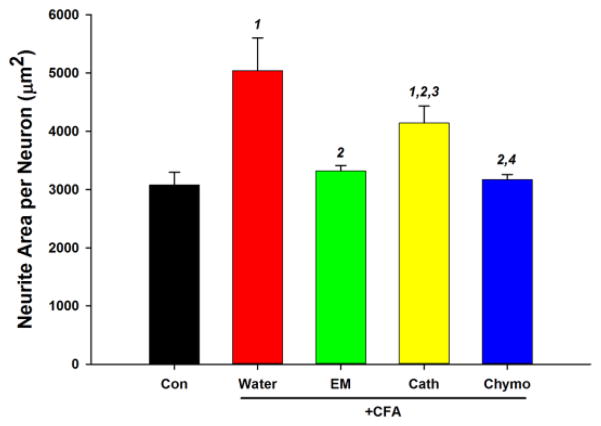
Vestibulodynia is characterized by perivaginal mechanical hypersensitivity, hyperinnervation, and abundant inflammatory cells expressing renin-angiotensin system proteins. We developed a tractable rat model of vestibulodynia to further assess the contributions of the renin-angiotensin system. Complete Freund's adjuvant injected into the posterior vestibule induced marked vestibular hypersensitivity throughout a 7-day test period. Numbers of axons immunoreactive for PGP9.5, calcitonin gene-related peptide, and GFRα2 were increased. Numbers of macrophages and T cells were also increased whereas B cells were not. Renin-angiotensin-associated proteins were abundant, with T cells as well as macrophages contributing to increased renin and angiotensinogen. Media conditioned with inflamed vestibular tissue promoted neurite sprouting by rat dorsal root ganglion neurons in vitro, and this was blocked by the angiotensin II receptor type 2 receptor antagonist PD123319 or by an angiotensin II function blocking antibody. Sensory axon sprouting induced by inflamed tissue was dependent on activity of angiotensin-converting enzyme or chymase, but not cathepsin G. Thus, vestibular Complete Freund's adjuvant injection substantially recapitulates changes seen in patients with provoked vestibulodynia, and shows that manipulation of the local inflammatory renin-angiotensin system may be a useful therapeutic strategy.
This study provides evidence that inflammation of the rat vestibule induces a phenotype recapitulating behavioral and cytological features of human vestibulodynia. The model confirms a crucial role of the local inflammatory renin-angiotensin system in hypersensitivity and hyperinnervation. Targeting this system holds promise for developing new nonopioid analgesic treatment strategies.
外阴痛的特征是阴道周围机械性超敏反应、神经支配过度和大量表达肾素-血管紧张素系统蛋白的炎症细胞。我们开发了一种可行的外阴痛大鼠模型,以进一步评估肾素-血管紧张素系统的作用。在后前庭注射完全弗氏佐剂可诱导前庭超敏反应,持续 7 天。PGP9.5、降钙素基因相关肽和 GFRα2 免疫反应性轴突的数量增加。巨噬细胞和 T 细胞的数量也增加,而 B 细胞没有增加。肾素-血管紧张素相关蛋白丰富,T 细胞和巨噬细胞有助于增加肾素和血管紧张素原。用炎症前庭组织培养的条件培养基促进大鼠背根神经节神经元的轴突发芽,这一过程被血管紧张素 II 受体 2 型受体拮抗剂 PD123319 或血管紧张素 II 功能阻断抗体阻断。炎症组织诱导的感觉轴突发芽依赖于血管紧张素转换酶或糜酶的活性,但不依赖于组织蛋白酶 G。因此,前庭完全弗氏佐剂注射实质上再现了在诱发外阴痛患者中看到的变化,并表明局部炎症肾素-血管紧张素系统的操纵可能是一种有用的治疗策略。
本研究提供了证据表明,大鼠前庭的炎症诱导了一种表型,重现了人类外阴痛的行为和细胞学特征。该模型证实了局部炎症肾素-血管紧张素系统在超敏反应和神经支配过度中的关键作用。针对该系统有望为开发新的非阿片类镇痛药治疗策略。