Lieberman Richard, Kranzler Henry R, Levine Eric S, Covault Jonathan
Alcohol Research Center, Department of Psychiatry, University of Connecticut School of Medicine, Farmington, CT, 06030-1410, USA.
Center for Studies of Addiction, Department of Psychiatry, Perelman School of Medicine of the University of Pennsylvania, Philadelphia, PA, 19104, USA; VISN4 MIRECC, Crescenz Philadelphia VAMC, Philadelphia, PA, 19104, USA.
Alcohol. 2018 Feb;66:45-53. doi: 10.1016/j.alcohol.2017.08.005. Epub 2017 Aug 12.
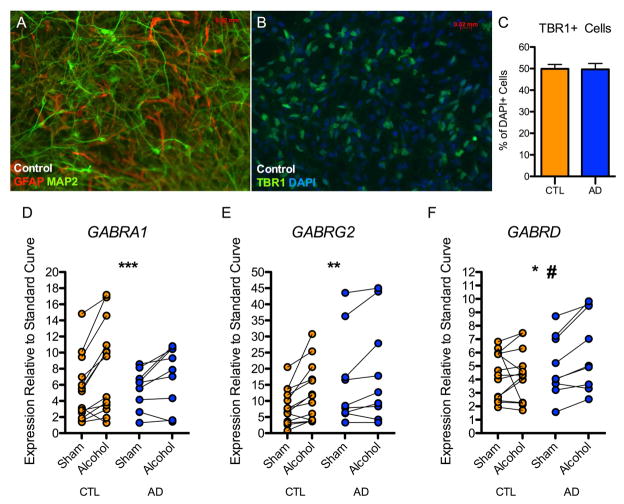
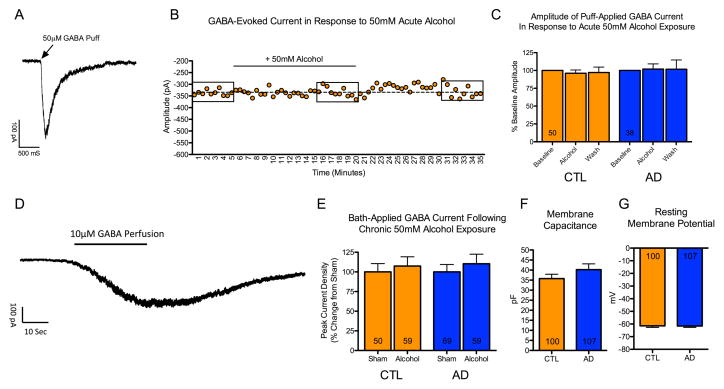
Factors influencing the development of alcohol-use disorder (AUD) are complex and heterogeneous. While animal models have been crucial to identifying actions of alcohol on neural cells, human-derived in vitro systems that reflect an individual's genetic background hold promise in furthering our understanding of the molecular and functional effects of alcohol exposure and the pathophysiology of AUD. In this report, we utilized induced pluripotent stem cell (iPSCs)-derived neural cell cultures obtained from healthy individuals (CTLs) and those with alcohol dependence (ADs) to 1) examine the effect of 21-day alcohol exposure on mRNA expression of three genes encoding GABA receptor subunits (GABRA1, GABRG2, and GABRD) using quantitative PCR, and 2) examine the effect of acute and chronic alcohol exposure on GABA-evoked currents using whole-cell patch-clamp electrophysiology. iPSCs from CTLs and ADs were differentiated into neural cultures enriched for forebrain-type excitatory glutamate neurons. Following 21-day alcohol exposure, significant treatment effects were observed in GABRA1, GABRG2, and GABRD mRNA expression. A modestly significant interaction between treatment and donor phenotype was observed for GABRD, which was increased in cell cultures derived from ADs. No effect of acute or chronic alcohol was observed on GABA-evoked currents in neurons from either CTLs or ADs. This work extends findings examining the effects of alcohol on the GABA receptor in human cell in vitro model systems.
影响酒精使用障碍(AUD)发展的因素复杂且多样。虽然动物模型对于确定酒精对神经细胞的作用至关重要,但反映个体遗传背景的人源体外系统有望进一步增进我们对酒精暴露的分子和功能影响以及AUD病理生理学的理解。在本报告中,我们利用从健康个体(CTLs)和酒精依赖者(ADs)获得的诱导多能干细胞(iPSCs)衍生的神经细胞培养物,来1)使用定量PCR检测21天酒精暴露对编码GABA受体亚基(GABRA1、GABRG2和GABRD)的三个基因的mRNA表达的影响,以及2)使用全细胞膜片钳电生理学检测急性和慢性酒精暴露对GABA诱发电流的影响。来自CTLs和ADs的iPSCs分化为富含前脑型兴奋性谷氨酸能神经元的神经培养物。在21天酒精暴露后,观察到GABRA1、GABRG2和GABRD mRNA表达有显著的处理效应。对于GABRD,观察到处理与供体表型之间存在适度显著的相互作用,在源自ADs的细胞培养物中其表达增加。在来自CTLs或ADs的神经元中,未观察到急性或慢性酒精对GABA诱发电流有影响。这项工作扩展了在人源体外模型系统中研究酒精对GABA受体影响的研究结果。