Institut de Recherche en Santé, de Surveillance Epidémiologique et de Formations (IRESSEF), Arrondissement 4, Rue 2D1, Pôle Urbain de Diamniadio, BP 7325, Dakar, Senegal.
Faculty of Health Sciences, School of Public Health, University of the Witwatersrand, Johannesburg, South Africa.
Malar J. 2017 Nov 21;16(1):470. doi: 10.1186/s12936-017-2095-2.
The World Health Organization (WHO) recommends the use of insecticide-treated nets (ITNs) and intermittent preventive treatment in pregnancy (IPTp) as a cost-effective intervention for the prevention of malaria during pregnancy in endemic areas. This study was conducted to investigate: (1) the extent of use of both IPTp and ITNs, and (2) conduct multinomial regression to identify factors affecting the optimal usage of IPTp and ITNs among women with a recent pregnancy in Senegal.
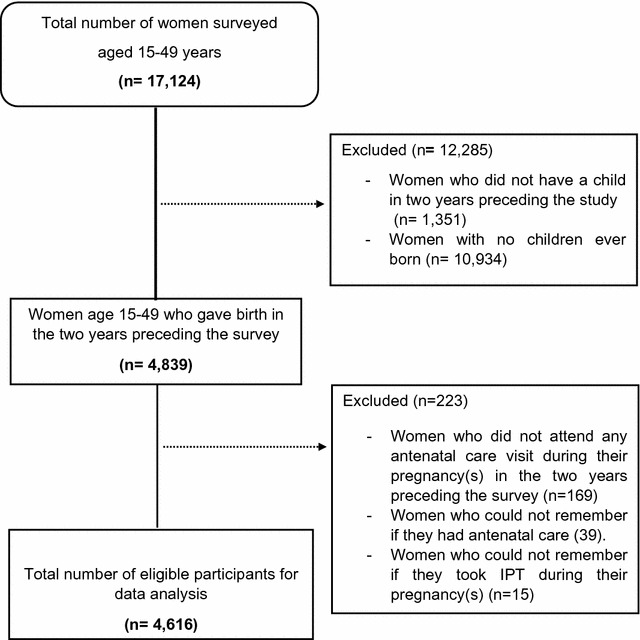
Data was drawn from the 2013-2014 Demographic and Health Survey. A total of 4616 women aged 15-49 years old, who had a recent pregnancy were analyzed. Multinomial logistic regression model was used to assess factors associated with optimal uptake of malaria preventive strategies (both IPTp and ITN use).
Amongst women who had a recent pregnancy, less than half of them used ITNs (46.84%) however, 80.35% reported taking IPTp during their last pregnancy. Overall, 37.51% reported using the optimal malaria preventive strategies. Women aged 35-49 years and living in the richer or middle wealth quintile were more likely to use optimal prevention methods. Pregnant women living in Diourbel, Saint-Louis, Thies, Louga, Fatick and Matam were more likely to use both IPTp-SP and ITNs compared to those living in Dakar. Additionally, women who initiated antenatal care in at least at 6 weeks of pregnancy or who attended four antenatal visits or more were more likely to use optimal malaria preventive methods during pregnancy.
This study has shown important factors that influence the uptake of malaria prevention methods during pregnancy in Senegal. These findings highlight the need for targeted preventive strategies when designing and implementing policies aimed at improving the uptake of these measures during pregnancy in Senegal.
世界卫生组织(WHO)建议在疟疾流行地区使用经杀虫剂处理的蚊帐(ITNs)和孕妇间歇性预防治疗(IPTp),以作为一种具有成本效益的预防妊娠疟疾的干预措施。本研究旨在调查:(1)IPT 和 ITN 的使用程度,(2)进行多项回归分析,以确定塞内加尔近期妊娠妇女中影响 IPT 和 ITN 最佳使用的因素。
数据来自 2013-2014 年人口与健康调查。共分析了 4616 名年龄在 15-49 岁之间、最近怀孕的妇女。使用多项逻辑回归模型评估与最佳疟疾预防策略(IPT 和 ITN 联合使用)相关的因素。
在最近怀孕的妇女中,不到一半的人使用 ITN(46.84%),但 80.35%的人报告在最近一次怀孕时服用 IPTp。总的来说,37.51%的人报告使用了最佳的疟疾预防策略。35-49 岁的妇女和生活在较富裕或中等财富五分位数的妇女更有可能使用最佳预防方法。与生活在达喀尔的妇女相比,生活在迪奥尔布尔、圣路易、捷斯、卢加、法蒂克和马塔姆的孕妇更有可能同时使用 IPTp-SP 和 ITN。此外,在至少 6 周的孕期开始产前保健或至少接受 4 次产前检查的孕妇更有可能在怀孕期间使用最佳的疟疾预防方法。
本研究表明了影响塞内加尔妊娠期间预防疟疾方法采用的重要因素。这些发现强调了在制定和实施旨在改善塞内加尔妊娠期间这些措施采用率的政策时,需要有针对性的预防策略。