Department of Psychiatry, University of California, San Francisco, San Francisco, CA, USA.
Department of Ophthalmology, University of California, San Francisco, San Francisco, CA, USA.
Mol Psychiatry. 2018 Aug;23(8):1687-1698. doi: 10.1038/mp.2017.238. Epub 2017 Nov 21.
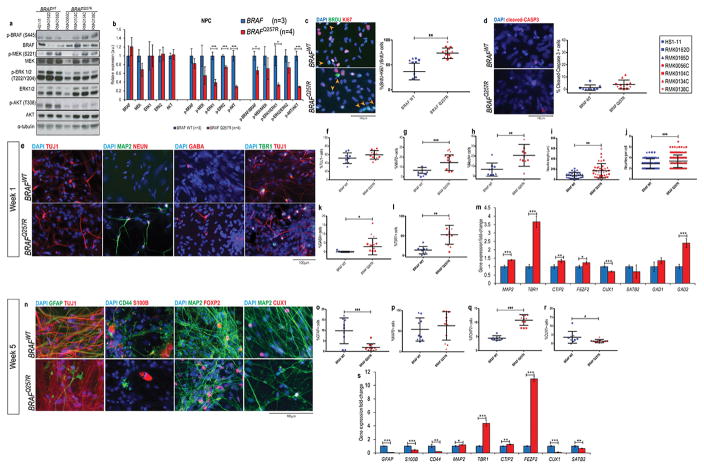
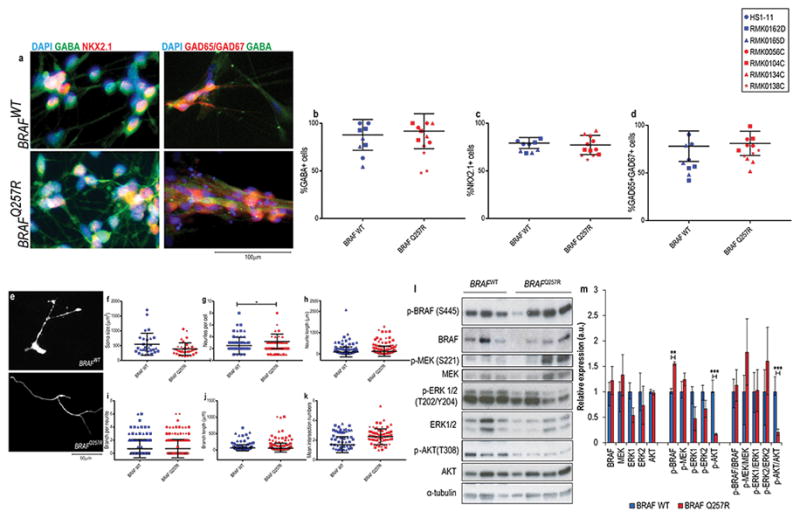
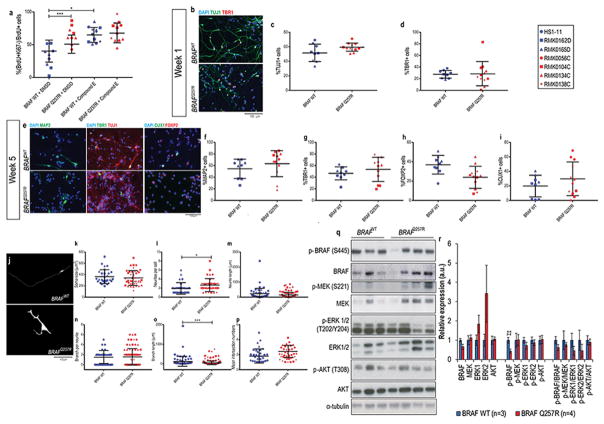
Ras/MAPK pathway signaling is a major participant in neurodevelopment, and evidence suggests that BRAF, a key Ras signal mediator, influences human behavior. We studied the role of the mutation BRAF, the most common cause of cardiofaciocutaneous syndrome (CFC), in an induced pluripotent stem cell (iPSC)-derived model of human neurodevelopment. In iPSC-derived neuronal cultures from CFC subjects, we observed decreased p-AKT and p-ERK1/2 compared to controls, as well as a depleted neural progenitor pool and rapid neuronal maturation. Pharmacological PI3K/AKT pathway manipulation recapitulated cellular phenotypes in control cells and attenuated them in CFC cells. CFC cultures displayed altered cellular subtype ratios and increased intrinsic excitability. Moreover, in CFC cells, Ras/MAPK pathway activation and morphological abnormalities exhibited cell subtype-specific differences. Our results highlight the importance of exploring specific cellular subtypes and of using iPSC models to reveal relevant human-specific neurodevelopmental events.
Ras/MAPK 信号通路的信号转导是神经发育的主要参与者,有证据表明,Ras 信号转导的关键介质 BRAF 影响人类行为。我们研究了突变 BRAF(卡-皮综合征的最常见病因)在诱导多能干细胞(iPSC)衍生的人类神经发育模型中的作用。在 CFC 患者来源的 iPSC 衍生的神经元培养物中,与对照组相比,我们观察到 p-AKT 和 p-ERK1/2 减少,以及神经祖细胞池耗竭和神经元快速成熟。PI3K/AKT 通路的药理学操作在对照细胞中再现了细胞表型,并在 CFC 细胞中减弱了这些表型。CFC 培养物显示出改变的细胞亚型比例和增加的内在兴奋性。此外,在 CFC 细胞中,Ras/MAPK 信号通路的激活和形态异常表现出细胞亚型特异性差异。我们的研究结果强调了探索特定细胞亚型和使用 iPSC 模型来揭示相关的人类特异性神经发育事件的重要性。