Yao Shixiang, Deng Lili, Zeng Kaifang
College of Food Science, Southwest University, Chongqing, China.
PeerJ. 2017 Nov 15;5:e4051. doi: 10.7717/peerj.4051. eCollection 2017.
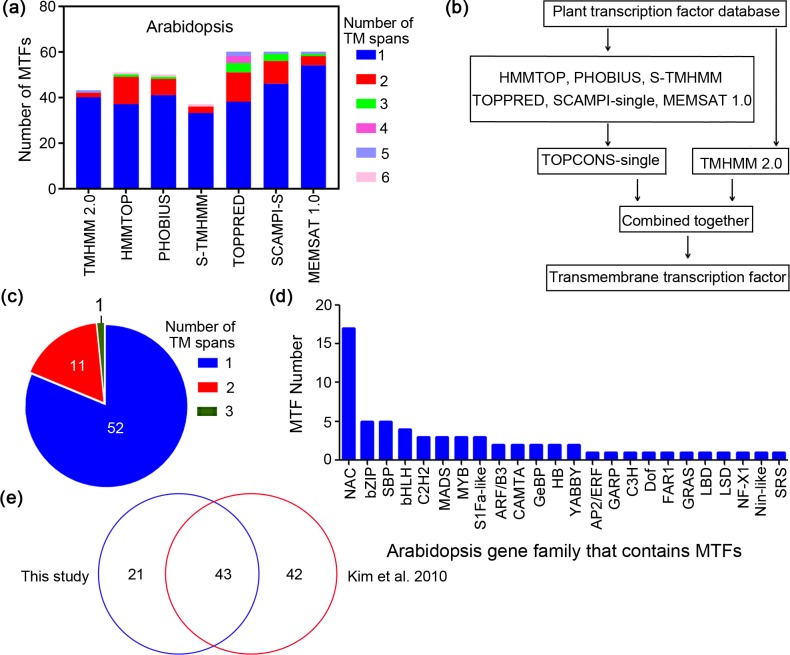
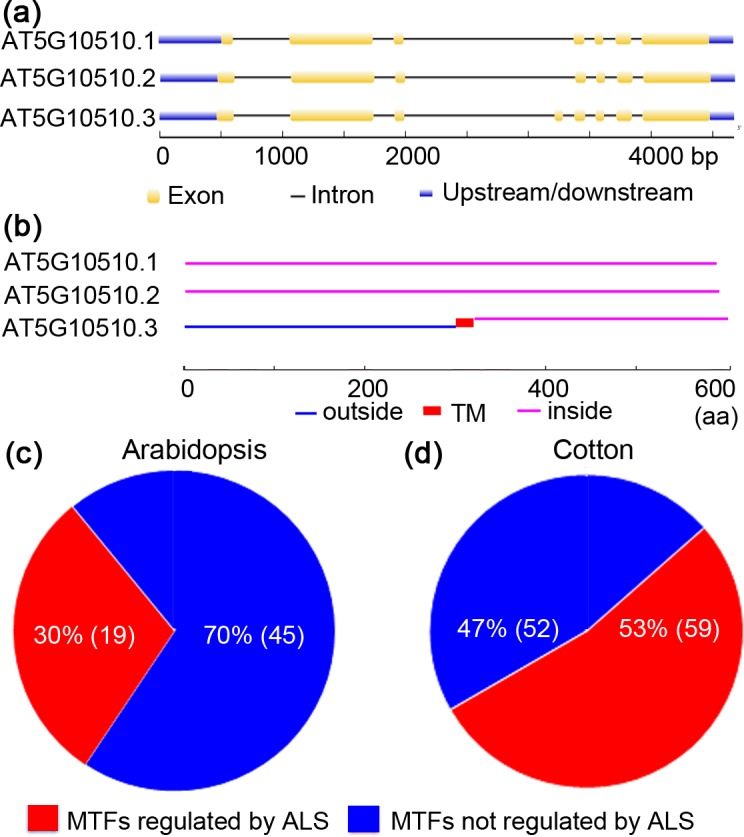
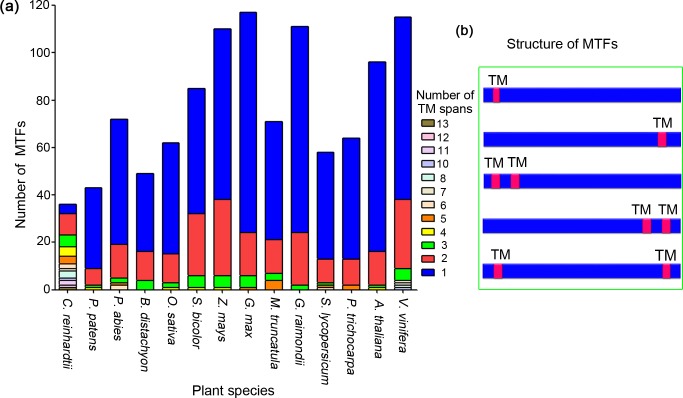
Membrane-bound transcription factors (MTFs) are located in cellular membranes due to their transmembrane domains. In plants, proteolytic processing is considered to be the main mechanism for MTF activation, which ensures the liberation of MTFs from membranes and further their translocation into the nucleus to regulate gene expression; this process skips both the transcriptional and translational stages, and thus it guarantees the prompt responses of plants to various stimuli. Currently, information concerning plant MTFs is limited to model organisms, including and , and little is known in other plant species at the genome level. In the present study, seven membrane topology predictors widely used by the research community were employed to establish a reliable workflow for MTF identification. Genome-wide analysis of MTFs was then performed in 14 plant species spanning the chlorophytes, bryophytes, gymnosperms, monocots and eudicots. A total of 1,089 MTFs have been identified from a total of 25,850 transcription factors in these 14 plant species. These MTFs belong to 52 gene family, and the top six most abundant families are the NAC (128), SBP (77), C2H2 (70), bZIP (67), MYB-related (65) and bHLH (63) families. The MTFs have transmembrane spans ranging from one to thirteen, and 71.5% and 21.1% of the MTFs have one and two transmembrane motifs, respectively. Most of the MTFs in this study have transmembrane motifs located in either N- or C-terminal regions, indicating that proteolytic cleavage could be a conserved mechanism for MTF activation. Additionally, approximately half of the MTFs in the genome of either or could be potentially regulated by alternative splicing, indicating that alternative splicing is another conserved activation mechanism for MTFs. The present study performed systematic analyses of MTFs in plant lineages at the genome level, and provides invaluable information for the research community.
膜结合转录因子(MTFs)因其跨膜结构域而位于细胞膜中。在植物中,蛋白水解加工被认为是MTF激活的主要机制,它确保MTFs从膜上释放出来,并进一步转运到细胞核中以调节基因表达;这个过程跳过了转录和翻译阶段,因此保证了植物对各种刺激的快速反应。目前,关于植物MTFs的信息仅限于模式生物,包括[具体模式生物1]和[具体模式生物2],而在其他植物物种的基因组水平上了解甚少。在本研究中,使用了研究界广泛使用的七种膜拓扑结构预测器来建立一个可靠的MTF识别工作流程。然后在涵盖绿藻、苔藓植物、裸子植物、单子叶植物和双子叶植物的14种植物物种中进行了MTF的全基因组分析。在这14种植物物种的总共25,850个转录因子中,总共鉴定出了1089个MTFs。这些MTFs属于52个基因家族,最丰富的前六个家族是NAC(128个)、SBP(77个)、C2H2(70个)、bZIP(67个)、MYB相关(65个)和bHLH(63个)家族。MTFs的跨膜跨度从1到13不等,分别有71.5%和21.1%的MTFs具有一个和两个跨膜基序。本研究中的大多数MTFs的跨膜基序位于N端或C端区域,这表明蛋白水解切割可能是MTF激活的一种保守机制。此外,[具体植物1]或[具体植物2]基因组中大约一半的MTFs可能受到可变剪接的潜在调控,这表明可变剪接是MTFs的另一种保守激活机制。本研究在基因组水平上对植物谱系中的MTFs进行了系统分析,并为研究界提供了宝贵的信息。