Hellstrand Tang Ulla, Zügner Roland, Lisovskaja Vera, Karlsson Jon, Hagberg Kerstin, Tranberg Roy
Department of Orthopaedics, Institute of Clinical Sciences, the Sahlgrenska Academy at University of Gothenburg, Gothenburg, Sweden.
Department of Prosthetics and Orthotics, Sahlgrenska University Hospital, Gothenburg, Sweden.
J Clin Transl Endocrinol. 2014 Jul 24;1(4):121-132. doi: 10.1016/j.jcte.2014.06.002. eCollection 2014 Dec.
Special insoles and shoes designed to prevent foot ulcers caused by repetitive high pressures are recommended for patients with diabetes who have any of the following risk factors: neuropathy; peripheral vascular disease; foot deformities; previous ulcers; amputation; and skin pathologies. However, there is a need for increased knowledge regarding: a) differences in the peak pressure (PP) and pressure time integral (PTI) for different types of insoles; and b) the properties of the pressure distribution for insoles used over a period of several months. We present the results of a randomized trial to compare the plantar pressures of three commonly used insoles.
The primary objective was to compare the PP and PTI between three types of insoles. The secondary objective was to explore the long-term pattern of peak plantar pressure distribution and variations in specific regions of interest (ROI). The tertiary objective was to investigate the impacts of insole adjustments, how much the insoles were used, and the levels of patient satisfaction.
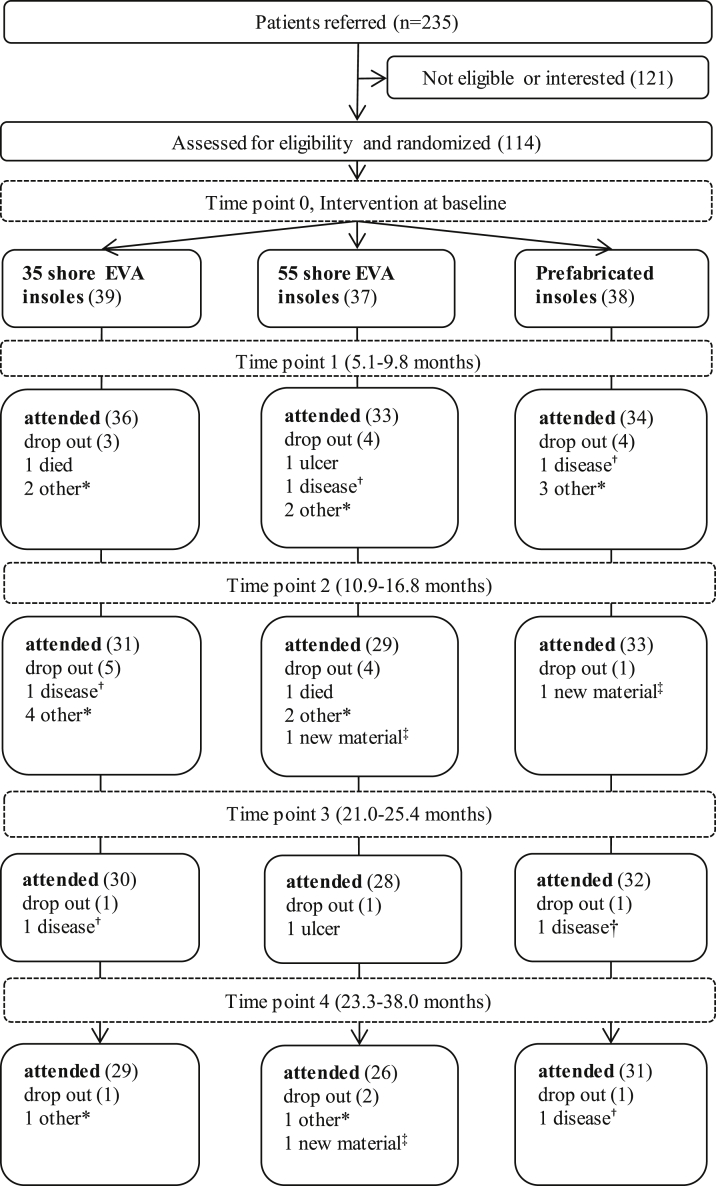
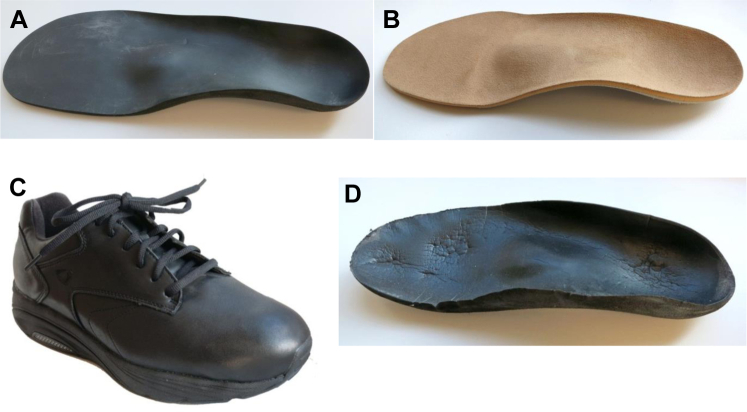
In a 2-year trial, 114 patients with type 1 ( = 31) or type 2 ( = 83) diabetes (62 men and 52 women; mean age, 57.7 ± 15.4 years; duration of diabetes, 12.3 ± 11.2 years; neuropathy, 38%), were randomized to be supplied with one of three different insoles. The ethylene vinyl acetate (EVA) insoles were used in outdoor walking shoes. The 35 EVA group ( = 39) received soft custom-made insoles composed of EVA of 35 shore A hardness, the 55 EVA group ( = 37) received custom-made insoles composed of EVA of 55 shore hardness, and the control group ( = 38) received prefabricated insoles composed of a hard core with a top layer of soft 12 shore hardness microfiber. Using F-Scan, the in-shoe plantar pressures were measured at seven ROI (hallux, metatarsal head 1, metatarsal head 2, metatarsal head 4, metatarsal head 5, lateral aspect of the mid-foot, heel) on five occasions during the study period. The plantar-pressure variables used were PP (main outcome) and PTI. The plantar patterns of load were explored, satisfaction and usage of the insoles were rated by the participants, and insole adjustments were recorded.
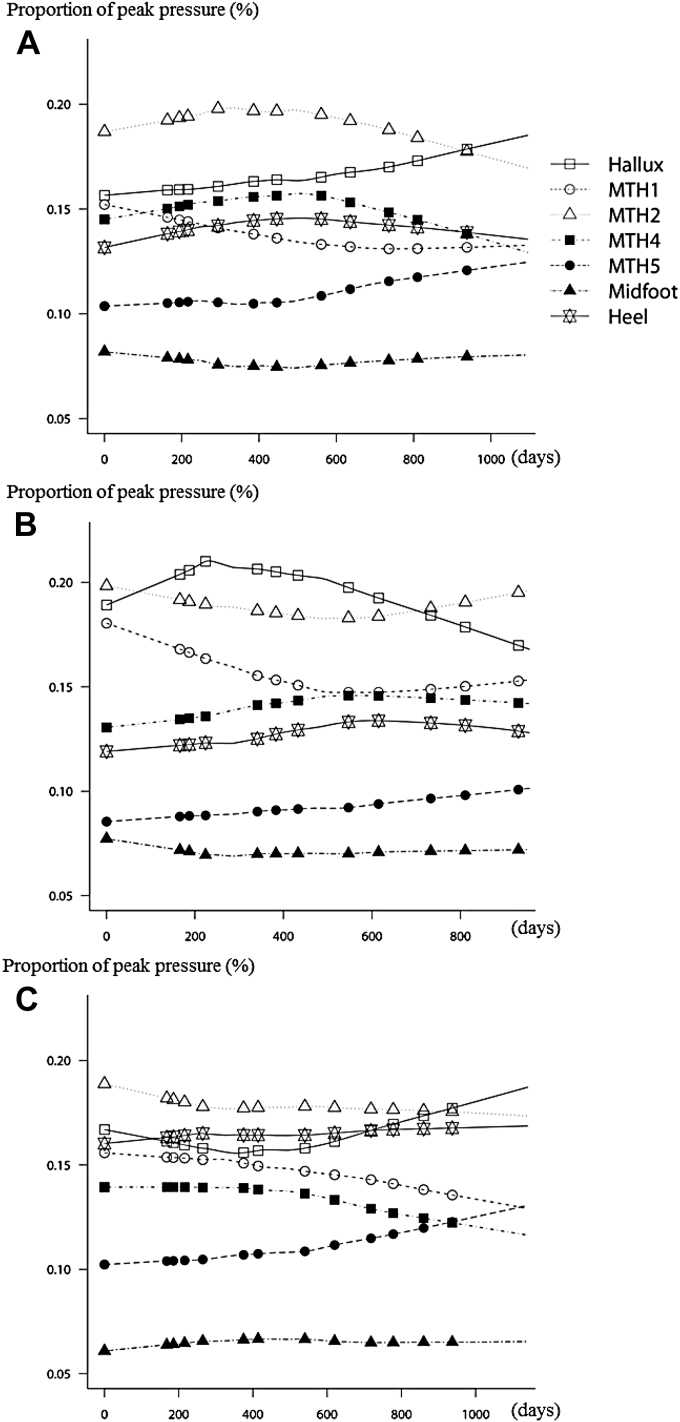
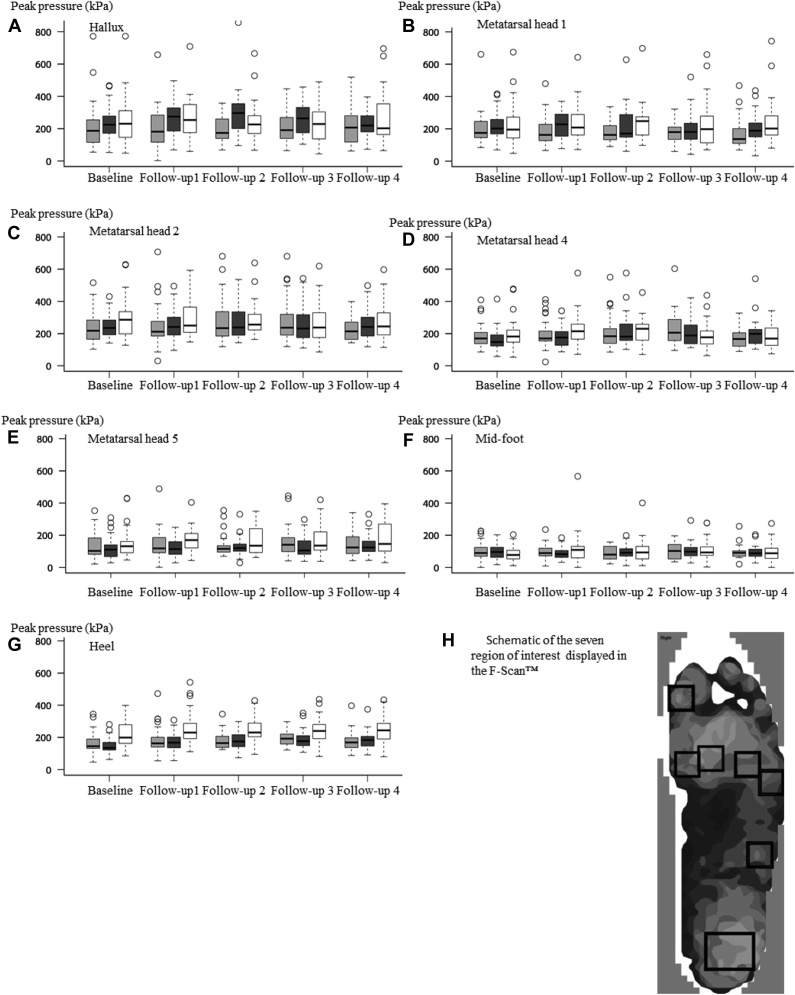
A mixed model analysis estimated lower PP values in the heel regions for the 35 EVA and 55 EVA insoles (171 ± 13 and 161 ± 13 kPa, respectively) than for the prefabricated insoles (234 ± 10 kPa) ( < 0.001). Also for some of the other six ROI indications of difference in PP or PTI could be observed. The redistribution of peak plantar pressure for all of the insoles, was stable at the mid-foot, while the proportion of load on the distal area changed during the study period According to the self-reported answers (scale, 0-100), the average usage of the insoles was rated as 79 and satisfaction was rated as 85 ( = 75). Thirty-two percent of the subjects had not received foot care. Fourteen adjustments to insoles were made during the study period, and 86 pairs of insoles were exchanged due to wear, with 49% being exchanged in the 35 EVA group.
Custom-made insoles used in combination with stable walking shoes gave lower pressures at the heel region. The variation makes it difficult to detect a systematic difference in plantar pressure for the 6 ROI, if such a difference indeed exists. The levels of satisfaction and usage for all the insoles tested were high. The insoles maintained their pressure redistribution properties over long periods, and few adjustments were needed.
对于患有以下任何一种风险因素的糖尿病患者,建议使用专门设计用于预防因反复高压导致足部溃疡的鞋垫和鞋子:神经病变;外周血管疾病;足部畸形;既往溃疡;截肢;以及皮肤病变。然而,需要更多关于以下方面的知识:a)不同类型鞋垫的峰值压力(PP)和压力时间积分(PTI)的差异;b)使用数月的鞋垫的压力分布特性。我们展示了一项随机试验的结果,以比较三种常用鞋垫的足底压力。
主要目的是比较三种类型鞋垫之间的PP和PTI。次要目的是探索足底峰值压力分布的长期模式以及特定感兴趣区域(ROI)的变化。第三目的是研究鞋垫调整、鞋垫使用量以及患者满意度水平的影响。
在一项为期2年的试验中,114例1型(n = 31)或2型(n = 83)糖尿病患者(62名男性和52名女性;平均年龄57.7±15.4岁;糖尿病病程12.3±11.2年;神经病变患者38%)被随机分配使用三种不同鞋垫中的一种。乙烯醋酸乙烯酯(EVA)鞋垫用于户外步行鞋。35 EVA组(n = 39)接受由邵氏A硬度为35的EVA制成的软定制鞋垫,55 EVA组(n = 37)接受由邵氏硬度为55的EVA制成的定制鞋垫,对照组(n = 38)接受由硬芯和顶层为邵氏硬度12的软微纤维制成的预制鞋垫。在研究期间,使用F-Scan在五个时间点对七个ROI(拇趾、第一跖骨头、第二跖骨头、第四跖骨头、第五跖骨头、足中部外侧、足跟)测量鞋内足底压力。所使用的足底压力变量为PP(主要结果)和PTI。探索了足底负荷模式,参与者对鞋垫的满意度和使用情况进行了评分,并记录了鞋垫调整情况。
混合模型分析估计,35 EVA和55 EVA鞋垫在足跟区域的PP值(分别为171±13和161±13 kPa)低于预制鞋垫(234±10 kPa)(P < 0.001)。对于其他六个ROI中的一些,也可观察到PP或PTI存在差异。所有鞋垫的足底峰值压力重新分布在足中部是稳定的,而在研究期间,远端区域的负荷比例发生了变化。根据自我报告的答案(评分范围0 - 100),鞋垫的平均使用评分为79,满意度评分为85(n = 75)。32%的受试者未接受足部护理。在研究期间对鞋垫进行了14次调整,并且由于磨损更换了86双鞋垫,其中49%在35 EVA组中被更换。
与稳定的步行鞋结合使用的定制鞋垫在足跟区域产生较低压力。这种变化使得难以检测六个ROI中足底压力是否存在系统差异(如果确实存在这种差异的话)。所有测试鞋垫的满意度和使用水平都很高。鞋垫在长时间内保持其压力重新分布特性,并且几乎不需要调整。