Roy-O'Reilly Meaghan, Zhu Liang, Atadja Louise, Torres Glenda, Aronowski Jaroslaw, McCullough Louise, Edwards Nancy J
Department of Neurology University of Texas Health Science Center Houston Texas 77030.
Department of Neurosurgery University of Texas Health Science Center Houston Texas 77030.
Ann Clin Transl Neurol. 2017 Oct 19;4(11):793-800. doi: 10.1002/acn3.485. eCollection 2017 Nov.
Patients with intracerebral hemorrhage (ICH) may elaborate varying degrees of perihematomal edema (PHE), requiring closer monitoring and a higher intensity of treatment. Here, we explore whether the soluble form of CD163, a scavenger receptor responsible for hemoglobin sequestration, can serve as a prognostic biomarker of PHE development and poor outcome after ICH.
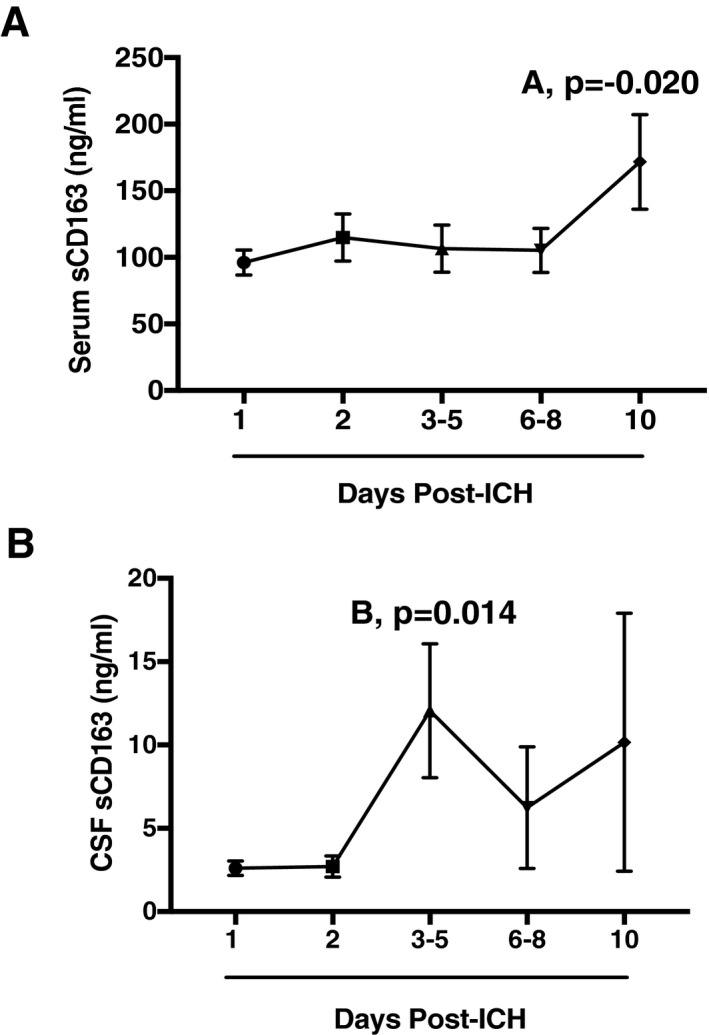
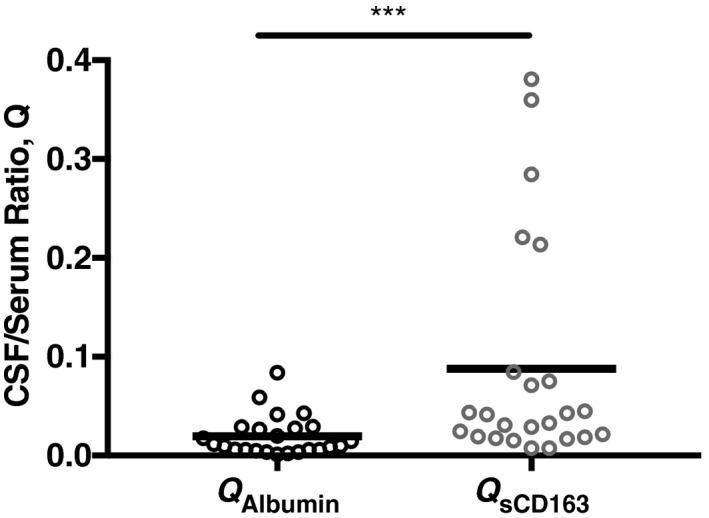
Our study cohort was comprised of 51 primary age- and sex-matched ICH patients with moderate-sized, hypertensive deep hemorrhages. Patients were part of a prospective ICH registry cataloguing admission data along with functional outcomes. We measured sCD163 levels in serial serum and cerebrospinal fluid (CSF) samples obtained at prespecified timepoints. Descriptive statistics, including a generalized estimating equation for longitudinal data, were used to analyze sCD163 in relation to ICH outcomes.
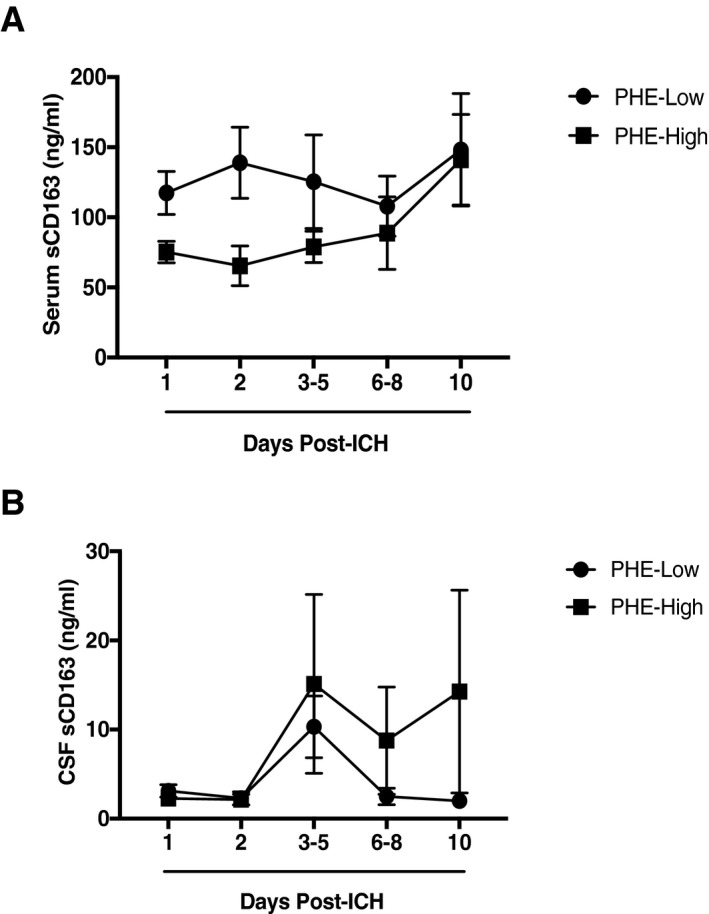
Acute serum sCD163 (<48 h postictus) was significantly elevated in ICH patients compared to both acute neurological event controls ( = <0.001) and healthy controls ( = 0.003). As predicted, acute serum sCD163 levels were significantly associated with both hematoma volume expansion ( = 0.009) and PHE expansion ( = 0.002). Further examination determined that patients with high PHE expansion had poorer modified Rankin Scale scores at discharge ( = 0.024), and circulating sCD163 levels were found to be significantly lower in patients with high-level PHE expansion.
Acute sCD163 levels may be a useful biomarker for the acute identification of patients at risk for hematoma expansion, perihematomal edema expansion and poorer short-term outcomes.
脑出血(ICH)患者可能会出现不同程度的血肿周围水肿(PHE),需要更密切的监测和更高强度的治疗。在此,我们探讨负责血红蛋白隔离的清道夫受体CD163的可溶性形式是否可作为PHE发展和ICH后不良预后的预后生物标志物。
我们的研究队列由51例年龄和性别匹配的原发性中度大小、高血压性深部脑出血患者组成。患者是前瞻性ICH登记处的一部分,该登记处对入院数据以及功能结局进行编目。我们在预先指定的时间点采集的系列血清和脑脊液(CSF)样本中测量sCD163水平。描述性统计,包括用于纵向数据的广义估计方程,用于分析与ICH结局相关的sCD163。
与急性神经事件对照组(P<0.001)和健康对照组(P = 0.003)相比,ICH患者的急性血清sCD163(发病后<48小时)显著升高。如预期的那样,急性血清sCD163水平与血肿体积扩大(P = 0.009)和PHE扩大(P = 0.002)均显著相关。进一步检查确定,PHE扩大程度高的患者出院时改良Rankin量表评分较差(P = 0.024),并且发现PHE扩大程度高的患者循环sCD163水平显著较低。
急性sCD163水平可能是急性识别有血肿扩大、血肿周围水肿扩大和短期预后较差风险患者的有用生物标志物。