Laboratory of Experimental Neurology and Neuroimmunology, 2nd Department of Neurology, AHEPA University Hospital, Aristotle University of Thessaloniki, Thessaloniki, Greece.
Department of Neurology, Faculty of Medicine, University of Thessaly, Larissa, Greece.
J Neuroinflammation. 2017 Nov 21;14(1):227. doi: 10.1186/s12974-017-0995-2.
Neural precursor cells (NPCs) located in the subventricular zone (SVZ), a well-defined NPC niche, play a crucial role in central nervous system (CNS) homeostasis. Moreover, NPCs are involved in the endogenous reparative process both in multiple sclerosis (MS) and experimental autoimmune encephalomyelitis (EAE). However, the possibility that NPCs may be vulnerable to immune-related components may not be ruled out. Therefore, we investigated the potential affinity of myelin oligodendrocyte glycoprotein (MOG)-induced humoral response(s) to NPCs.
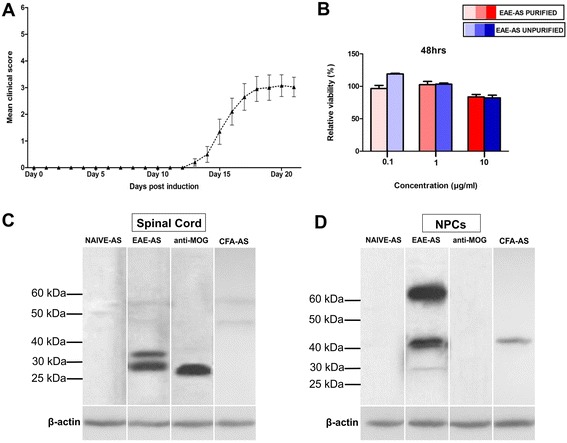
MOG-EAE was induced in C57BL/6 mice; blood-sampling was performed on days 17-21 (acute phase) along with a naive group and corresponding antisera (AS) were collected (EAE-AS, NAIVE-AS). The presence of anti-CNS autoantibodies was examined with western blotting. Furthermore, using the collected antisera and anti-MOG antibody (as positive control), immunohistochemistry and double immunofluorescence were implemented on normal neonatal, postnatal, and adult mouse brain sections. Targeted NPCs were identified with confocal microscopy. In vitro immunoreactivity assessment on NPCs challenged with autoantibodies was evaluated for apoptotic/autophagic activity.
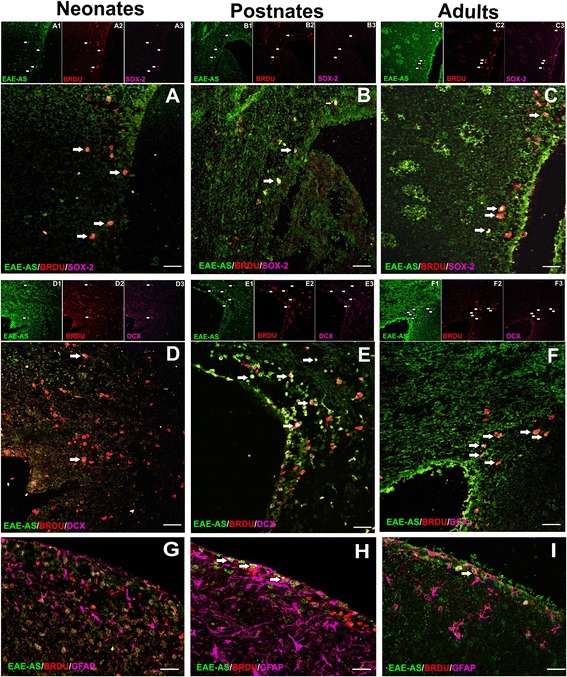
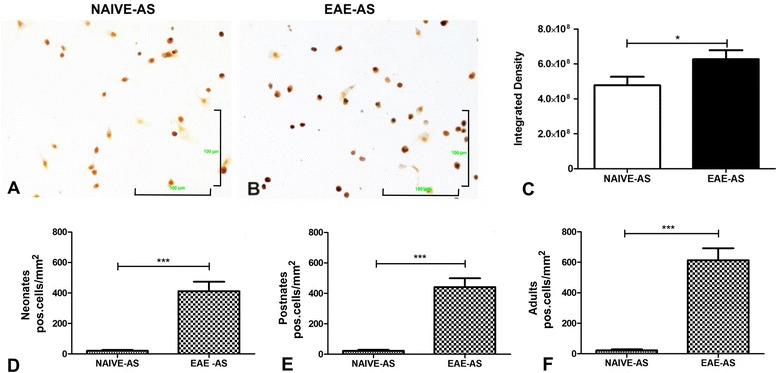
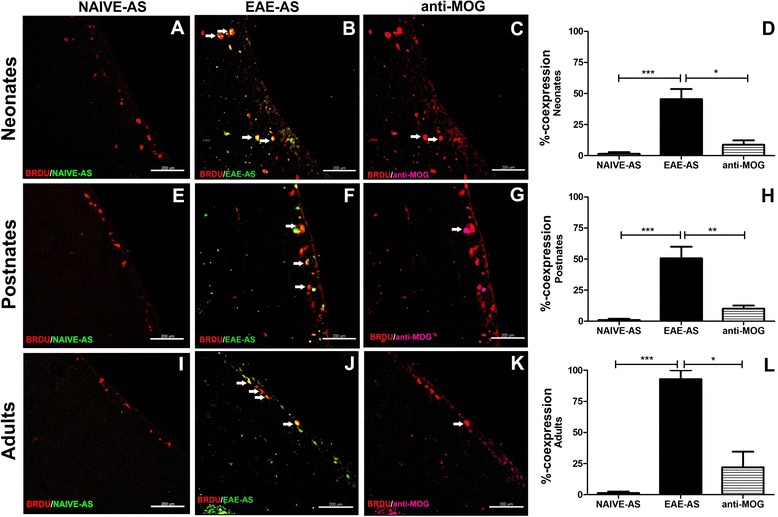
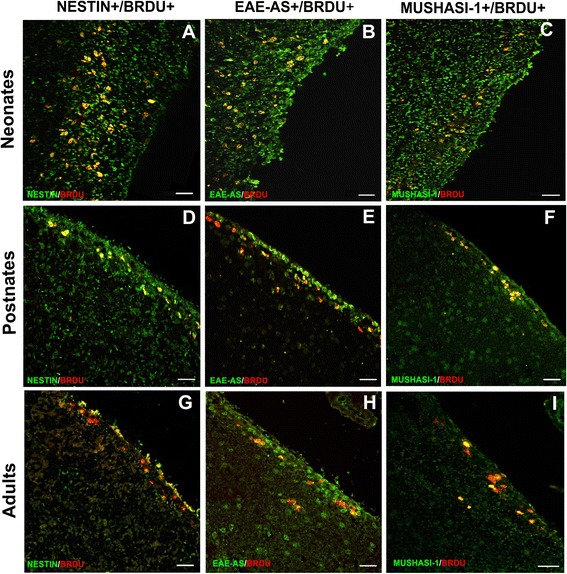
Western blotting verified the existence of autoantibodies in EAE mice and demonstrated bands corresponding to yet unidentified NPC surface epitopes. A dominant selective binding of EAE-AS in the subventricular zone in all age groups compared to NAIVE-AS (p < 0.001) was observed. Additionally, anti-BrdU/EAE-AS colocalization was significantly higher than anti-BrdU/anti-MOG, a finding suggesting that the EAE humoral response colocalized with NPCs(BrdU), cells that do not express MOG. Well-established NPC markers (Nestin, m-Musashi-1, Sox2, DCX, GFAP, NG2) were used to identify the distinct cell types which exhibited selective binding with EAE-AS. The findings verified that EAE-AS exerts cross-reactivity with NPCs which varies throughout the neonatal to adult stage, with a preference to cells of early developmental stages. Finally, increased expressions of Caspase 3 and Beclin 1 on NPCs were detected.
We provide evidence for the first time that MOG EAE induces production of antibodies with affinity to SVZ of naive mice in three different age groups. These autoantibodies target lineage-specific NPCs as brain develops and have the potential to trigger apoptotic pathways. Thus, our findings provide indication that cross-talk between immunity and NPCs may lead to functional alteration of NPCs regarding their viability and potentially oligodendrogenesis and effective remyelination.
位于侧脑室下区(SVZ)的神经前体细胞(NPC)是一个明确的 NPC 生态位,在中枢神经系统(CNS)稳态中发挥着关键作用。此外,NPC 参与多发性硬化症(MS)和实验性自身免疫性脑脊髓炎(EAE)中的内源性修复过程。然而,不能排除 NPC 可能易受免疫相关成分影响的可能性。因此,我们研究了髓鞘少突胶质细胞糖蛋白(MOG)诱导的体液反应(s)对 NPC 的潜在亲和力。
在 C57BL/6 小鼠中诱导 MOG-EAE;在急性阶段(第 17-21 天)采血,并采集血液样本(EAE-AS、NAIVE-AS)。使用 Western blot 检测抗 CNS 自身抗体的存在。此外,使用收集的抗血清和抗 MOG 抗体(作为阳性对照),对正常新生、出生后和成年小鼠脑切片进行免疫组织化学和双重免疫荧光染色。使用共聚焦显微镜鉴定靶向 NPC。评估 NPC 受到自身抗体攻击时的体外免疫反应性,以评估细胞凋亡/自噬活性。
Western blot 验证了 EAE 小鼠中存在自身抗体,并证明了与 NPC 表面未知表位相对应的条带。与 NAIVE-AS 相比,所有年龄组的 EAE-AS 在侧脑室下区均表现出明显的选择性结合(p < 0.001)。此外,与抗 BrdU/抗 MOG 相比,抗 BrdU/EAE-AS 的共定位显著升高,这表明 EAE 体液反应与 NPC(BrdU)共定位,而 NPC 不表达 MOG。使用成熟的 NPC 标志物(Nestin、m-Musashi-1、Sox2、DCX、GFAP、NG2)来鉴定表现出与 EAE-AS 选择性结合的不同细胞类型。结果证实,EAE-AS 与 NPC 发生交叉反应,这种反应在新生儿到成年期的不同阶段存在差异,且与早期发育阶段的细胞有偏好。最后,在 NPC 上检测到 Caspase 3 和 Beclin 1 的表达增加。
我们首次提供证据表明,MOG EAE 在三个不同年龄组的幼稚小鼠 SVZ 中诱导产生了具有亲和力的抗体。这些自身抗体针对脑发育过程中谱系特异性 NPC,并有可能触发细胞凋亡途径。因此,我们的研究结果表明,免疫与 NPC 之间的相互作用可能导致 NPC 功能发生改变,从而影响其存活能力以及潜在的少突胶质细胞生成和有效的髓鞘再生。