UCIBIO, Departamento de Ciências da Vida, Faculdade de Ciências e Tecnologia, Universidade NOVA de Lisboa, Caparica, Portugal.
Institute for Life Sciences, Physics and Astronomy, Faculty of Physical Sciences and Engineering, University of Southampton, Southampton, SO17 1BJ, UK.
J Nanobiotechnology. 2017 Nov 21;15(1):85. doi: 10.1186/s12951-017-0321-2.
Anti-angiogenic therapy has great potential for cancer therapy with several FDA approved formulations but there are considerable side effects upon the normal blood vessels that decrease the potential application of such therapeutics. Chicken chorioallantoic membrane (CAM) has been used as a model to study angiogenesis in vivo. Using a CAM model, it had been previously shown that spherical gold nanoparticles functionalised with an anti-angiogenic peptide can humper neo-angiogenesis.
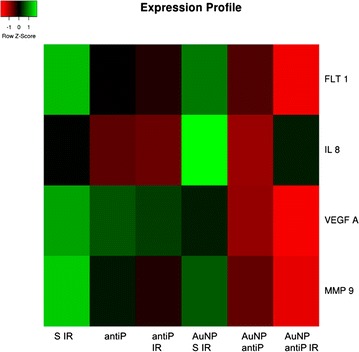
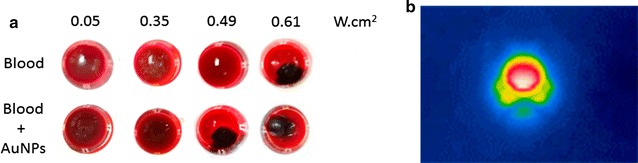
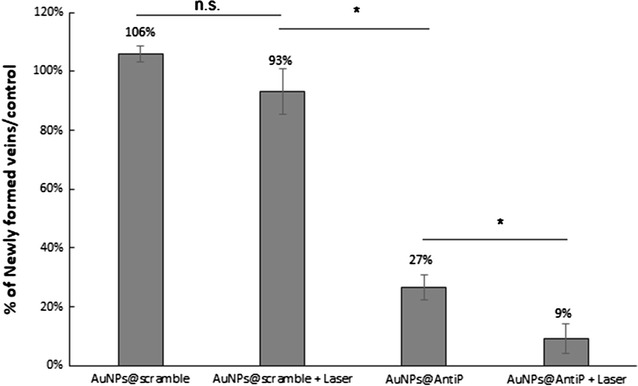
Our results show that gold nanoparticles conjugated with an anti-angiogenic peptide can be combined with visible laser irradiation to enhance angiogenesis arrest in vivo. We show that a green laser coupled to gold nanoparticles can achieve high localized temperatures able to precisely cauterize blood vessels. This combined therapy acts via VEGFR pathway inhibition, leading to a fourfold reduction in FLT-1 expression.
The proposed phototherapy extends the use of visible lasers in clinics, combining it with chemotherapy to potentiate cancer treatment. This approach allows the reduction of dose of anti-angiogenic peptide, thus reducing possible side effects, while destroying blood vessels supply critical for tumour progression.
抗血管生成疗法在癌症治疗方面具有很大的潜力,已有多种获得 FDA 批准的制剂,但对正常血管存在相当大的副作用,这降低了此类治疗方法的应用潜力。鸡胚尿囊膜(CAM)已被用作体内血管生成研究的模型。先前的研究表明,经过抗血管生成肽功能化的球形金纳米粒子可以抑制新血管生成。
我们的结果表明,与抗血管生成肽偶联的金纳米粒子可以与可见激光辐射结合,从而增强体内血管生成抑制。我们表明,与金纳米粒子结合的绿光激光可以达到能够精确烧灼血管的高局部温度。这种联合疗法通过 VEGFR 通路抑制起作用,导致 FLT-1 表达降低四倍。
所提出的光疗方法扩展了可见激光在临床中的应用,将其与化疗相结合以增强癌症治疗效果。这种方法允许减少抗血管生成肽的剂量,从而减少可能的副作用,同时破坏对肿瘤进展至关重要的血管供应。