Egamberdieva Dilfuza, Wirth Stephan J, Alqarawi Abdulaziz A, Abd Allah Elsayed F, Hashem Abeer
Leibniz Centre for Agricultural Landscape Research, Institute of Landscape Biogeochemistry, Müncheberg, Germany.
Plant Production Department, College of Food and Agricultural Sciences, King Saud University, Riyadh, Saudi Arabia.
Front Microbiol. 2017 Oct 31;8:2104. doi: 10.3389/fmicb.2017.02104. eCollection 2017.
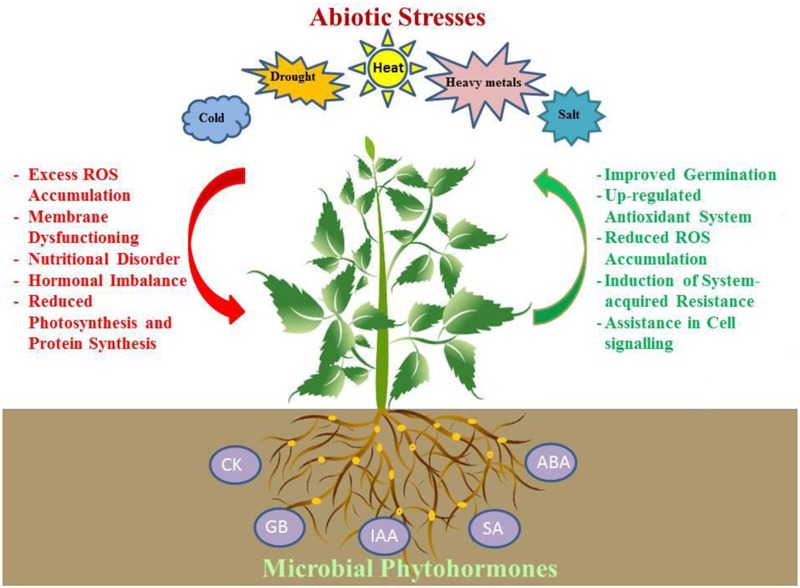
Plants are subjected to various abiotic stresses, such as drought, extreme temperature, salinity, and heavy metals. Abiotic stresses have negative impact on the physiology and morphology of plants through defects in the genetic regulation of cellular pathways. Plants employ several tolerance mechanisms and pathways to avert the effects of stresses that are triggered whenever alterations in metabolism are encountered. Phytohormones are among the most important growth regulators; they are known for having a prominent impact on plant metabolism, and additionally, they play a vital role in the stimulation of plant defense response mechanisms against stresses. Exogenous phytohormone supplementation has been adopted to improve growth and metabolism under stress conditions. Recent investigations have shown that phytohormones produced by root-associated microbes may prove to be important metabolic engineering targets for inducing host tolerance to abiotic stresses. Phytohormone biosynthetic pathways have been identified using several genetic and biochemical methods, and numerous reviews are currently available on this topic. Here, we review current knowledge on the function of phytohormones involved in the improvement of abiotic stress tolerance and defense response in plants exposed to different stressors. We focus on recent successes in identifying the roles of microbial phytohormones that induce stress tolerance, especially in crop plants. In doing so, this review highlights important plant morpho-physiological traits that can be exploited to identify the positive effects of phytohormones on stress tolerance. This review will therefore be helpful to plant physiologists and agricultural microbiologists in designing strategies and tools for the development of broad spectrum microbial inoculants supporting sustainable crop production under hostile environments.
植物会遭受各种非生物胁迫,如干旱、极端温度、盐度和重金属。非生物胁迫通过细胞途径的遗传调控缺陷对植物的生理和形态产生负面影响。每当遇到代谢变化时,植物会采用多种耐受机制和途径来避免胁迫的影响。植物激素是最重要的生长调节剂之一;它们以对植物代谢有显著影响而闻名,此外,它们在刺激植物对胁迫的防御反应机制中也起着至关重要的作用。已采用外源添加植物激素来改善胁迫条件下的生长和代谢。最近的研究表明,根际微生物产生的植物激素可能被证明是诱导宿主对非生物胁迫耐受性的重要代谢工程靶点。已经使用多种遗传和生化方法鉴定了植物激素生物合成途径,目前关于这个主题有大量综述。在这里,我们综述了当前关于植物激素在提高暴露于不同胁迫源的植物对非生物胁迫耐受性和防御反应中的功能的知识。我们关注最近在确定诱导胁迫耐受性的微生物植物激素的作用方面取得的成功,特别是在农作物中。通过这样做,本综述强调了重要的植物形态生理特征,这些特征可用于确定植物激素对胁迫耐受性的积极影响。因此,本综述将有助于植物生理学家和农业微生物学家设计策略和工具,以开发在恶劣环境下支持可持续作物生产的广谱微生物接种剂。