Paytubi Sonia, Cansado Cintia, Madrid Cristina, Balsalobre Carlos
Section of Microbiology, Virology and Biotechnology, Department of Genetics, Microbiology and Statistics, University of Barcelona, Barcelona, Spain.
Front Microbiol. 2017 Nov 7;8:2160. doi: 10.3389/fmicb.2017.02160. eCollection 2017.
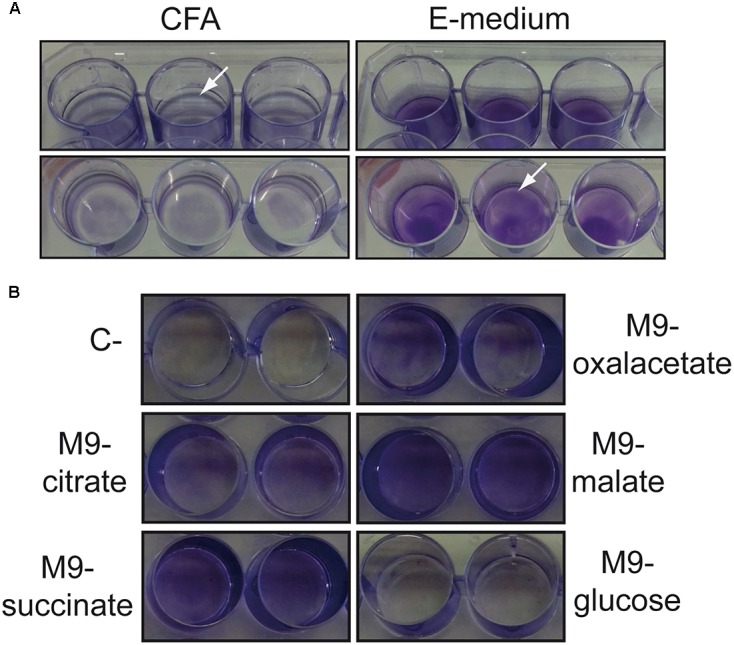
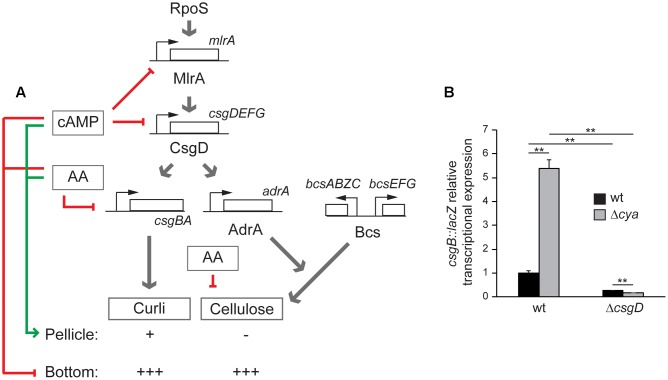
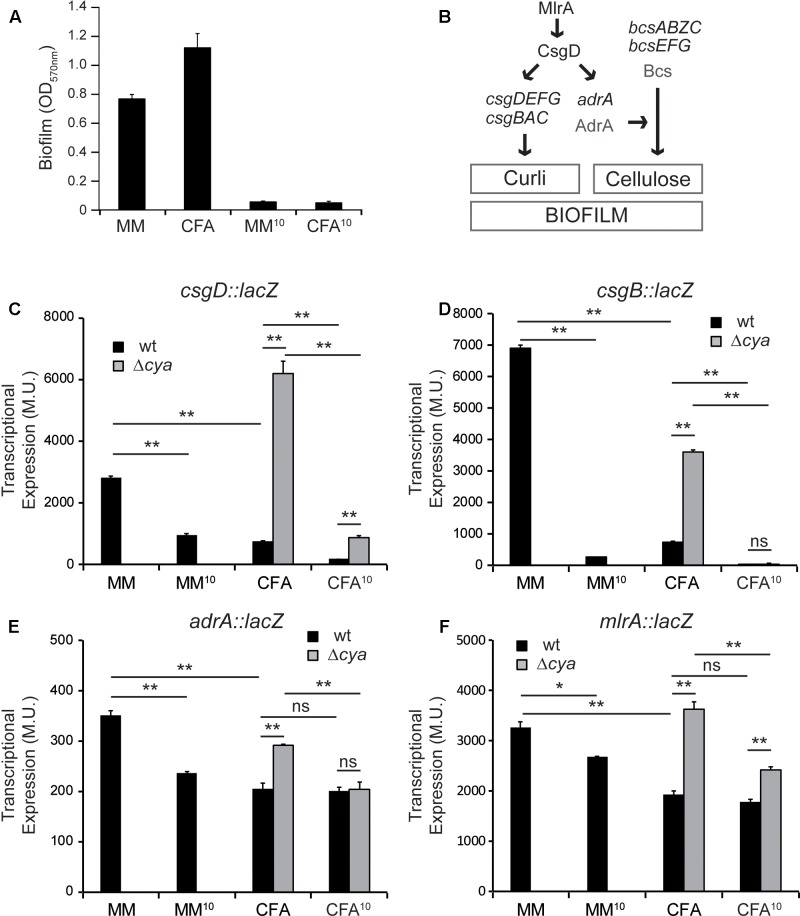
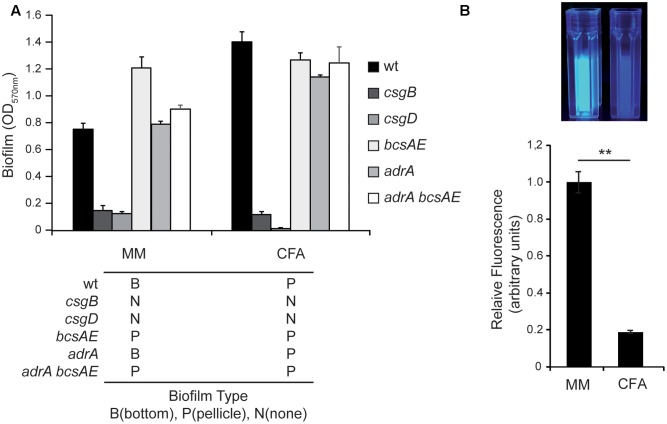
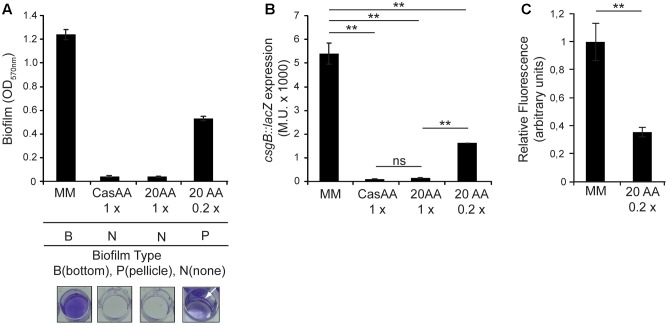
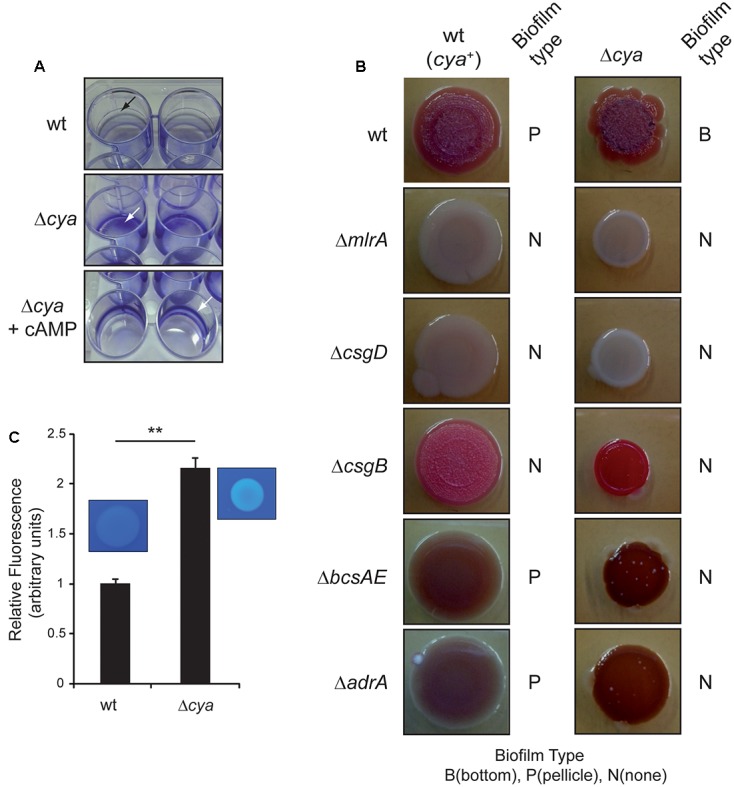
is one of the most frequently reported causes of foodborne illness worldwide. Non-typhoidal serovars cause gastroenteritis in humans. can grow on surfaces forming biofilms, contributing to its persistence since biofilms are difficult to eradicate due to the high resistance to antimicrobials and disinfectants. It has been described that there are two crucial biofilm promoting factors in : curli and cellulose. The expression of both factors is coordinately regulated by the transcriptional regulator CsgD. Most biofilm studies of have been performed by growing bacteria in low osmolarity rich medium and low temperature (25°C). In such conditions, the biofilm is formed at the air-liquid interface (pellicle biofilm). Remarkably, when grow in minimal medium, biofilm formation switches from the air-liquid interface to the solid-liquid interface (bottom biofilm). In this report, the switching between pellicle and bottom biofilm has been characterized. Our data indicate that curli, but not cellulose, is crucial for the formation of both kinds of biofilms. In minimal medium, conditions promoting formation of bottom biofilm, a high transcriptional expression of and consequently of the genes involved in the synthesis of curli and cellulose was detected. The nutritional status of the cells seems to be pivotal for the spatial distribution of the biofilms formed. When bacteria is growing in minimal medium the addition of amino acids downregulates the expression of and causes the switch between bottom and pellicle biofilm. The crosstalk between general metabolism and biofilm formation is also highlighted by the fact that the metabolic sensor cAMP modulates the type of biofilm generated by . Moreover, cAMP regulates transcriptional expression of and stimulates pellicle biofilm formation, suggesting that the physiological conditions define the type of biofilm formed by . The consequences of the switching between pellicle and bottom biofilm during either infection or survival in natural environments remain undercover.
是全球食源性疾病最常报告的病因之一。非伤寒血清型在人类中引起肠胃炎。它能在表面形成生物膜并生长,这有助于其持续存在,因为生物膜由于对抗微生物剂和消毒剂具有高抗性而难以根除。据描述,在中有两个关键的生物膜促进因子:卷曲菌毛和纤维素。这两个因子的表达由转录调节因子CsgD协同调控。大多数关于的生物膜研究是通过在低渗透压丰富培养基和低温(25°C)下培养细菌进行的。在这种条件下,生物膜在气液界面形成(菌膜生物膜)。值得注意的是,当在基本培养基中生长时,生物膜形成从气液界面转变为固液界面(底部生物膜)。在本报告中,已对菌膜和底部生物膜之间的转变进行了表征。我们的数据表明,卷曲菌毛而非纤维素对于两种生物膜的形成至关重要。在基本培养基中,促进底部生物膜形成的条件下,检测到的高转录表达以及因此参与卷曲菌毛和纤维素合成的基因的高转录表达。细胞的营养状态似乎对于所形成生物膜的空间分布至关重要。当细菌在基本培养基中生长时,添加氨基酸会下调的表达并导致底部和菌膜生物膜之间的转变。一般代谢与生物膜形成之间的相互作用也通过代谢传感器cAMP调节由产生的生物膜类型这一事实得到突出体现。此外,cAMP调节的转录表达并刺激菌膜生物膜形成,表明生理条件决定了由形成的生物膜类型。在感染或自然环境中的生存过程中,菌膜和底部生物膜之间转变的后果仍未被揭示。