University of North Texas Health Science Center, School of Public Health, 3500 Camp Bowie Blvd, Fort Worth, TX 76107. Email:
University of North Texas Health Science Center, Fort Worth, Texas.
Prev Chronic Dis. 2017 Nov 22;14:E119. doi: 10.5888/pcd14.170143.
African American women have higher rates of obesity and related chronic disease than other demographic groups. The poorer health of African American women compared with other groups may be explained by allostatic load, or cumulative physiologic stress, due to chronic socioeconomic disadvantage. The objective of this study was to evaluate neighborhood and individual factors contributing to allostatic load in African American women at risk for obesity-related diseases.
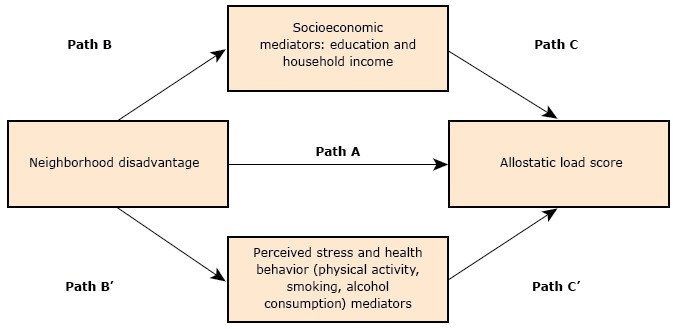
This study evaluated the relationship of allostatic load with neighborhood disadvantage, individual socioeconomic determinants, and synergism between neighborhood and socioeconomic disadvantage, along with health behaviors and other factors as mediators in African American women. Our sample consisted of 220 African American women at risk of obesity-related diseases enrolled in the Better Me Within program (mean [standard deviation] age, 50.1 [11.2] y; mean [standard deviation] body mass index, 36.7 [8.4] kg/m). Allostatic load score for each participant was calculated by summing the number of biomarkers (of 9 biomarkers) that were determined to be in the high-risk quartile.
Poisson regression of neighborhood disadvantage and individual socioeconomic determinants found that neighborhood disadvantage, but not education level or household income, was significantly associated with allostatic load (β = 0.22, SE, 0.10, P = .04). Tests for mediators showed that household income and alcohol consumption partially mediated the relationship between allostatic load score and neighborhood disadvantage but were not significant.
More research is necessary to determine the mechanisms by which neighborhoods can exacerbate and attenuate cumulative disadvantage among African American women. Policies and interventions that focus on neighborhood health may improve the outcomes of individual-level health interventions among women who reside in disadvantaged communities.
非裔美国女性的肥胖率和相关慢性疾病发病率高于其他人群。与其他群体相比,非裔美国女性的健康状况较差,这可能是由于长期社会经济劣势导致的累积生理压力,即体适能负荷。本研究旨在评估与非裔美国女性肥胖相关疾病风险相关的社区和个体因素对体适能负荷的影响。
本研究评估了体适能负荷与社区劣势、个体社会经济决定因素以及社区和社会经济劣势之间协同作用的关系,以及健康行为和其他因素作为中介在非裔美国女性中的作用。我们的样本包括 220 名有肥胖相关疾病风险的非裔美国女性,她们参加了“Better Me Within”计划(平均[标准差]年龄 50.1[11.2]岁;平均[标准差]体重指数 36.7[8.4]kg/m)。每位参与者的体适能负荷评分通过将 9 种生物标志物(其中有 3 种生物标志物被确定为高危四分位数)的数量相加来计算。
对社区劣势和个体社会经济决定因素的泊松回归发现,社区劣势,但不是教育程度或家庭收入,与体适能负荷显著相关(β=0.22,SE=0.10,P=0.04)。对中介的检验表明,家庭收入和饮酒部分中介了体适能负荷评分与社区劣势之间的关系,但无统计学意义。
需要进一步研究以确定社区如何加剧和减轻非裔美国女性累积劣势的机制。关注社区健康的政策和干预措施可能会改善居住在弱势社区的女性个体层面健康干预的效果。