Gattie Eric Robert, Cleland Joshua A, Snodgrass Suzanne J
Rehabilitation Services, Concord Hospital, Concord, NH, United States.
Physical Therapy Program, Franklin Pierce University, Manchester, NH, United States.
JMIR Res Protoc. 2017 Nov 22;6(11):e227. doi: 10.2196/resprot.7980.
Neck pain is a costly and common problem. Current treatments are not adequately effective for a large proportion of patients who continue to experience recurrent pain. Therefore, new treatment strategies should be investigated in an attempt to reduce the disability and high costs associated with neck pain. Dry needling is a technique in which a fine needle is used to penetrate the skin, subcutaneous tissues, and muscle with the intent to mechanically disrupt tissue without the use of an anesthetic. Dry needling is emerging as a treatment modality that is widely used clinically to address a variety of musculoskeletal conditions. Recent studies of dry needling in mechanical neck pain suggest potential benefits, but do not utilize methods typical to clinical practice and lack long-term follow-up. Therefore, a clinical trial with realistic treatment time frames and methods consistent with clinical practice is needed to examine the effectiveness of dry needling on reducing pain and enhancing function in patients presenting to physical therapy with mechanical neck pain.
The aim of this trial will be to examine the short- and long-term effectiveness of dry needling delivered by a physical therapist on pain, disability, and patient-perceived improvements in patients with mechanical neck pain.
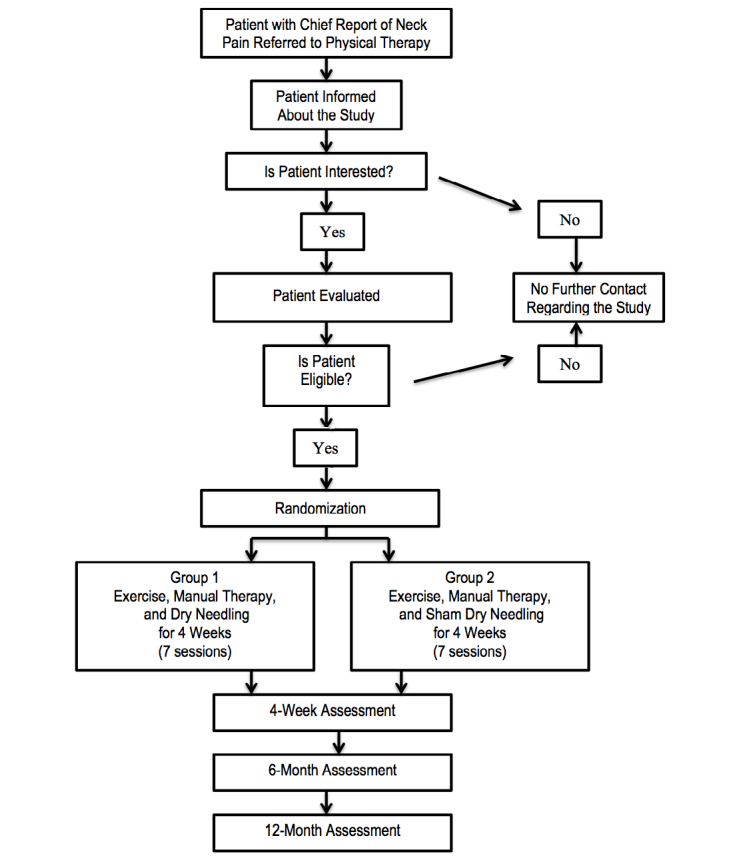
We will conduct a randomized, double-blind, placebo-controlled trial in accordance with the CONSORT guidelines. A total of 76 patients over the age of 18 with acute or chronic mechanical neck pain resulting from postural dysfunction, trauma, or insidious onset who are referred to physical therapy will be enrolled after meeting the eligibility criteria. Subjects will be excluded if they have previous history of surgery, whiplash in the last 6 weeks, nerve root compression, red flags, or contraindications to dry needling or manual therapy. Participants will be randomized to receive (1) dry needling, manual therapy, and exercise or (2) sham dry needling, manual therapy, and exercise. Participants will receive seven physical therapy treatments lasting 45 minutes each over a maximum of 4 weeks. The primary outcome will be disability as measured by the Neck Disability Index. Secondary outcomes include the following: pain, patient-perceived improvement, patient expectations, and successful blinding to the needling intervention. Outcome measures will be assessed at 4 weeks, 6 months, and 12 months by an assessor who is blind to the group allocation of the participants to determine the short- and long-term treatment effects. We will examine the primary aim with a two-way, repeated-measures analysis of variance with treatment group as the between-subjects variable and time as the within-subjects variable. The hypothesis of interest will be the two-way group by time interaction. An a priori alpha level of .05 will be used for all analyses.
Recruitment is currently underway and is expected to be completed by the end of 2017. Data collection for long-term outcomes will occur throughout 2017 and 2018. Data analysis, preparation, and publication submission is expected to occur throughout the final three quarters of 2018.
The successful completion of this trial will provide evidence to demonstrate whether dry needling is effective for the management of mechanical neck pain when used in a combined treatment approach, as is the common clinical practice.
ClinicalTrials.gov NCT02731014; https://clinicaltrials.gov/ct2/show/NCT02731014 (Archived by WebCite at http://www.webcitation.org/6ujZgbhsq).
颈部疼痛是一个代价高昂且常见的问题。对于很大一部分仍有复发性疼痛的患者,目前的治疗方法效果并不理想。因此,应研究新的治疗策略,以试图减少与颈部疼痛相关的残疾和高昂费用。干针疗法是一种使用细针穿透皮肤、皮下组织和肌肉的技术,目的是在不使用麻醉剂的情况下机械性地破坏组织。干针疗法正在成为一种在临床上广泛用于治疗各种肌肉骨骼疾病的治疗方式。最近关于机械性颈部疼痛的干针疗法研究显示出潜在益处,但未采用临床实践中的典型方法且缺乏长期随访。因此,需要进行一项具有实际治疗时间框架且方法符合临床实践的临床试验,以检验干针疗法对减轻机械性颈部疼痛患者的疼痛和改善功能的有效性。
本试验的目的是检验物理治疗师实施的干针疗法对机械性颈部疼痛患者的疼痛、残疾以及患者自我感知改善情况的短期和长期有效性。
我们将按照CONSORT指南进行一项随机、双盲、安慰剂对照试验。共有76名18岁以上因姿势功能障碍、创伤或隐匿性起病导致急性或慢性机械性颈部疼痛且被转诊至物理治疗的患者,在符合纳入标准后入组。如果受试者有手术史、过去6周内有挥鞭样损伤、神经根受压、警示征象或干针疗法或手法治疗的禁忌症,则将被排除。参与者将被随机分为两组,分别接受:(1)干针疗法、手法治疗和运动;(2)假干针疗法、手法治疗和运动。参与者将在最多4周内接受7次每次持续45分钟的物理治疗。主要结局将通过颈部残疾指数来衡量残疾情况。次要结局包括以下方面:疼痛、患者自我感知改善情况、患者期望以及对针刺干预的成功设盲。结局指标将在4周、6个月和12个月时由对参与者分组情况不知情的评估者进行评估,以确定短期和长期治疗效果。我们将使用以治疗组作为组间变量、时间作为组内变量的双向重复测量方差分析来检验主要目的。感兴趣的假设将是组间与时间的双向交互作用。所有分析将使用预先设定的α水平0.05。
目前正在进行招募,预计2017年底完成。2017年全年和2018年将进行长期结局的数据收集。数据分析、准备和论文提交预计在2018年最后三个季度完成。
本试验的成功完成将提供证据,以证明干针疗法在采用联合治疗方法(这是常见的临床实践)时对机械性颈部疼痛的管理是否有效。
ClinicalTrials.gov NCT02731014;https://clinicaltrials.gov/ct2/show/NCT02731014(由WebCite存档于http://www.webcitation.org/6ujZgbhsq)