Moret L, Anthoine E, Pourreau A, Beaudeau F, Leclère B
Public Health Department, University Hospital, Saint-Jacques Hospital, 85, rue Saint-Jacques, 44093, Nantes Cedex, France.
UMR 1246 INSERM SPHERE "MethodS in Patients-centered outcomes and HEalth ResEarch", University of Nantes, Bd Benoni-Goullin, 44200, Nantes, France.
BMC Health Serv Res. 2017 Nov 23;17(1):769. doi: 10.1186/s12913-017-2728-8.
The main objective of this study was to explore the relationships between inpatients' social differentiation and satisfaction with the medical information delivered by caregivers.
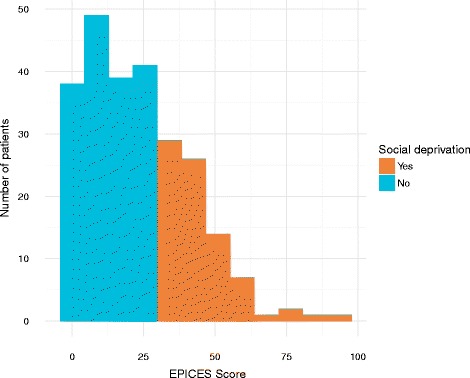
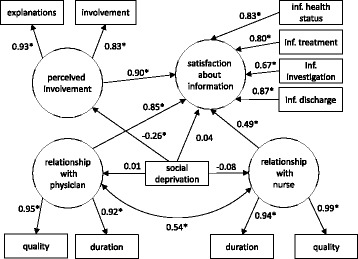
In four departments of a teaching hospital, patients were enrolled as well as their attending physician and one of the nurses assigned to them. Structured survey questionnaires were administered face-to-face to patients and caregivers. Patients were asked to rate their satisfaction with the medical information received, the quality and duration of the interactions with the caregivers, and their experience regarding their involvement in medical decision-making. Caregivers were asked to rate their perception of the patients' social position and involvement in medical decision-making. Social deprivation was assessed using the EPICES score in particular. The statistical analysis was mainly descriptive and completed by a structural equation model.
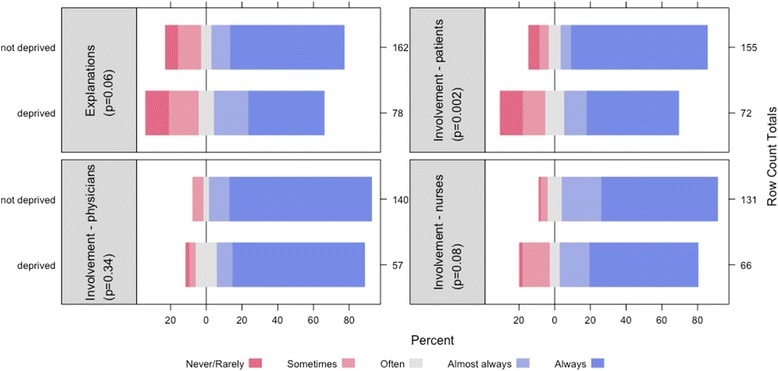
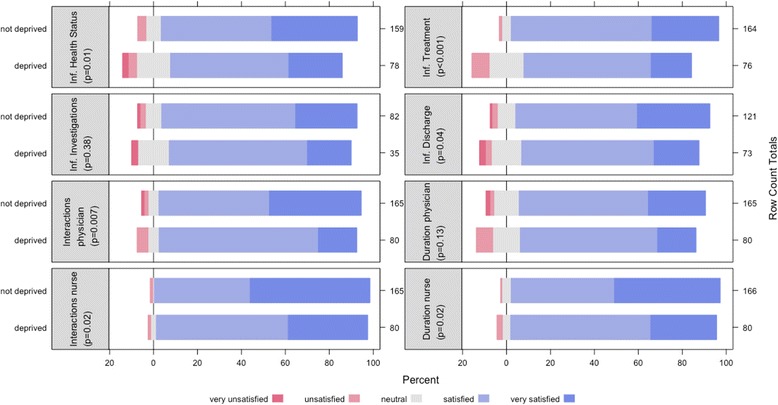
A sample of 255 patients, 221 pairs of patient-physician and 235 pairs of patient-nurse were considered. One third of the patients (32.7%) were identified as socially deprived. They were significantly less satisfied with the information they received on their health status or their treatment; 56.7% of patients thought that they received sufficient explanations without having to ask. This proportion was significantly lower in socially deprived patients (42.3%) compared to not deprived patients (63.6%, p < 0.01). Patients' reported involvement in medical decision-making was significantly lower for socially deprived patients (75.0% vs 89.0%, p < 0.001). The structural equation model showed that the main determinant of patients' satisfaction regarding medical information was their perceived involvement in informed medical decision-making (CFI = 0.998, RMSEA = 0.022).
These findings suggest that physicians and nurses need training on communication targeted towards vulnerable patients, in order to improve the accessibility of medical information, and thus to reduce health inequalities.
本研究的主要目的是探讨住院患者的社会差异与对医护人员提供的医疗信息的满意度之间的关系。
在一家教学医院的四个科室,纳入患者及其主治医生和负责护理他们的一名护士。对患者和医护人员进行面对面的结构化调查问卷。询问患者对所接收医疗信息的满意度、与医护人员互动的质量和时长,以及他们参与医疗决策的经历。询问医护人员对患者社会地位和参与医疗决策的看法。特别使用EPICES评分评估社会剥夺情况。统计分析主要是描述性的,并通过结构方程模型完成。
共纳入255名患者、221对患者 - 医生和235对患者 - 护士。三分之一的患者(32.7%)被确定为社会剥夺人群。他们对所收到的关于自身健康状况或治疗的信息明显不满意;56.7%的患者认为无需询问就能得到充分解释。与非社会剥夺患者(63.6%)相比,社会剥夺患者中这一比例显著更低(42.3%,p < 0.01)。社会剥夺患者报告的参与医疗决策的比例显著更低(75.0%对89.0%,p < 0.001)。结构方程模型表明,患者对医疗信息满意度的主要决定因素是他们感知到的参与知情医疗决策的程度(CFI = 0.998,RMSEA = 0.022)。
这些发现表明,医生和护士需要接受针对弱势患者的沟通培训,以提高医疗信息的可及性,从而减少健康不平等。