
基因治疗恢复 Mfrp 并纠正眼球轴向长度。
Gene Therapy Restores Mfrp and Corrects Axial Eye Length.
机构信息
Omics Laboratory, Stanford University, Palo Alto, CA, USA.
Byers Eye Institute, Department of Ophthalmology, Stanford University, Palo Alto, CA, USA.
出版信息
Sci Rep. 2017 Nov 23;7(1):16151. doi: 10.1038/s41598-017-16275-8.
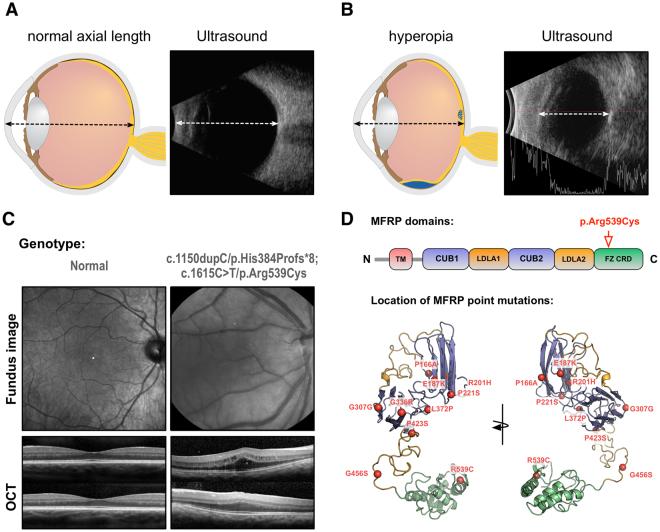
Hyperopia (farsightedness) is a common and significant cause of visual impairment, and extreme hyperopia (nanophthalmos) is a consequence of loss-of-function MFRP mutations. MFRP deficiency causes abnormal eye growth along the visual axis and significant visual comorbidities, such as angle closure glaucoma, cystic macular edema, and exudative retinal detachment. The Mfrp /Mfrp mouse is used as a pre-clinical animal model of retinal degeneration, and we found it was also hyperopic. To test the effect of restoring Mfrp expression, we delivered a wild-type Mfrp to the retinal pigmented epithelium (RPE) of Mfrp /Mfrp mice via adeno-associated viral (AAV) gene therapy. Phenotypic rescue was evaluated using non-invasive, human clinical testing, including fundus auto-fluorescence, optical coherence tomography, electroretinography, and ultrasound. These analyses showed gene therapy restored retinal function and normalized axial length. Proteomic analysis of RPE tissue revealed rescue of specific proteins associated with eye growth and normal retinal and RPE function. The favorable response to gene therapy in Mfrp /Mfrp mice suggests hyperopia and associated refractive errors may be amenable to AAV gene therapy.
远视(远视)是视力损害的常见和重要原因,而极度远视(小眼症)是功能丧失的 MFRP 突变的结果。MFRP 缺乏会导致沿视觉轴的异常眼球生长和严重的视觉合并症,如闭角型青光眼、囊状黄斑水肿和渗出性视网膜脱离。Mfrp / Mfrp 小鼠被用作视网膜变性的临床前动物模型,我们发现它也是远视。为了测试恢复 Mfrp 表达的效果,我们通过腺相关病毒(AAV)基因治疗将野生型 Mfrp 递送至 Mfrp / Mfrp 小鼠的视网膜色素上皮(RPE)。通过非侵入性的人类临床测试评估表型挽救,包括眼底自发荧光、光学相干断层扫描、视网膜电图和超声。这些分析表明,基因治疗恢复了视网膜功能并使眼轴正常化。RPE 组织的蛋白质组学分析显示,与眼生长以及正常视网膜和 RPE 功能相关的特定蛋白质得到了挽救。Mfrp / Mfrp 小鼠对基因治疗的良好反应表明,远视和相关的屈光不正可能适合 AAV 基因治疗。


 Zotero 插件