Klein Dorthe O, Rennenberg Roger J M W, Koopmans Richard P, Prins Martin H
Department of Clinical Epidemiology and Medical Technology Assessment, Maastricht University Medical Centre, Maastricht, The Netherlands.
Department of Internal Medicine, Maastricht University Medical Centre, Maastricht, The Netherlands.
Prev Med Rep. 2017 Nov 3;8:250-255. doi: 10.1016/j.pmedr.2017.10.016. eCollection 2017 Dec.
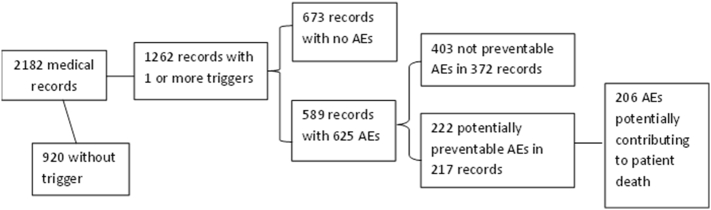
Several trigger systems have been developed to screen medical records of hospitalized patients for adverse events (AEs). Because it's too labor-intensive to screen the records of all patients, usually a sample is screened. Our sample consists of patients who died during their stay because chances of finding preventable AEs in this subset are highest. Records were reviewed for fifteen triggers ( = 2182). When a trigger was present, the records were scrutinized by specialized medical doctors who searched for AEs. The positive predictive value (PPV) of the total trigger system and of the individual triggers was calculated. Additional analyses were performed to identify a possible optimization of the trigger system. In our sample, the trigger system had an overall PPV for AEs of 47%, 17% for potentially preventable AEs. More triggers present in a record increased the probability of detecting an AE. Adjustments to the trigger system slightly increased the positive predictive value but missed about 10% of the AEs detected with the original system. In our sample of deceased patients the trigger system has a PPV comparable to other samples. However still, an enormous amount of time and resources are spent on cases without AEs or with non-preventable AEs. Possibly, the performance could be further improved by combining triggers with clinical scores and laboratory results. This could be promising in reducing the costly and labor-intensive work of screening medical records.
已经开发了几种触发系统来筛查住院患者的医疗记录以发现不良事件(AE)。由于筛查所有患者的记录过于耗费人力,通常只筛查一个样本。我们的样本包括住院期间死亡的患者,因为在这个子集中发现可预防不良事件的可能性最高。对记录进行了15种触发因素的审查(n = 2182)。当出现触发因素时,由专业医生仔细检查记录以寻找不良事件。计算了整个触发系统和各个触发因素的阳性预测值(PPV)。进行了额外的分析以确定触发系统可能的优化方法。在我们的样本中,触发系统对不良事件的总体PPV为47%,对潜在可预防不良事件的PPV为17%。记录中出现的触发因素越多,检测到不良事件的可能性就越大。对触发系统的调整略微提高了阳性预测值,但遗漏了约10%用原始系统检测到的不良事件。在我们的死亡患者样本中,触发系统的PPV与其他样本相当。然而,仍然有大量的时间和资源花费在没有不良事件或有不可预防不良事件的病例上。可能通过将触发因素与临床评分和实验室结果相结合,性能可以进一步提高。这在减少筛查医疗记录的昂贵且耗费人力的工作方面可能很有前景。