Unbeck Maria, Schildmeijer Kristina, Henriksson Peter, Jürgensen Urban, Muren Olav, Nilsson Lena, Pukk Härenstam Karin
Karolinska Institutet, Department of Clinical Sciences, Danderyd Hospital, Division of Orthopaedics, Stockholm, Sweden.
Patient Saf Surg. 2013 Apr 15;7(1):10. doi: 10.1186/1754-9493-7-10.
There has been a theoretical debate as to which retrospective record review method is the most valid, reliable, cost efficient and feasible for detecting adverse events. The aim of the present study was to evaluate the feasibility and capability of two common retrospective record review methods, the "Harvard Medical Practice Study" method and the "Global Trigger Tool" in detecting adverse events in adult orthopaedic inpatients.
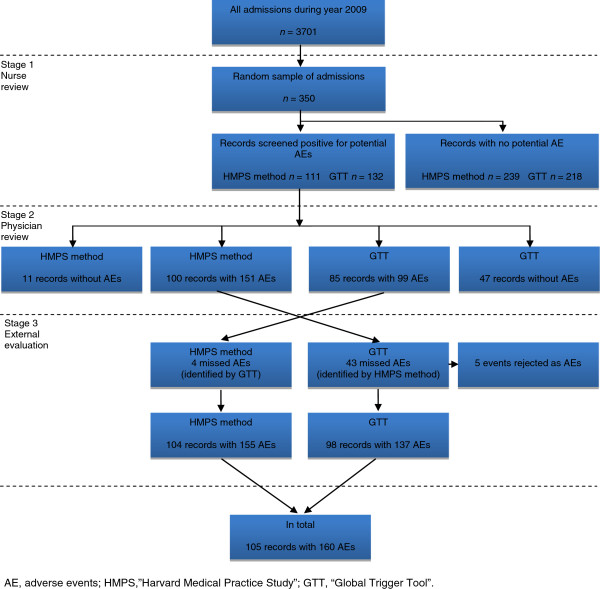
We performed a three-stage structured retrospective record review process in a random sample of 350 orthopaedic admissions during 2009 at a Swedish university hospital. Two teams comprised each of a registered nurse and two physicians were assigned, one to each method. All records were primarily reviewed by registered nurses. Records containing a potential adverse event were forwarded to physicians for review in stage 2. Physicians made an independent review regarding, for example, healthcare causation, preventability and severity. In the third review stage all adverse events that were found with the two methods together were compared and all discrepancies after review stage 2 were analysed. Events that had not been identified by one of the methods in the first two review stages were reviewed by the respective physicians.
Altogether, 160 different adverse events were identified in 105 (30.0%) of the 350 records with both methods combined. The "Harvard Medical Practice Study" method identified 155 of the 160 (96.9%, 95% CI: 92.9-99.0) adverse events in 104 (29.7%) records compared with 137 (85.6%, 95% CI: 79.2-90.7) adverse events in 98 (28.0%) records using the "Global Trigger Tool". Adverse events "causing harm without permanent disability" accounted for most of the observed difference. The overall positive predictive value for criteria and triggers using the "Harvard Medical Practice Study" method and the "Global Trigger Tool" was 40.3% and 30.4%, respectively.
More adverse events were identified using the "Harvard Medical Practice Study" method than using the "Global Trigger Tool". Differences in review methodology, perception of less severe adverse events and context knowledge may explain the observed difference between two expert review teams in the detection of adverse events.
关于哪种回顾性病历审查方法在检测不良事件方面最有效、可靠、具有成本效益且可行,一直存在理论上的争论。本研究的目的是评估两种常见的回顾性病历审查方法,即“哈佛医疗实践研究”方法和“全球触发工具”在检测成人骨科住院患者不良事件方面的可行性和能力。
我们在瑞典一家大学医院对2009年期间随机抽取的350例骨科入院病例进行了三阶段结构化回顾性病历审查过程。两个团队,每个团队由一名注册护士和两名医生组成,分别负责一种方法。所有病历首先由注册护士进行审查。包含潜在不良事件的病历被转交给医生在第二阶段进行审查。医生对例如医疗保健因果关系、可预防性和严重程度进行独立审查。在第三审查阶段,对两种方法共同发现的所有不良事件进行比较,并分析第二审查阶段后的所有差异。在前两个审查阶段中未被其中一种方法识别的事件由各自的医生进行审查。
两种方法结合,在350份病历中的105份(30.0%)中总共识别出160种不同的不良事件。“哈佛医疗实践研究”方法在104份(29.7%)病历中识别出160种不良事件中的155种(96.9%,95%可信区间:92.9 - 99.0),而使用“全球触发工具”在98份(28.0%)病历中识别出137种(85.6%,95%可信区间:79.2 - 90.7)不良事件。“造成伤害但无永久性残疾”的不良事件占观察到的差异的大部分。使用“哈佛医疗实践研究”方法和“全球触发工具”的标准和触发因素的总体阳性预测值分别为40.3%和30.4%。
使用“哈佛医疗实践研究”方法比使用“全球触发工具”识别出更多的不良事件。审查方法的差异、对不太严重不良事件的认知以及背景知识可能解释了两个专家审查团队在检测不良事件方面观察到的差异。