• 文献检索
  • 文档翻译
  • 深度研究
  • 学术资讯
  • Suppr Zotero 插件Zotero 插件
  • 邀请有礼
  • 套餐&价格
  • 历史记录
应用&插件
Suppr Zotero 插件Zotero 插件浏览器插件Mac 客户端Windows 客户端微信小程序
定价
高级版会员购买积分包购买API积分包
服务
文献检索文档翻译深度研究API 文档MCP 服务
关于我们
关于 Suppr公司介绍联系我们用户协议隐私条款
关注我们

Suppr 超能文献

核心技术专利:CN118964589B侵权必究
粤ICP备2023148730 号-1Suppr @ 2026

文献检索

告别复杂PubMed语法,用中文像聊天一样搜索,搜遍4000万医学文献。AI智能推荐,让科研检索更轻松。

立即免费搜索

文件翻译

保留排版,准确专业,支持PDF/Word/PPT等文件格式,支持 12+语言互译。

免费翻译文档

深度研究

AI帮你快速写综述,25分钟生成高质量综述,智能提取关键信息,辅助科研写作。

立即免费体验

佛罗里达收获蚁(Pogonomyrmex badius)巢穴内劳动分工的垂直组织形式。

Vertical organization of the division of labor within nests of the Florida harvester ant, Pogonomyrmex badius.

作者信息

Tschinkel Walter R, Hanley Nicholas

机构信息

Department of Biological Science, Florida State University, Tallahassee, Florida, United States of America.

出版信息

PLoS One. 2017 Nov 28;12(11):e0188630. doi: 10.1371/journal.pone.0188630. eCollection 2017.

DOI:10.1371/journal.pone.0188630
PMID:29182686
原文链接:https://pmc.ncbi.nlm.nih.gov/articles/PMC5705139/
Abstract

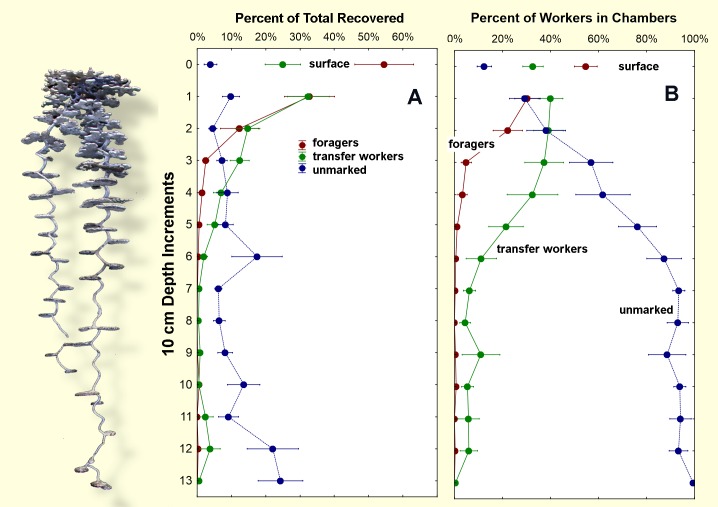
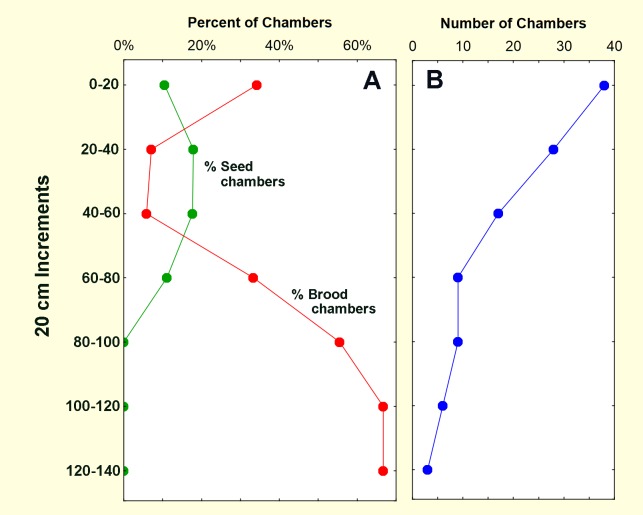
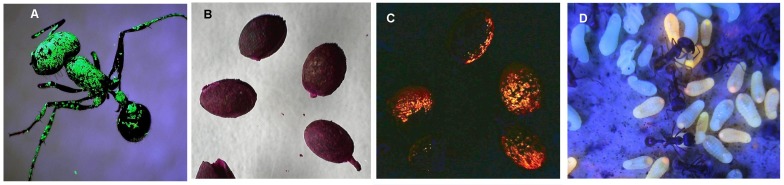
In the Florida harvester ant, Pogonomyrmex badius, foragers occur only in the top 15 cm of the nest, whereas brood and brood-care workers reside mostly in the deepest regions, yet the food and seeds foragers collect must be transported downward 30 to 80 cm to seed chambers and up to 2 m to brood chambers. Using mark-recapture techniques with fluorescent printer's ink, we identified a class of workers that ranges widely within the vertical structure of the nest, rapidly moving materials dropped by foragers in the upper regions downward, and excavated soil from deeper upward. Within the nest, only 5% of foragers were recovered below 20 cm depth, but about 30% of transfer workers and 82% of unmarked workers were found there. Below 70 cm depth, 90% of workers were unmarked, and were probably involved mostly in brood care. During the summer, the transfer workers comprise about a quarter of the nest population, while foragers make up about 40%. Workers marked as transfer workers later appear as foragers, while those marked as foragers die and disappear from the foraging population, suggesting that transfer workers are younger, and age into foraging. The importance of these findings for laboratory studies of division of labor are discussed. The efficient allocation of labor is a key component of superorganismal fitness.

摘要

在佛罗里达收获蚁(Pogonomyrmex badius)中,觅食工蚁仅出现在蚁巢顶部15厘米范围内,而幼虫和照顾幼虫的工蚁大多栖息在最深的区域,然而觅食工蚁收集的食物和种子必须向下运输30至80厘米到种子室,向上运输可达2米到育雏室。我们使用荧光打印机墨水的标记重捕技术,识别出一类在蚁巢垂直结构中活动范围广泛的工蚁,它们迅速将上部区域觅食工蚁掉落的物资向下搬运,并将深层的土壤向上挖掘。在蚁巢内,只有5%的觅食工蚁在20厘米深度以下被发现,但约30%的搬运工蚁和82%的未标记工蚁在该深度以下被发现。在70厘米深度以下,90%的工蚁是未标记的,它们可能主要参与育雏工作。在夏季,搬运工蚁约占蚁巢群体的四分之一,而觅食工蚁约占40%。被标记为搬运工蚁的工蚁后来会成为觅食工蚁,而那些被标记为觅食工蚁的则会死亡并从觅食群体中消失,这表明搬运工蚁更年轻,并会成长为觅食工蚁。我们讨论了这些发现对分工实验室研究的重要性。劳动力的有效分配是超个体适应性的关键组成部分。
https://cdn.ncbi.nlm.nih.gov/pmc/blobs/9b28/5705139/386aa00f1b50/pone.0188630.g007.jpg
https://cdn.ncbi.nlm.nih.gov/pmc/blobs/9b28/5705139/971da7353e03/pone.0188630.g001.jpg
https://cdn.ncbi.nlm.nih.gov/pmc/blobs/9b28/5705139/2616013510ae/pone.0188630.g002.jpg
https://cdn.ncbi.nlm.nih.gov/pmc/blobs/9b28/5705139/a299cdb17567/pone.0188630.g004.jpg
https://cdn.ncbi.nlm.nih.gov/pmc/blobs/9b28/5705139/697a8630dbf7/pone.0188630.g005.jpg
https://cdn.ncbi.nlm.nih.gov/pmc/blobs/9b28/5705139/d7ac43e0deb2/pone.0188630.g006.jpg
https://cdn.ncbi.nlm.nih.gov/pmc/blobs/9b28/5705139/386aa00f1b50/pone.0188630.g007.jpg
https://cdn.ncbi.nlm.nih.gov/pmc/blobs/9b28/5705139/971da7353e03/pone.0188630.g001.jpg
https://cdn.ncbi.nlm.nih.gov/pmc/blobs/9b28/5705139/2616013510ae/pone.0188630.g002.jpg
https://cdn.ncbi.nlm.nih.gov/pmc/blobs/9b28/5705139/a299cdb17567/pone.0188630.g004.jpg
https://cdn.ncbi.nlm.nih.gov/pmc/blobs/9b28/5705139/697a8630dbf7/pone.0188630.g005.jpg
https://cdn.ncbi.nlm.nih.gov/pmc/blobs/9b28/5705139/d7ac43e0deb2/pone.0188630.g006.jpg
https://cdn.ncbi.nlm.nih.gov/pmc/blobs/9b28/5705139/386aa00f1b50/pone.0188630.g007.jpg

相似文献

1
Vertical organization of the division of labor within nests of the Florida harvester ant, Pogonomyrmex badius.佛罗里达收获蚁(Pogonomyrmex badius)巢穴内劳动分工的垂直组织形式。
PLoS One. 2017 Nov 28;12(11):e0188630. doi: 10.1371/journal.pone.0188630. eCollection 2017.
2
The nest architecture of the Florida harvester ant, Pogonomyrmex badius.佛罗里达收获蚁(Pogonomyrmex badius)的巢穴结构。
J Insect Sci. 2004;4:21. doi: 10.1093/jis/4.1.21. Epub 2004 Jul 2.
3
Sequential Subterranean Transport of Excavated Sand and Foraged Seeds in Nests of the Harvester Ant, Pogonomyrmex badius.收获蚁(Pogonomyrmex badius)巢穴中挖掘出的沙子和觅食种子的顺序性地下运输
PLoS One. 2015 Oct 28;10(10):e0139922. doi: 10.1371/journal.pone.0139922. eCollection 2015.
4
Biomantling and bioturbation by colonies of the Florida harvester ant, Pogonomyrmex badius.佛罗里达收获蚁(Pogonomyrmex badius)蚁群的生物覆盖与生物扰动
PLoS One. 2015 Mar 20;10(3):e0120407. doi: 10.1371/journal.pone.0120407. eCollection 2015.
5
Florida harvester ant nest architecture, nest relocation and soil carbon dioxide gradients.佛罗里达收获蚁蚁巢结构、蚁巢迁移和土壤二氧化碳梯度。
PLoS One. 2013;8(3):e59911. doi: 10.1371/journal.pone.0059911. Epub 2013 Mar 28.
6
The Florida Harvester Ant, Pogonomyrmex badius, Relies on Germination to Consume Large Seeds.佛罗里达收获蚁(Pogonomyrmex badius)依靠种子发芽来食用大粒种子。
PLoS One. 2016 Nov 28;11(11):e0166907. doi: 10.1371/journal.pone.0166907. eCollection 2016.
7
Nest relocation and excavation in the Florida harvester ant, Pogonomyrmex badius.佛罗里达收获蚁(Pogonomyrmex badius)的巢穴迁移与挖掘
PLoS One. 2014 Nov 19;9(11):e112981. doi: 10.1371/journal.pone.0112981. eCollection 2014.
8
An illustrated guide to seeds found in nests of the Florida harvester ant, Pogonomyrmex badius.佛罗里达收获蚁(Pogonomyrmex badius)巢穴中发现的种子图鉴指南。
PLoS One. 2017 Mar 1;12(3):e0171419. doi: 10.1371/journal.pone.0171419. eCollection 2017.
9
Homing in the harvester ant Pogonomyrmex badius.收获蚁(Pogonomyrmex badius)的归巢行为
Science. 1971 Mar 19;171(3976):1149-51. doi: 10.1126/science.171.3976.1149.
10
Division of labor is associated with age-independent changes in ovarian activity in Pogonomyrmex californicus harvester ants.分工与 Pogonomyrmex californicus 收获蚁卵巢活动的与年龄无关的变化有关。
J Insect Physiol. 2013 Apr;59(4):519-24. doi: 10.1016/j.jinsphys.2013.02.008. Epub 2013 Mar 6.

引用本文的文献

1
Nest Entrance Architecture and the Regulation of Foraging Activity in Desert Harvester Ants.蚁巢入口结构与沙漠收获蚁觅食活动的调节
Ecol Evol. 2025 Sep 6;15(9):e72122. doi: 10.1002/ece3.72122. eCollection 2025 Sep.
2
Spatial organization within social ambrosia beetle nests limits spread of infectious disease.社会性 ambrosia 甲虫巢穴内的空间组织限制了传染病的传播。
iScience. 2025 Aug 5;28(9):113281. doi: 10.1016/j.isci.2025.113281. eCollection 2025 Sep 19.
3
The ontogeny of selection on genetic diversity in harvester ants.

本文引用的文献

1
Sequential Subterranean Transport of Excavated Sand and Foraged Seeds in Nests of the Harvester Ant, Pogonomyrmex badius.收获蚁(Pogonomyrmex badius)巢穴中挖掘出的沙子和觅食种子的顺序性地下运输
PLoS One. 2015 Oct 28;10(10):e0139922. doi: 10.1371/journal.pone.0139922. eCollection 2015.
2
Absence of temporal polyethism in the ponerine ant pachycondyla caffraria (Smith) (hymenoptera: formicidae): Early specialization of the foragers.ponerine蚁类卡氏厚结猛蚁(史密斯)(膜翅目:蚁科)不存在时间多型行为:觅食者的早期特化
Behav Processes. 1994 Jun;32(1):47-52. doi: 10.1016/0376-6357(94)90026-4. Epub 2002 May 28.
3
收获蚁遗传多样性选择的个体发育史。
Proc Biol Sci. 2022 Jun 8;289(1976):20220496. doi: 10.1098/rspb.2022.0496.
4
Carbon dioxide levels and ventilation in nests: significance and evolution of architectural innovations in leaf-cutting ants.蚁巢中的二氧化碳水平与通风:切叶蚁建筑创新的意义与演化
R Soc Open Sci. 2021 Nov 24;8(11):210907. doi: 10.1098/rsos.210907. eCollection 2021 Nov.
5
Gall-Colonizing Ants and Their Role as Plant Defenders: From 'Bad Job' to 'Useful Service'.寄生于瘿蜂的蚂蚁及其作为植物防御者的角色:从“有害工作”到“有益服务”
Insects. 2019 Nov 6;10(11):392. doi: 10.3390/insects10110392.
6
A spatiotemporal analysis of the food dissemination process and the trophallactic network in the ant Lasius niger.黑褐林蚁食物传播过程和拟态网络的时空分析。
Sci Rep. 2019 Oct 30;9(1):15620. doi: 10.1038/s41598-019-52019-6.
7
Ants Use Multiple Spatial Memories and Chemical Pointers to Navigate Their Nest.蚂蚁利用多种空间记忆和化学线索来导航回巢。
iScience. 2019 Apr 26;14:264-276. doi: 10.1016/j.isci.2019.04.003. Epub 2019 Apr 5.
8
Ant-plant sociometry in the Azteca-Cecropia mutualism.蚂蚁-植物社会计量学在阿兹特克-拟巢蕨共生关系中的应用。
Sci Rep. 2018 Dec 19;8(1):17968. doi: 10.1038/s41598-018-36399-9.
9
Learning Distinct Chemical Labels of Nestmates in Ants.学习蚂蚁中同巢伙伴的不同化学标记。
Front Behav Neurosci. 2018 Aug 29;12:191. doi: 10.3389/fnbeh.2018.00191. eCollection 2018.
10
The non-additive effects of body size on nest architecture in a polymorphic ant.体型对多态蚁巢结构的非加性影响。
Philos Trans R Soc Lond B Biol Sci. 2018 Aug 19;373(1753). doi: 10.1098/rstb.2017.0235.
Worker personality and its association with spatially structured division of labor.
劳动者个性及其与空间结构化分工的关联。
PLoS One. 2014 Jan 30;9(1):e79616. doi: 10.1371/journal.pone.0079616. eCollection 2014.
4
Tracking individuals shows spatial fidelity is a key regulator of ant social organization.追踪个体表明,空间保真度是蚂蚁社会组织的关键调节因素。
Science. 2013 May 31;340(6136):1090-3. doi: 10.1126/science.1234316. Epub 2013 Apr 18.
5
Florida harvester ant nest architecture, nest relocation and soil carbon dioxide gradients.佛罗里达收获蚁蚁巢结构、蚁巢迁移和土壤二氧化碳梯度。
PLoS One. 2013;8(3):e59911. doi: 10.1371/journal.pone.0059911. Epub 2013 Mar 28.
6
Worker division of labor and endocrine physiology are associated in the harvester ant, Pogonomyrmex californicus.工蚁分工与内分泌生理学在加利福尼亚木匠蚁( Pogonomyrmex californicus )中相关联。
J Exp Biol. 2012 Feb 1;215(Pt 3):454-60. doi: 10.1242/jeb.060822.
7
Temporal polyethism, life expectancy, and entropy of workers of the ant Ectatomma vizottoi Almeida, 1987 (Formicidae: Ectatomminae).1987年发现的蚂蚁Ectatomma vizottoi Almeida工蚁的时间多型性、预期寿命和熵(蚁科:切叶蚁亚科)
Acta Ethol. 2010 May;13(1):23-31. doi: 10.1007/s10211-010-0069-2. Epub 2010 May 4.
8
Differential regulation of the foraging gene associated with task behaviors in harvester ants.与收获蚁任务行为相关的觅食基因的差异调控。
BMC Ecol. 2011 Aug 10;11:19. doi: 10.1186/1472-6785-11-19.
9
The organization of foraging in the fire ant, Solenopsis invicta.火蚁,即不被征服的红火蚁的觅食组织。
J Insect Sci. 2011;11:26. doi: 10.1673/031.011.0126.
10
Mortality rates and division of labor in the leaf-cutting ant, Atta colombica.哥伦比亚切叶蚁的死亡率与劳动分工
J Insect Sci. 2006;6:1-8. doi: 10.1673/2006_06_18.1.