Neupert Stefanie, Hornung Manuel, Grenwille Millar Jocelyn, Kleineidam Christoph Johannes
Department of Neurobiology/Zoology, Universität Konstanz, Konstanz, Germany.
Department of Entomology, University of Riverside, Riverside, CA, United States.
Front Behav Neurosci. 2018 Aug 29;12:191. doi: 10.3389/fnbeh.2018.00191. eCollection 2018.
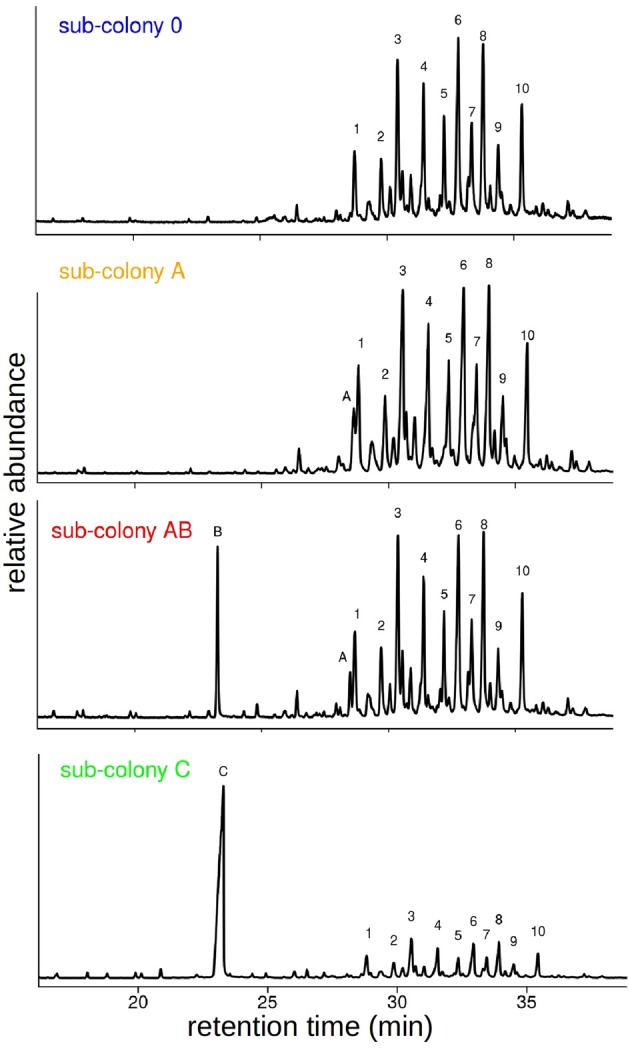
Colony coherence is essential for eusocial insects because it supports the inclusive fitness of colony members. Ants quickly and reliably recognize who belongs to the colony (nestmates) and who is an outsider (non-nestmates) based on chemical recognition cues (cuticular hydrocarbons: CHCs) which as a whole constitute a chemical label. The process of nestmate recognition often is described as matching a neural template with the label. In this study, we tested the prevailing view that ants use commonalities in the colony odor that are present in the CHC profile of all individuals of a colony or whether different CHC profiles are learned independently. We created and manipulated sub-colonies by adding one or two different hydrocarbons that were not present in the original colony odor of our colony and later tested workers of the sub-colonies in one-on-one encounters for aggressive responses. We found that workers adjust their nestmate recognition by learning novel, manipulated CHC profiles, but still accept workers with the previous CHC profile. Workers from a sub-colony with two additional components showed aggression against workers with only one of the two components added to their CHC profile. Thus, additional components as well as the lack of a component can alter a label as "non-nestmate." Our results suggest that ants have multiple-templates to recognize nestmates carrying distinct labels. This finding is in contrast to what previously has been proposed, i.e., a widening of the acceptance range of one template. We conclude that nestmate recognition in ants is a partitioned (multiple-template) process of the olfactory system that allows discrimination and categorization of nestmates by differences in their CHC profiles. Our findings have strong implications for our understanding of the underlying mechanisms of colony coherence and task allocation because they illustrate the importance of individual experience and task associated differences in the CHC profiles that can be instructive for the organization of insect societies.
群体凝聚力对于群居昆虫至关重要,因为它支持群体成员的广义适合度。蚂蚁能够基于化学识别线索(表皮碳氢化合物:CHCs)迅速且可靠地识别谁属于群体(巢伴)以及谁是外来者(非巢伴),这些线索整体构成了一种化学标签。巢伴识别过程通常被描述为将神经模板与该标签进行匹配。在本研究中,我们测试了一种主流观点,即蚂蚁是利用群体中所有个体CHC谱中存在的群体气味共性,还是不同的CHC谱是独立学习的。我们通过添加一种或两种不存在于我们群体原始群体气味中的不同碳氢化合物来创建和操控亚群体,随后在一对一遭遇中测试亚群体的工蚁的攻击反应。我们发现工蚁通过学习新的、经操控的CHC谱来调整它们的巢伴识别,但仍然接受具有先前CHC谱的工蚁。来自添加了两种额外成分的亚群体的工蚁会对其CHC谱中只添加了两种成分之一的工蚁表现出攻击性。因此,额外的成分以及成分的缺失都可以将一个标签改变为“非巢伴”。我们的结果表明,蚂蚁有多个模板来识别携带不同标签的巢伴。这一发现与先前提出的观点相反,即一个模板的接受范围扩大。我们得出结论,蚂蚁的巢伴识别是嗅觉系统的一种分区(多模板)过程,它允许通过CHC谱的差异来区分和分类巢伴。我们的发现对于我们理解群体凝聚力和任务分配的潜在机制具有重要意义,因为它们说明了个体经验和与任务相关的CHC谱差异的重要性,这些差异可能对昆虫社会的组织具有指导意义。