Department of Environmental Immunology, Helmholtz Centre for Environmental Research-UFZ, Leipzig, Germany.
Department of Respiratory Medicine, University of Leipzig, Leipzig, Germany.
BMC Pulm Med. 2017 Nov 28;17(1):159. doi: 10.1186/s12890-017-0509-0.
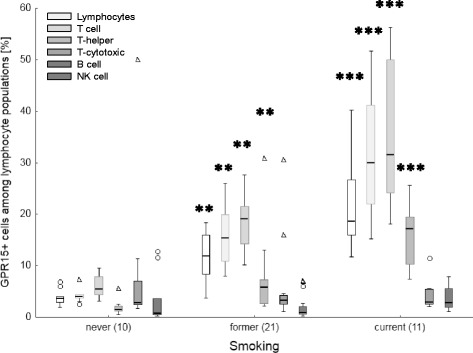
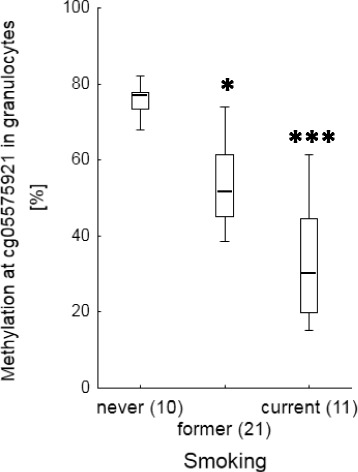
Recently, it was shown that chronic tobacco smoking evokes specific cellular and molecular changes in white blood cells by an excess of G protein-coupled receptor 15 (GPR15)-expressing T cells as well as a hypomethylation at DNA CpG site cg05575921 in granulocytes. In the present study, we aimed to clarify the general usefulness of these two biomarkers as putative signs of non-cancerous change in homeostasis of the lungs.
In a clinical cohort consisting of 42 patients with chronic obstructive pulmonary disease (COPD), interstitial lung disease (ILD) and pneumonia and a control cohort of 123 volunteers, the content of GPR15-expressing blood cells as well as the degree of methylation at cg05575921 were analysed by flow-cytometry and pyrosequencing, respectively. Smoking behaviour was estimated by questionnaire and cotinine level in plasma.
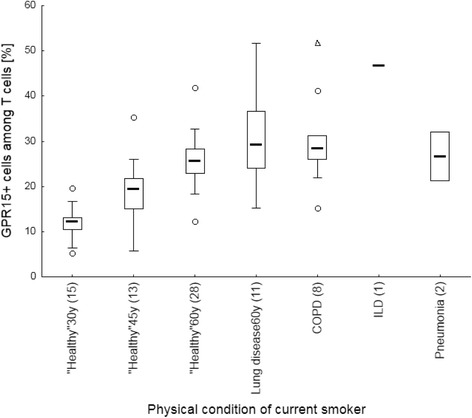
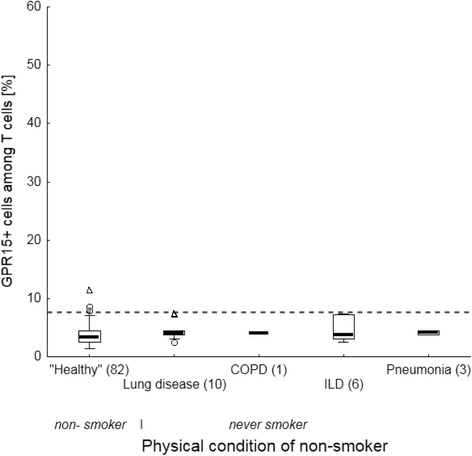
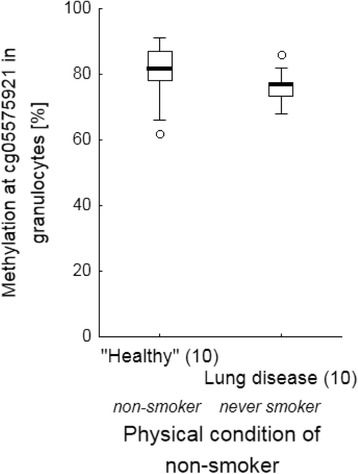
Never-smoking patients could be distinguished from former and current smokers by both the proportion of GPR15-expressing T cells as well as cg05575921 methylation in granulocytes, with 100% and 97% specificity and 100% sensitivity, respectively. However, both parameters were not affected by lung diseases. The degrees of both parameters were not changed neither in non-smoking nor smoking patients, compared to appropriate control cohorts of volunteers.
The degree of GPR15-expressing cells among T cells as well as the methylation at cg05575921 in granulocytes in blood are both rather signs of tobacco-smoking induced systemic inflammation because they don't indicate specifically non-cancerous pathological changes in the lungs.
最近的研究表明,慢性吸烟会通过表达 G 蛋白偶联受体 15(GPR15)的 T 细胞的过度表达以及粒细胞中 DNA CpG 位点 cg05575921 的低甲基化引起白细胞的特定细胞和分子变化。在本研究中,我们旨在阐明这两个生物标志物作为肺部内稳态非癌性变化的潜在标志物的一般用途。
在一个由 42 名慢性阻塞性肺疾病(COPD)、间质性肺疾病(ILD)和肺炎患者以及 123 名志愿者对照组组成的临床队列中,通过流式细胞术和焦磷酸测序分别分析了 GPR15 表达血细胞的含量和 cg05575921 的甲基化程度。通过问卷调查和血浆中可替宁水平评估吸烟行为。
从不吸烟者可以通过 GPR15 表达 T 细胞的比例以及粒细胞中 cg05575921 的甲基化程度与既往和现吸烟者区分开来,特异性分别为 100%和 97%,敏感性均为 100%。然而,这两个参数都不受肺部疾病的影响。与志愿者的适当对照组相比,无论是在非吸烟者还是吸烟者中,这两个参数的程度都没有改变。
T 细胞中 GPR15 表达细胞的程度以及血液中粒细胞中 cg05575921 的甲基化程度都是吸烟引起的系统性炎症的标志,因为它们并不能特异性地表明肺部的非癌性病理变化。