van der Lee Saskia, Stoof Susanne P, van Ravenhorst Mariette B, van Gageldonk Pieter G M, van der Maas Nicoline A T, Sanders Elisabeth A M, Buisman Anne-Marie, Berbers Guy A M
Centre for Infectious Disease Control, National institute for Public Health and the Environment (RIVM), Bilthoven, The Netherlands.
Department of Peadiatric Immunology and Infectious Diseases, Wilhelmina Children's Hospital, University Medical Center, Utrecht, The Netherlands.
Euro Surveill. 2017 Nov;22(47). doi: 10.2807/1560-7917.ES.2017.22.47.17-00011.
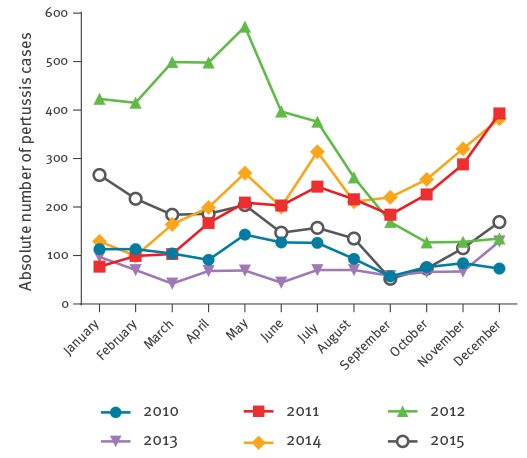
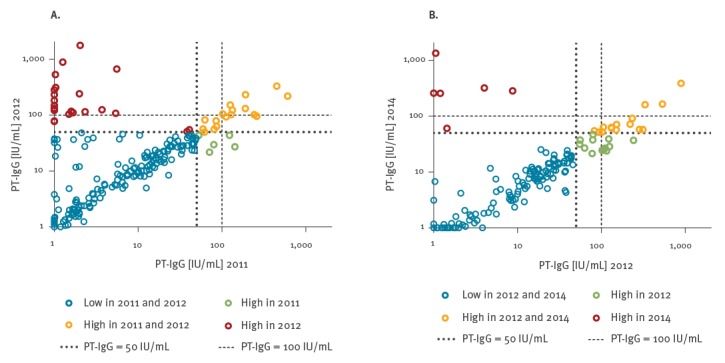
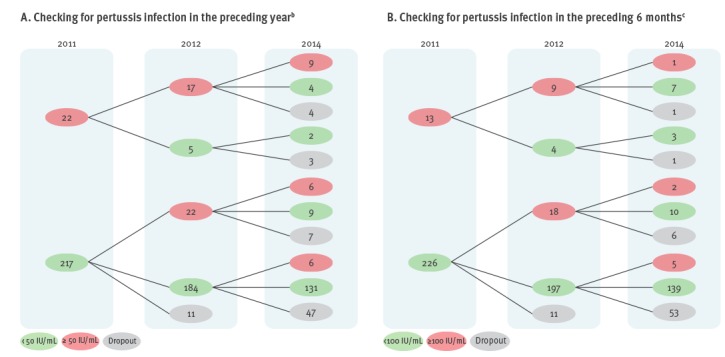
IntroductionIn 2012 a large epidemic of pertussis occurred in the Netherlands. We assessed pertussis toxin (PT) antibody levels in longitudinal serum samples from Dutch 10-18 year-olds, encompassing the epidemic, to investigate pertussis infection incidence. : Blood was sampled in October 2011 (n = 239 adolescents), then 1 year (2012; n = 228) and 3 years (2014; n = 167) later. PT-IgG concentrations were measured by immunoassay and concentrations ≥50 IU/mL (seropositive) assumed indicative of an infection within the preceding year. : During the 2012 epidemic, 10% of participants became seropositive, while this was just 3% after the epidemic. The pertussis acquisition rate proved to be sixfold higher during the epidemic (97 per 1,000 person-years) compared with 2012-2014 (16 per 1,000 person-years). In 2012, pertussis notifications among adolescents nationwide were 228/100,000 (0.23%), which is at least 40 times lower than the seropositivity percentage. Remarkably, 17 of the 22 seropositive participants in 2011, were still seropositive in 2012 and nine remained seropositive for at least 3 years. : Longitudinal studies allow a better estimation of pertussis infections in the population. A PT-IgG concentration ≥50 IU/mL as indication of recent infection may overestimate these numbers in cross-sectional serosurveillance and should be used carefully.
引言
2012年荷兰发生了大规模百日咳疫情。我们评估了荷兰10至18岁青少年纵向血清样本中的百日咳毒素(PT)抗体水平,这些样本涵盖了疫情期间,以调查百日咳感染发病率。2011年10月采集血液样本(n = 239名青少年),随后在1年后(2012年;n = 228)和3年后(2014年;n = 167)再次采集。通过免疫测定法测量PT-IgG浓度,浓度≥50 IU/mL(血清阳性)被认为表明在前一年感染过。在2012年疫情期间,10%的参与者血清转为阳性,而疫情过后这一比例仅为3%。事实证明,疫情期间百日咳感染率(每1000人年97例)比2012年至2014年(每1000人年16例)高六倍。2012年,全国青少年中百日咳报告病例数为228/100,000(0.23%),这至少比血清阳性率低40倍。值得注意的是,2011年22名血清阳性参与者中有17名在2012年仍为血清阳性,9名至少3年保持血清阳性。纵向研究能够更好地估计人群中的百日咳感染情况。PT-IgG浓度≥50 IU/mL作为近期感染的指标,在横断面血清学监测中可能会高估这些数字,应谨慎使用。