Centre for Infectious Disease Control, National Institute for Public Health and the Environment (RIVM), Bilthoven, Netherlands.
Department of Paediatric Immunology and Infectious Diseases, Wilhelmina Children's Hospital, University Medical Centre, Utrecht, Netherlands.
Front Immunol. 2018 Apr 4;9:681. doi: 10.3389/fimmu.2018.00681. eCollection 2018.
To reduce the pertussis disease burden, nowadays several countries recommend acellular pertussis (aP) booster vaccinations for adults. We aimed to evaluate the immunogenicity of a first adult aP booster vaccination at childbearing age.
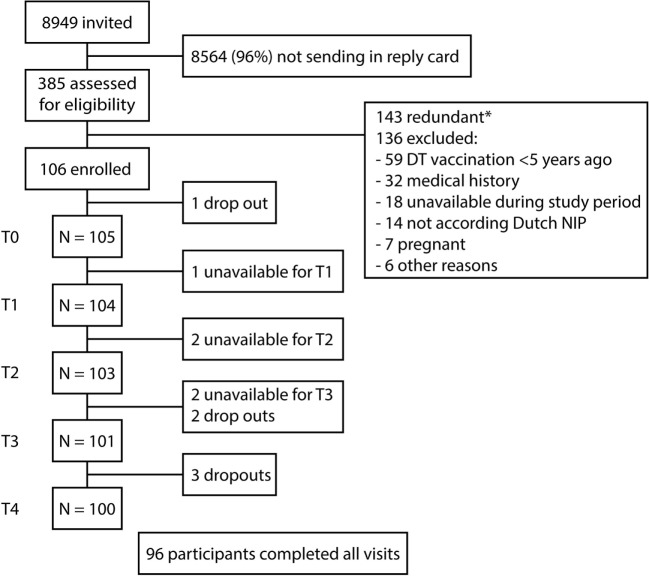
In 2014, healthy adults aged 25-29 years ( = 105), vaccinated during infancy with four doses of whole-cell pertussis (wP) vaccine, received a Tdap (tetanus, diphtheria, and aP) booster vaccination. Blood samples were collected longitudinally pre-booster, 2 and 4 weeks, and 1 year and 2 years post-booster. Tdap vaccine antigen-specific antibody levels and memory B- and T-cell responses were determined at all time points. Antibody persistence was calculated using a bi-exponential decay model.
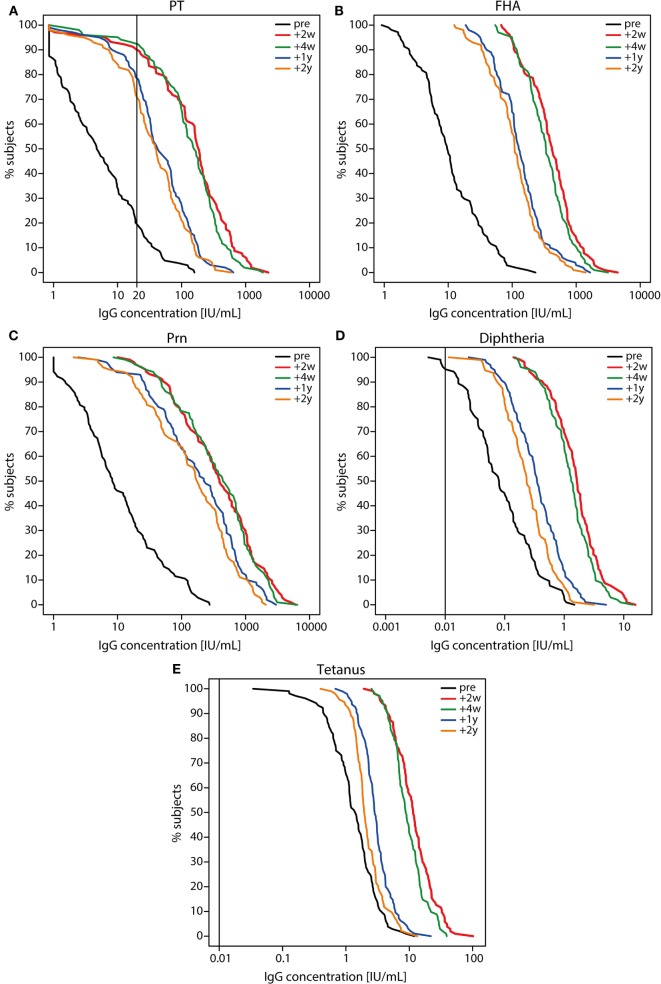
Upon booster vaccination, the IgG levels specific to all Tdap vaccine antigens were significantly increased. After an initial rapid decline in the first year, PT-IgG antibody decay was limited (15%) in the second year post-booster. The duration of a median level of PT-IgG ≥20 IU/mL was estimated to be approximately 9 years. Vaccine antigen-specific memory B- and T-cell numbers increased and remained at high levels although a significant decline was observed after 4 weeks post-booster. However, Th1, Th2, and Th17 cytokine production remained above pre-booster levels for 2 years.
The Tdap booster vaccination in wP-primed Dutch adults induced robust long-term humoral and cellular immune responses to pertussis antigens. Furthermore, PT-IgG levels are predicted to remain above the presumed protective cut-off for at least 9 years which might deserves further attention in evaluating the current recommendation to revaccinate women during every new pregnancy.
为了降低百日咳疾病负担,现在有几个国家建议为成年人接种无细胞百日咳(aP)加强疫苗。我们旨在评估初产妇在育龄期接受 aP 加强疫苗接种的免疫原性。
2014 年,105 名年龄在 25-29 岁之间、在婴儿期接种过 4 剂全细胞百日咳(wP)疫苗的健康成年人接种了 Tdap(破伤风、白喉和 aP)加强疫苗。在接种前、接种后 2 周和 4 周以及 1 年和 2 年,采集纵向血样。在所有时间点均测定 Tdap 疫苗抗原特异性抗体水平以及记忆 B 细胞和 T 细胞反应。使用双指数衰减模型计算抗体持久性。
在加强疫苗接种后,所有 Tdap 疫苗抗原特异性 IgG 水平显著增加。在第一年迅速下降后,PT-IgG 抗体衰减在第二年接种后受到限制(15%)。PT-IgG 中位数水平≥20 IU/mL 的持续时间估计约为 9 年。疫苗抗原特异性记忆 B 细胞和 T 细胞数量增加并保持在高水平,尽管在接种后 4 周观察到明显下降。然而,Th1、Th2 和 Th17 细胞因子的产生在两年内仍保持在接种前水平之上。
在 wP 疫苗接种的荷兰成年人中,Tdap 加强疫苗接种可诱导针对百日咳抗原的长期、强大的体液和细胞免疫应答。此外,PT-IgG 水平预计至少在 9 年内保持在假定的保护临界值以上,这在评估当前建议对每一次新妊娠期间对妇女进行复种时值得进一步关注。