Computational Genomics Laboratory, Genetics, Microbiology and Statistics Department, Institut de Biomedicina (IBUB), Universitat de Barcelona, Barcelona, Catalonia, Spain.
Bioinformatics. 2018 Mar 15;34(6):1016-1023. doi: 10.1093/bioinformatics/btx738.
Planarians are emerging as a model organism to study regeneration in animals. However, the little available data of protein-protein interactions hinders the advances in understanding the mechanisms underlying its regenerating capabilities.
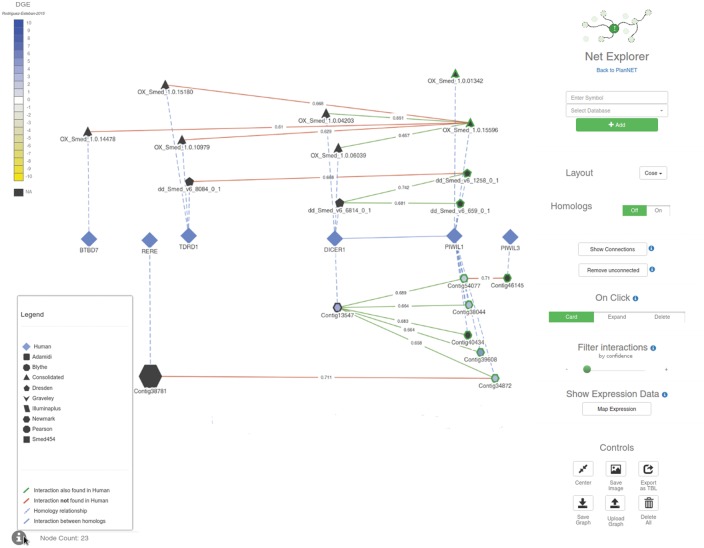
We have developed a protocol to predict protein-protein interactions using sequence homology data and a reference Human interactome. This methodology was applied on 11 Schmidtea mediterranea transcriptomic sequence datasets. Then, using Neo4j as our database manager, we developed PlanNET, a web application to explore the multiplicity of networks and the associated sequence annotations. By mapping RNA-seq expression experiments onto the predicted networks, and allowing a transcript-centric exploration of the planarian interactome, we provide researchers with a useful tool to analyse possible pathways and to design new experiments, as well as a reproducible methodology to predict, store, and explore protein interaction networks for non-model organisms.
The web application PlanNET is available at https://compgen.bio.ub.edu/PlanNET. The source code used is available at https://compgen.bio.ub.edu/PlanNET/downloads.
Supplementary data are available at Bioinformatics online.
扁形动物正在成为研究动物再生的模式生物。然而,可用的蛋白质 - 蛋白质相互作用数据很少,这阻碍了对其再生能力背后的机制的理解。
我们已经开发了一种使用序列同源性数据和参考人类相互作用组来预测蛋白质 - 蛋白质相互作用的协议。该方法应用于 11 个 Schmidtea mediterranea 转录组序列数据集。然后,我们使用 Neo4j 作为我们的数据库管理器,开发了 PlanNET,这是一个用于探索多种网络及其相关序列注释的网络应用程序。通过将 RNA-seq 表达实验映射到预测的网络上,并允许以转录本为中心的方式探索扁形动物相互作用组,我们为研究人员提供了一种有用的工具,可以分析可能的途径并设计新的实验,以及一种可重现的方法来预测、存储和探索非模式生物的蛋白质相互作用网络。
网络应用程序 PlanNET 可在 https://compgen.bio.ub.edu/PlanNET 上获得。使用的源代码可在 https://compgen.bio.ub.edu/PlanNET/downloads 上获得。
补充数据可在 Bioinformatics 在线获得。