Barnard-Kubow Karen B, Galloway Laura F
Department of Biology University of Virginia Charlottesville VA USA.
Ecol Evol. 2017 Oct 7;7(22):9347-9357. doi: 10.1002/ece3.3400. eCollection 2017 Nov.
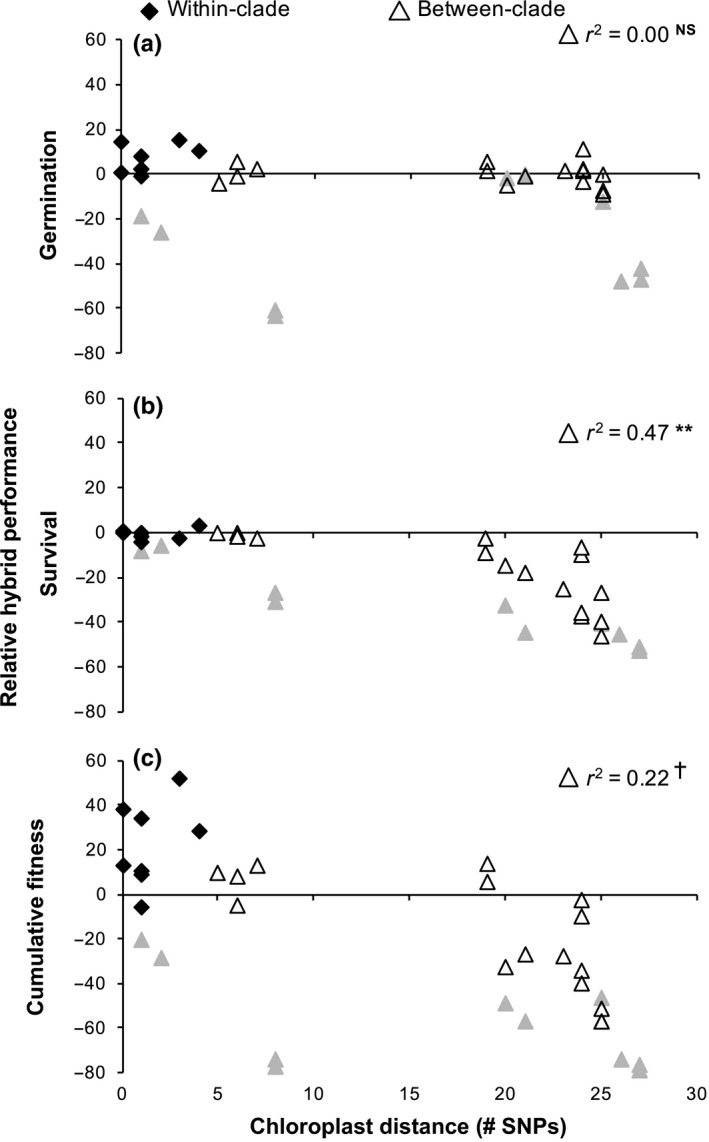
Reproductive isolation is often variable within species, a phenomenon that while largely ignored by speciation studies, can be leveraged to gain insight into the potential mechanisms driving the evolution of genetic incompatibilities. We used experimental greenhouse crosses to characterize patterns of reproductive isolation among three divergent genetic lineages of that occur in close geographic proximity in the Appalachian Mountains. Substantial, asymmetrical reproductive isolation for survival due to cytonuclear incompatibility was found among the lineages (up to 94% reduction). Moderate reductions in pollen viability, as well as cytoplasmic male sterility, were also found between some Mountain populations. We then compared these results to previously established patterns of reproductive isolation between these Mountain lineages and a fourth, widespread Western lineage to fully characterize reproductive isolation across the complete geographic and genetic range of . Reproductive isolation for survival and pollen viability was consistent across studies, indicating the evolution of the underlying genetic incompatibilities is primarily determined by intrinsic factors. In contrast, reproductive isolation for germination was only found when crossing Mountain populations with the Western lineage, suggesting the underlying genetic incompatibility is likely influenced by environmental or demographic differences between the two lineages. Cytoplasmic male sterility was also limited in occurrence, being restricted to a handful of Mountain populations in a narrow geographic range. These findings illustrate the complexity of speciation by demonstrating multiple, independent genetic incompatibilities that lead to a mosaic of genetic divergence and reproductive isolation across a species range.
生殖隔离在物种内部往往是可变的,这一现象虽然在物种形成研究中大多被忽视,但可以用来深入了解驱动遗传不相容性进化的潜在机制。我们利用实验温室杂交来描述阿巴拉契亚山脉地理距离相近的三个不同遗传谱系之间的生殖隔离模式。在这些谱系之间发现了由于细胞核质不相容导致的显著、不对称的生存生殖隔离(减少高达94%)。在一些山区种群之间还发现花粉活力适度下降以及细胞质雄性不育。然后,我们将这些结果与之前确定的这些山区谱系与第四个广泛分布的西部谱系之间的生殖隔离模式进行比较,以全面描述在整个地理和遗传范围内的生殖隔离情况。各项研究中生存和花粉活力的生殖隔离情况是一致的,这表明潜在遗传不相容性的进化主要由内在因素决定。相比之下,只有在将山区种群与西部谱系杂交时才发现萌发的生殖隔离,这表明潜在的遗传不相容性可能受到两个谱系之间环境或人口统计学差异的影响。细胞质雄性不育的发生也很有限,仅限于一个狭窄地理范围内的少数山区种群。这些发现通过展示多种独立的遗传不相容性说明了物种形成的复杂性,这些不相容性导致了整个物种范围内遗传分化和生殖隔离的镶嵌分布。