Univ. Montpellier, CNRS, IFREMER, UPVD, IHPE, Perpignan, France.
Centre for Emerging, Endemic and Exotic Diseases (CEEED), Department of Pathobiology and Population Sciences (PPS), Royal Veterinary College, University of London, Hawkshead Campus, Herts, United Kingdom.
PLoS Negl Trop Dis. 2021 May 4;15(5):e0009363. doi: 10.1371/journal.pntd.0009363. eCollection 2021 May.
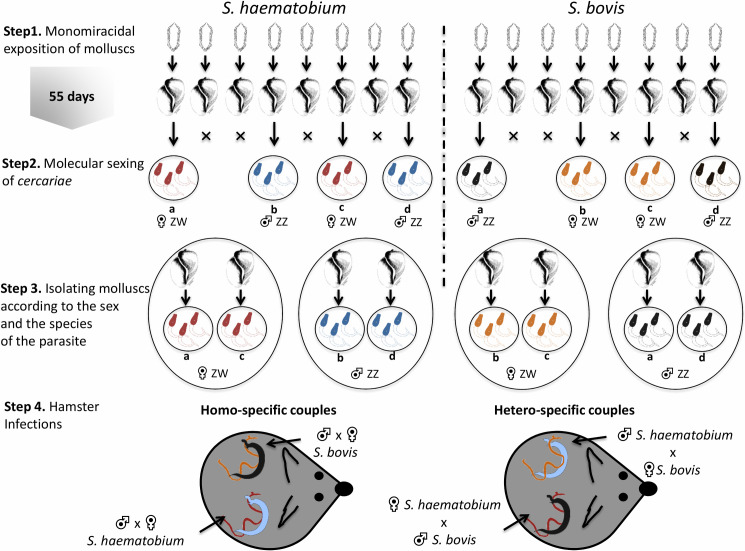
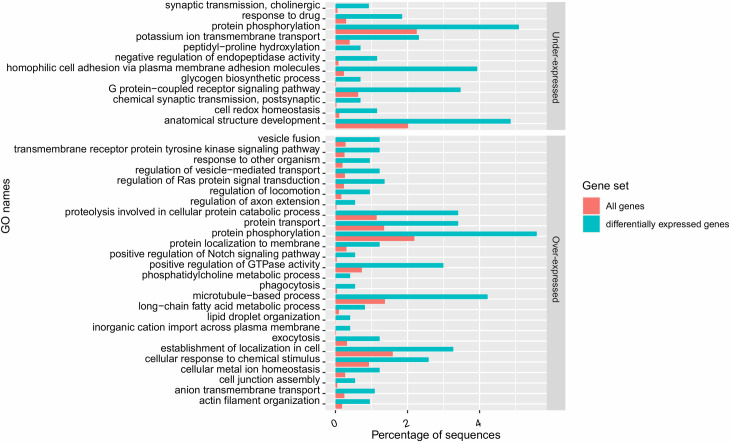
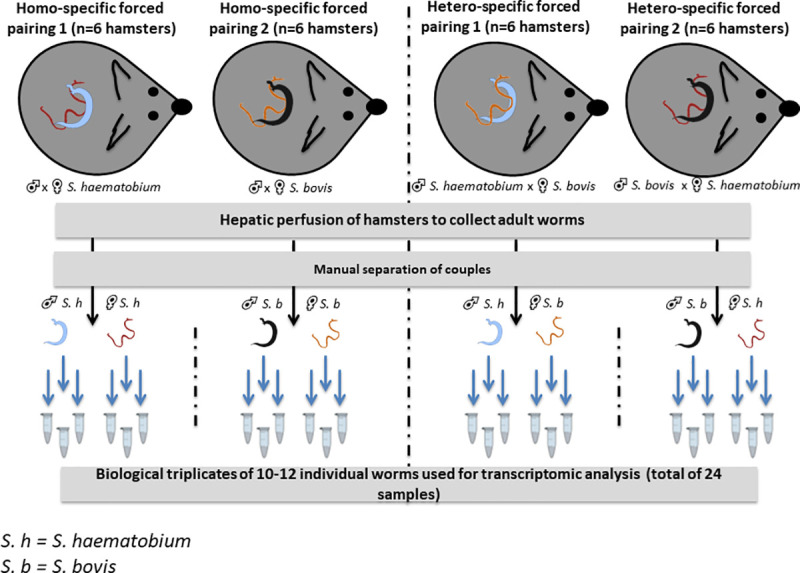
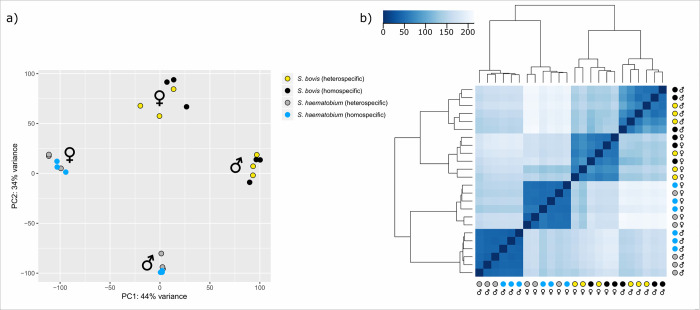
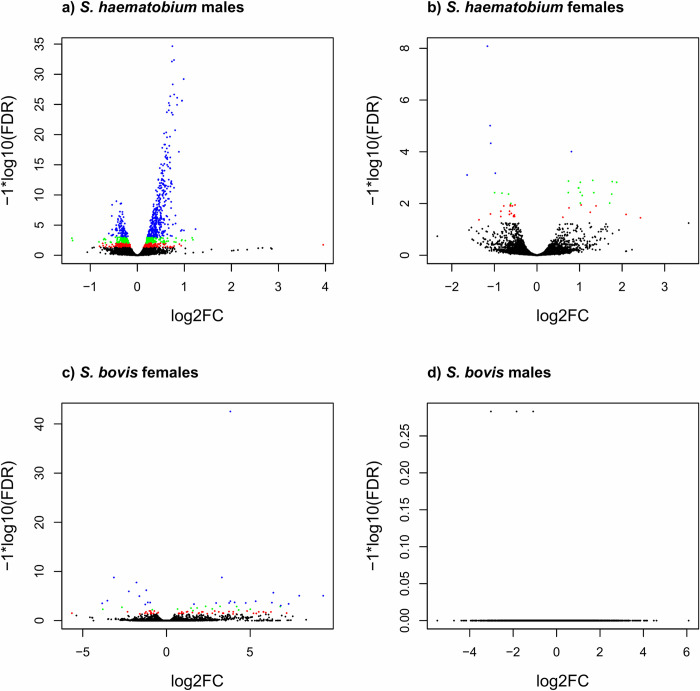
Species usually develop reproductive isolation mechanisms allowing them to avoid interbreeding. These preventive barriers can act before reproduction, "pre-zygotic barriers", or after reproduction, "post-zygotic barriers". Pre-zygotic barriers prevent unfavourable mating, while post-zygotic barriers determine the viability and selective success of the hybrid offspring. Hybridization in parasites and the underlying reproductive isolation mechanisms maintaining their genetic integrity have been overlooked. Using an integrated approach this work aims to quantify the relative importance of pre-zygotic barriers in Schistosoma haematobium x S. bovis crosses. These two co-endemic species cause schistosomiasis, one of the major debilitating parasitic diseases worldwide, and can hybridize naturally. Using mate choice experiments we first tested if a specific mate recognition system exists between both species. Second, using RNA-sequencing we analysed differential gene expression between homo- and hetero-specific pairing in male and female adult parasites. We show that homo- and hetero-specific pairing occurs randomly between these two species, and few genes in both sexes are affected by hetero-specific pairing. This suggests that i) mate choice is not a reproductive isolating factor, and that ii) no pre-zygotic barrier except spatial isolation "by the final vertebrate host" seems to limit interbreeding between these two species. Interestingly, among the few genes affected by the pairing status of the worms, some can be related to pathways affected during male and female interactions and may also present interesting candidates for species isolation mechanisms and hybridization in schistosome parasites.
物种通常会发展出生殖隔离机制,以避免杂交。这些预防屏障可以在繁殖前(“合子前屏障”)或繁殖后(“合子后屏障”)发挥作用。合子前屏障防止不利的交配,而合子后屏障决定杂种后代的生存能力和选择成功。寄生虫中的杂交以及维持其遗传完整性的生殖隔离机制一直被忽视。本研究采用综合方法,旨在量化血吸虫属间生殖隔离机制的相对重要性。这两种共生的物种会导致血吸虫病,这是全球主要的使人衰弱的寄生虫病之一,并且可以自然杂交。通过交配选择实验,我们首先测试了这两个物种之间是否存在特定的配偶识别系统。其次,我们使用 RNA 测序分析了雄性和雌性成体寄生虫中同种和异种配对之间的差异基因表达。我们发现这两个物种之间的同种和异种配对是随机发生的,而且两性中很少有基因受到异种配对的影响。这表明:i)配偶选择不是生殖隔离因素,并且 ii)除了“最终脊椎动物宿主”的空间隔离之外,似乎没有其他合子前屏障限制这两个物种之间的杂交。有趣的是,在受配对状态影响的少数基因中,一些基因可能与雌雄虫相互作用过程中的途径有关,这些基因也可能是血吸虫种间隔离机制和杂交的有趣候选基因。