Walthert Lorenz, Meier Eliane Seraina
Swiss Federal Institute for Forest Snow and Landscape Research WSL Birmensdorf Switzerland.
Agroscope Institute for Sustainability Sciences ISS Zurich Switzerland.
Ecol Evol. 2017 Oct 11;7(22):9473-9484. doi: 10.1002/ece3.3436. eCollection 2017 Nov.
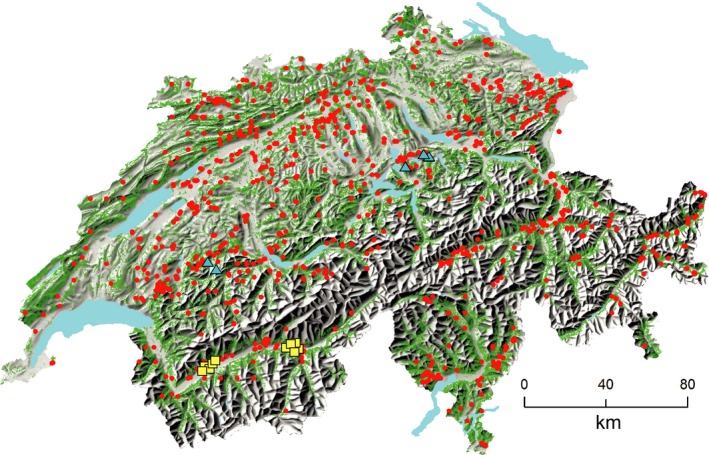
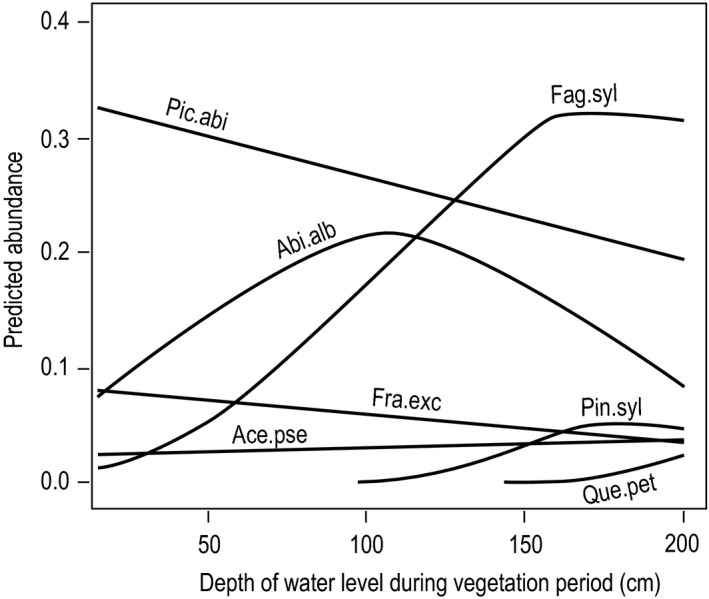
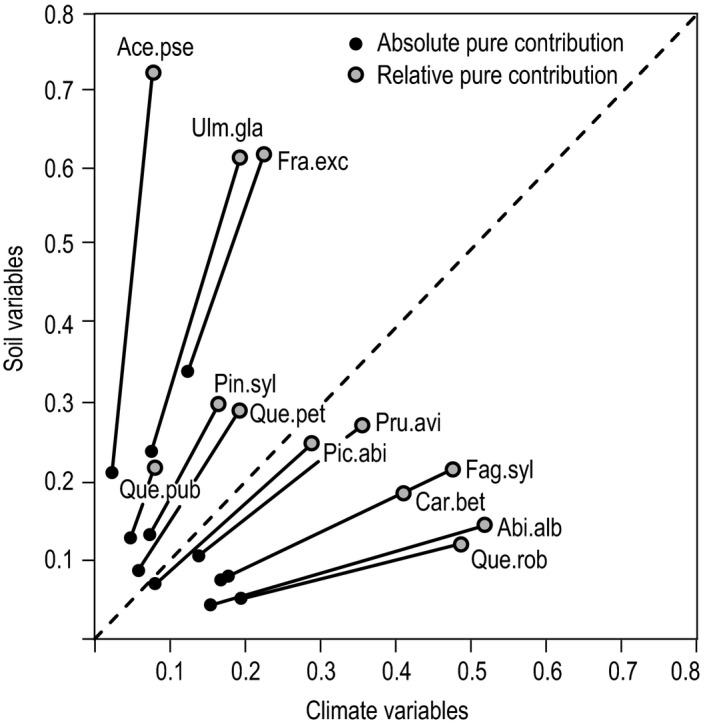
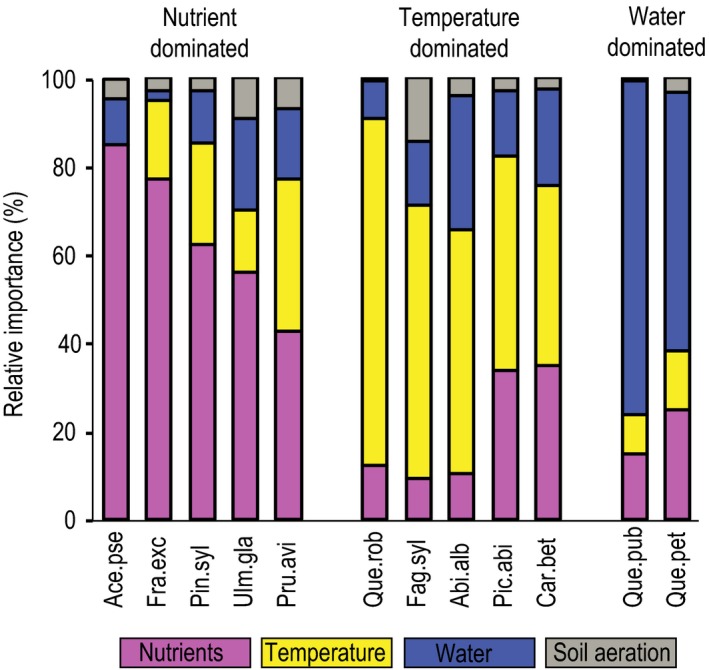
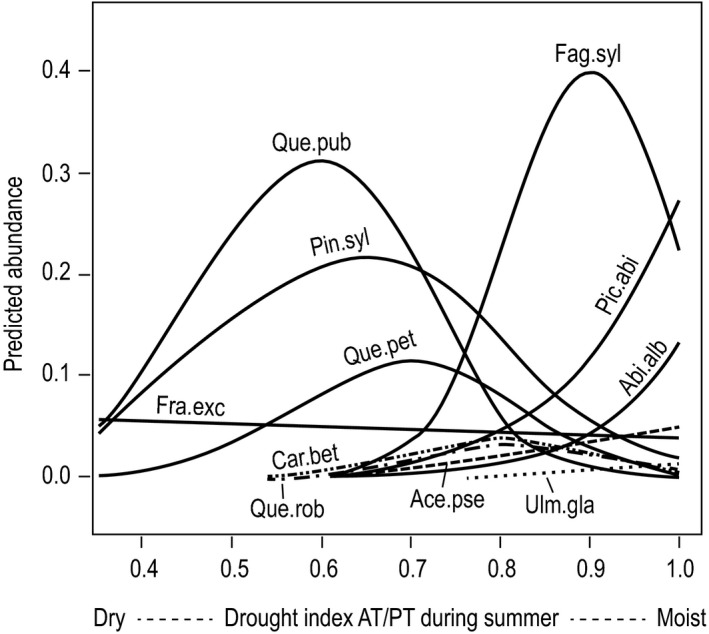
Knowledge of the ecological requirements determining tree species distributions is a precondition for sustainable forest management. At present, the abiotic requirements and the relative importance of the different abiotic factors are still unclear for many temperate tree species. We therefore investigated the relative importance of climatic and edaphic factors for the abundance of 12 temperate tree species along environmental gradients. Our investigations are based on data from 1,075 forest stands across Switzerland including the cold-induced tree line of all studied species and the drought-induced range boundaries of several species. Four climatic and four edaphic predictors represented the important growth factors temperature, water supply, nutrient availability, and soil aeration. The climatic predictors were derived from the meteorological network of MeteoSwiss, and the edaphic predictors were available from soil profiles. Species cover abundances were recorded in field surveys. The explanatory power of the predictors was assessed by variation partitioning analyses with generalized linear models. For six of the 12 species, edaphic predictors were more important than climatic predictors in shaping species distribution. Over all species, abundances depended mainly on nutrient availability, followed by temperature, water supply, and soil aeration. The often co-occurring species responded similar to these growth factors. Drought turned out to be a determinant of the lower range boundary for some species. We conclude that over all 12 studied tree species, soil properties were more important than climate variables in shaping tree species distribution. The inclusion of appropriate soil variables in species distribution models allowed to better explain species' ecological niches. Moreover, our study revealed that the ecological requirements of tree species assessed in local field studies and in experiments are valid at larger scales across Switzerland.
了解决定树种分布的生态需求是可持续森林管理的前提条件。目前,许多温带树种的非生物需求以及不同非生物因素的相对重要性仍不明确。因此,我们研究了气候和土壤因素对12种温带树种沿环境梯度丰度的相对重要性。我们的研究基于瑞士各地1075个林分的数据,包括所有研究物种的寒诱导树线以及几种物种的干旱诱导范围边界。四个气候预测因子和四个土壤预测因子代表了重要的生长因子,即温度、水分供应、养分有效性和土壤通气性。气候预测因子来自瑞士气象局的气象网络,土壤预测因子可从土壤剖面获得。在实地调查中记录了物种覆盖丰度。通过广义线性模型的变异分配分析评估预测因子的解释力。对于12个物种中的6个,土壤预测因子在塑造物种分布方面比气候预测因子更重要。在所有物种中,丰度主要取决于养分有效性,其次是温度、水分供应和土壤通气性。经常共生的物种对这些生长因子的反应相似。干旱被证明是一些物种下限范围的决定因素。我们得出结论,在所有12种研究树种中,土壤性质在塑造树种分布方面比气候变量更重要。在物种分布模型中纳入适当的土壤变量可以更好地解释物种的生态位。此外,我们的研究表明,在当地实地研究和实验中评估的树种生态需求在瑞士更大尺度上是有效的。