Bhardwaj Megha, Gies Anton, Werner Simone, Schrotz-King Petra, Brenner Hermann
Division of Preventive Oncology, German Cancer Research Center (DKFZ) and National Center for Tumor Diseases (NCT), Heidelberg, Germany.
Division of Clinical Epidemiology and Aging Research, German Cancer Research Center (DKFZ), Heidelberg, Germany.
Clin Transl Gastroenterol. 2017 Nov 30;8(11):e128. doi: 10.1038/ctg.2017.53.
Blood-based proteins might be an attractive option for early detection of colorectal cancer (CRC), but individually they are unlikely to achieve the diagnostic performance required for population based screening. We aimed at summarizing current evidence of diagnostic performance of signatures based on multiple proteins for early detection of CRC.
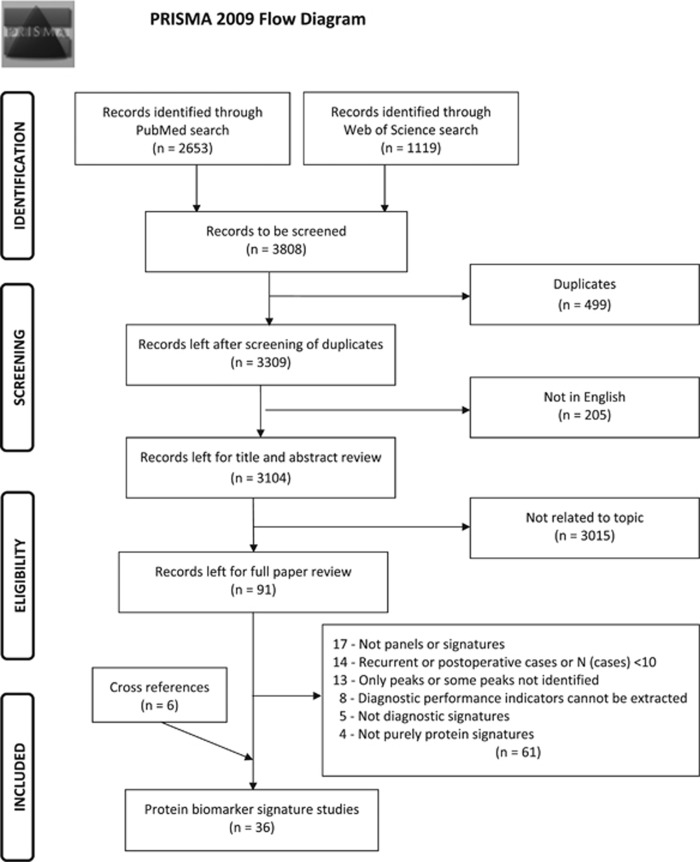
A systematic literature review adhering to the PRISMA (preferred reporting items for systematic reviews and meta-analysis) guidelines was performed. PubMed and Web of Science databases were searched for potentially relevant studies published until 28th August, 2017. Relevant studies were identified by predefined eligibility criteria. Estimates of indicators of diagnostic performance such as sensitivity, specificity, and the area under the curve (AUC), along with information on validation and other key methodological procedures were extracted. Study quality was assessed by a QUADAS-2 (Quality Assessment of Diagnostic Accuracy Studies 2) instrument tool.
Thirty six eligible studies with numbers of CRC cases ranging from 23 to 512 and the number of proteins included in signatures ranged from 3 to 13 were identified. Reported Youden's Index and AUC ranged from 0.19 to 0.95 and from 0.62 to 0.996, respectively. However most studies, especially those reporting better diagnostic performance, were conducted in clinical rather than screening setting and many studies lacked any internal or external validation of identified algorithm.
Blood-based tests using signatures of multiple proteins may be a promising approach for non-invasive CRC screening. However, promising signatures identified in clinical settings still require rigorous evaluation in large studies conducted in true screening setting.
基于血液的蛋白质可能是早期检测结直肠癌(CRC)的一个有吸引力的选择,但单独使用它们不太可能达到基于人群筛查所需的诊断性能。我们旨在总结基于多种蛋白质的标志物用于早期检测CRC的诊断性能的当前证据。
按照PRISMA(系统评价和Meta分析的首选报告项目)指南进行系统的文献综述。检索了PubMed和Web of Science数据库,以查找截至2017年8月28日发表的潜在相关研究。通过预定义的纳入标准确定相关研究。提取诊断性能指标的估计值,如敏感性、特异性和曲线下面积(AUC),以及有关验证和其他关键方法程序的信息。通过QUADAS - 2(诊断准确性研究质量评估2)工具评估研究质量。
确定了36项符合条件的研究,CRC病例数从23到512不等,标志物中包含的蛋白质数量从3到13不等。报告的约登指数和AUC分别在0.19至0.95和0.62至0.996之间。然而,大多数研究,尤其是那些报告了更好诊断性能的研究,是在临床而非筛查环境中进行的,并且许多研究缺乏对所确定算法的任何内部或外部验证。
使用多种蛋白质标志物的基于血液的检测可能是一种有前途的非侵入性CRC筛查方法。然而,在临床环境中确定的有前途的标志物仍需要在真正的筛查环境中进行的大型研究中进行严格评估。