Liu Ling, Wang Fan, Zhou Ke, Ding Nai, Luo Huan
School of Psychological and Cognitive Sciences, Peking University, Beijing, China.
Peking University-IDG/McGovern Institute for Brain Research, Peking University, Beijing, China.
PLoS Biol. 2017 Nov 30;15(11):e2003646. doi: 10.1371/journal.pbio.2003646. eCollection 2017 Nov.
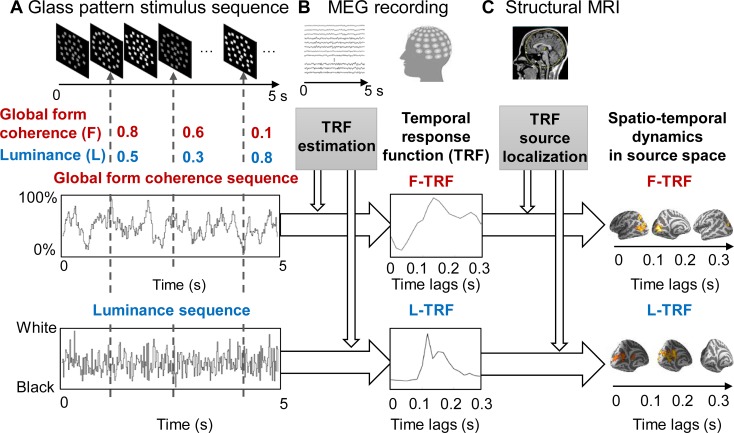
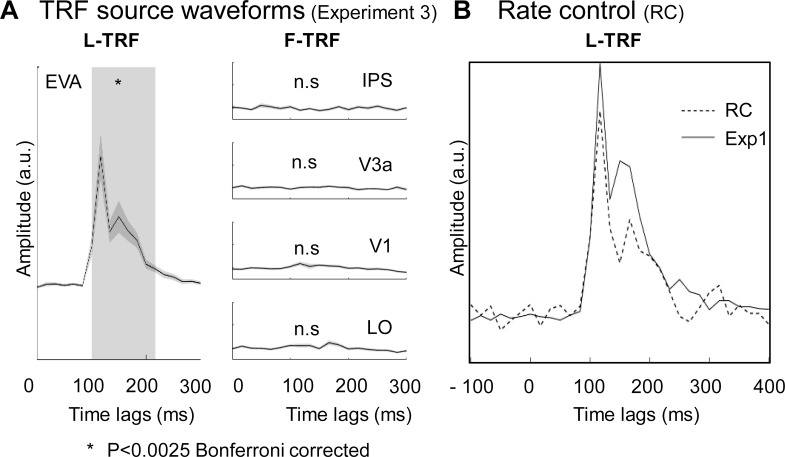
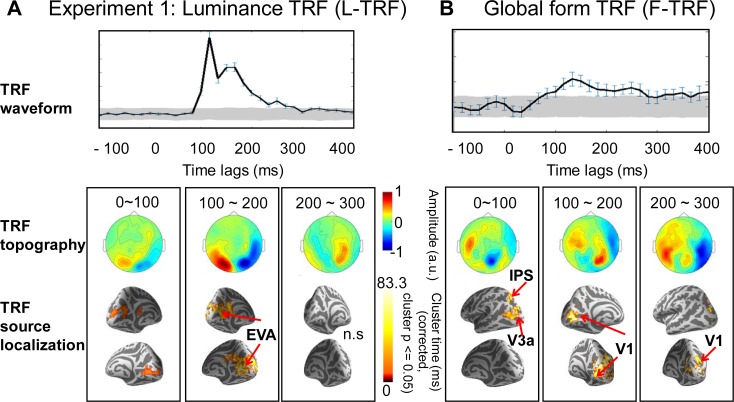
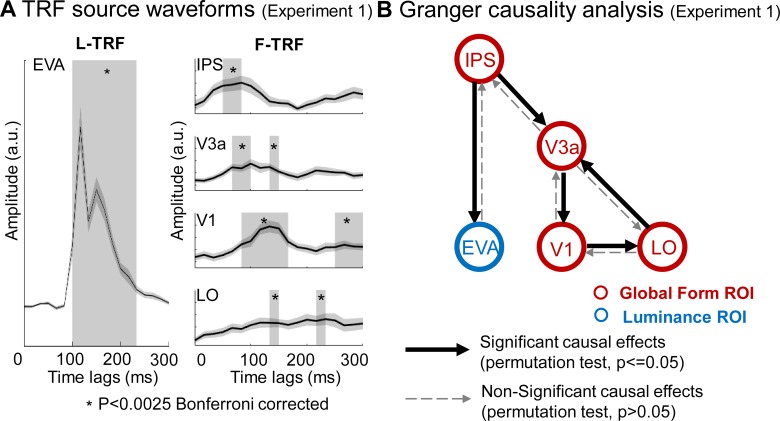
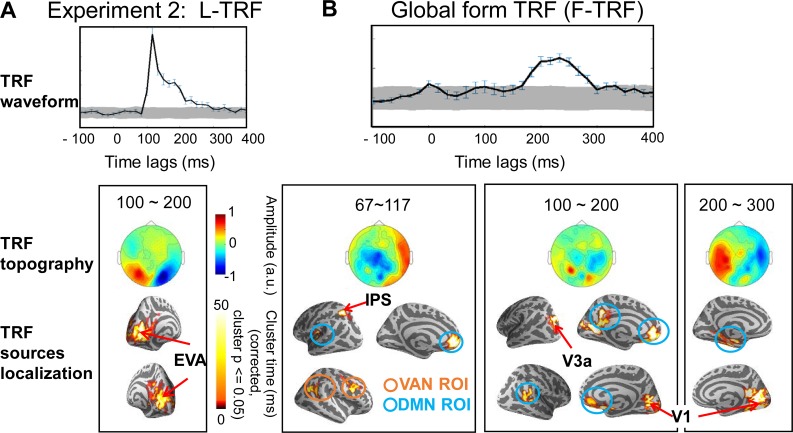
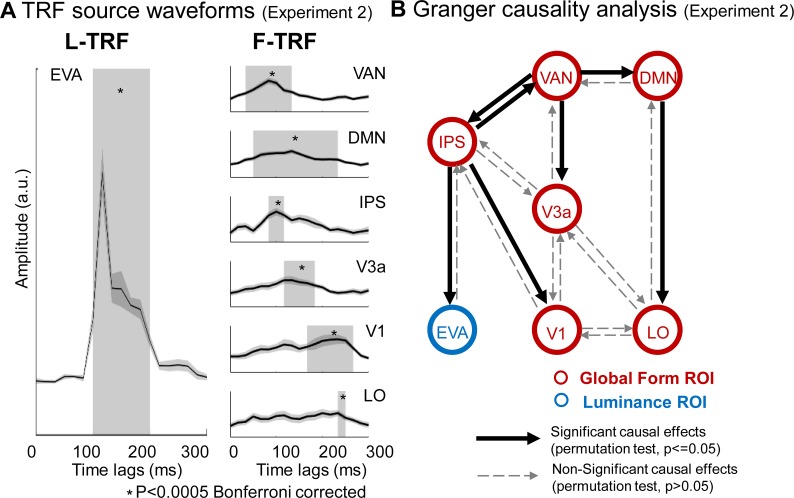
Rapidly grouping local elements into an organized object (i.e., perceptual integration) is a fundamental yet challenging task, especially in noisy contexts. Previous studies demonstrate that ventral visual pathway, which is widely known to mediate object recognition, engages in the process by conveying object-level information processed in high-level areas to modulate low-level sensory areas. Meanwhile, recent evidence suggests that the dorsal visual pathway, which is not typically attributable to object recognition, is also involved in the process. However, the underlying whole-brain fine spatiotemporal neuronal dynamics remains unknown. Here we used magnetoencephalography (MEG) recordings in combination with a temporal response function (TRF) approach to dissociate the time-resolved neuronal response that specifically tracks the perceptual grouping course. We demonstrate that perceptual integration initiates robust and rapid responses along the dorsal visual pathway in a reversed hierarchical manner, faster than the ventral pathway. Specifically, the anterior intraparietal sulcus (IPS) responds first (i.e., within 100 ms), followed by activities backpropagating along the dorsal pathway to early visual areas (EVAs). The IPS activity causally modulates the EVA response, even when the global form information is task-irrelevant. The IPS-to-EVA response profile fails to appear when the global form could not be perceived. Our results support the crucial function of the dorsal visual pathway in perceptual integration, by quickly extracting a coarse global template (i.e., an initial object representation) within first 100 ms to guide subsequent local sensory processing so that the ambiguities in the visual inputs can be efficiently resolved.
迅速将局部元素组织成一个有组织的对象(即知觉整合)是一项基本但具有挑战性的任务,尤其是在嘈杂的环境中。先前的研究表明,众所周知,介导物体识别的腹侧视觉通路通过传递在高级区域处理的物体级信息来调节低级感觉区域,从而参与这一过程。与此同时,最近的证据表明,通常不被认为与物体识别有关的背侧视觉通路也参与了这一过程。然而,潜在的全脑精细时空神经元动力学仍然未知。在这里,我们结合使用脑磁图(MEG)记录和时间响应函数(TRF)方法,以分离专门跟踪知觉分组过程的时间分辨神经元反应。我们证明,知觉整合沿着背侧视觉通路以相反的层次顺序引发强大而快速的反应,比腹侧通路更快。具体来说,顶内沟前部(IPS)首先做出反应(即在100毫秒内),随后活动沿着背侧通路反向传播到早期视觉区域(EVA)。即使全局形状信息与任务无关,IPS活动也会因果性地调节EVA反应。当无法感知全局形状时,IPS到EVA的反应模式不会出现。我们的结果支持背侧视觉通路在知觉整合中的关键作用,即通过在最初的100毫秒内快速提取一个粗略的全局模板(即初始物体表征)来指导后续的局部感觉处理,从而有效地解决视觉输入中的模糊性。