Wang Kehao, Venetsanos Demetrios T, Wang Jian, Augousti Andy T, Pierscionek Barbara K
Faculty of Science Engineering and Computing Penrhyn Road Kingston-upon, Thames, KT1 2EE, UK.
College of Science and Technology Nottingham Trent University, DH Lawrence Building, Clifton Campus Clifton Lane, Nottingham, NG11 8NS, UK.
Sci Rep. 2017 Nov 30;7(1):16688. doi: 10.1038/s41598-017-16854-9.
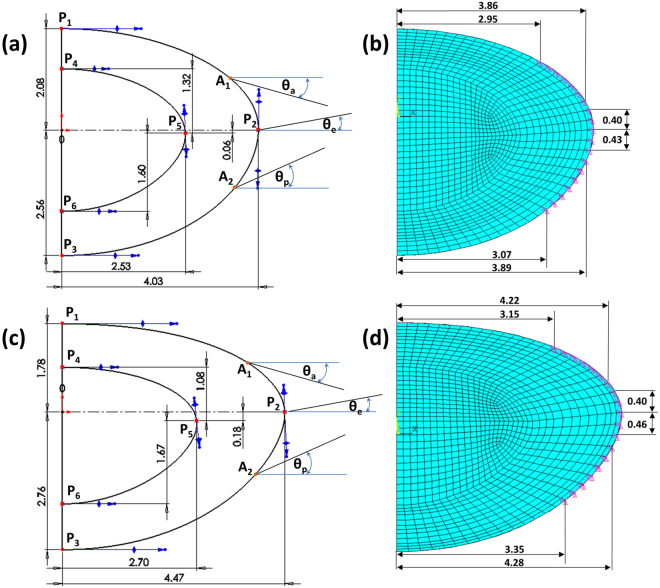
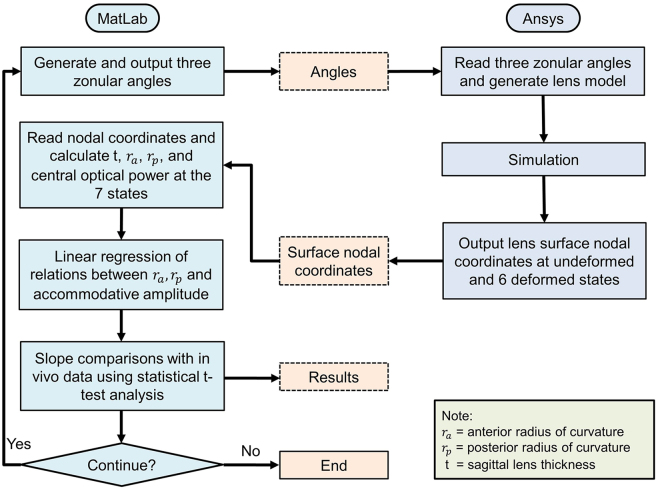
The lens provides refractive power to the eye and is capable of altering ocular focus in response to visual demand. This capacity diminishes with age. Current biomedical technologies, which seek to design an implant lens capable of replicating the function of the biological lens, are unable as yet to provide such an implant with the requisite optical quality or ability to change the focussing power of the eye. This is because the mechanism of altering focus, termed accommodation, is not fully understood and seemingly conflicting theories require experimental support which is difficult to obtain from the living eye. This investigation presents finite element models of the eye lens based on data from human lenses aged 16 and 35 years that consider the influence of various modelling parameters, including material properties, a wide range of angles of force application and capsular thickness. Results from axisymmetric models show that the anterior and posterior zonules may have a greater impact on shape change than the equatorial zonule and that choice of capsular thickness values can influence the results from modelled simulations.
晶状体为眼睛提供屈光力,并能够根据视觉需求改变眼的焦点。这种能力会随着年龄的增长而下降。当前的生物医学技术试图设计一种能够复制生物晶状体功能的植入式晶状体,但目前还无法为这种植入物提供所需的光学质量或改变眼聚焦能力。这是因为改变焦点的机制,即调节,尚未完全被理解,而且看似相互矛盾的理论需要实验支持,而这很难从活体眼睛中获得。本研究基于16岁和35岁人类晶状体的数据,提出了晶状体的有限元模型,该模型考虑了各种建模参数的影响,包括材料特性、广泛的力施加角度和囊膜厚度。轴对称模型的结果表明,前后小带对形状变化的影响可能比赤道小带更大,并且囊膜厚度值的选择会影响模拟结果。