Department of Neurosciences, University of California, San Diego, 9500 Gilman Drive, La Jolla, CA, 92093-0624, USA.
Department of Pathology, Icahn School of Medicine at Mount Sinai, 1 Gustave L. Levy, Place Box 1194, New York, NY, 10029, USA.
Acta Neuropathol. 2018 Mar;135(3):459-474. doi: 10.1007/s00401-017-1793-8. Epub 2017 Dec 1.
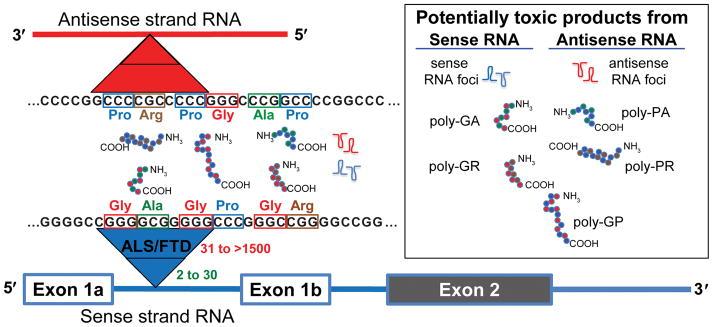
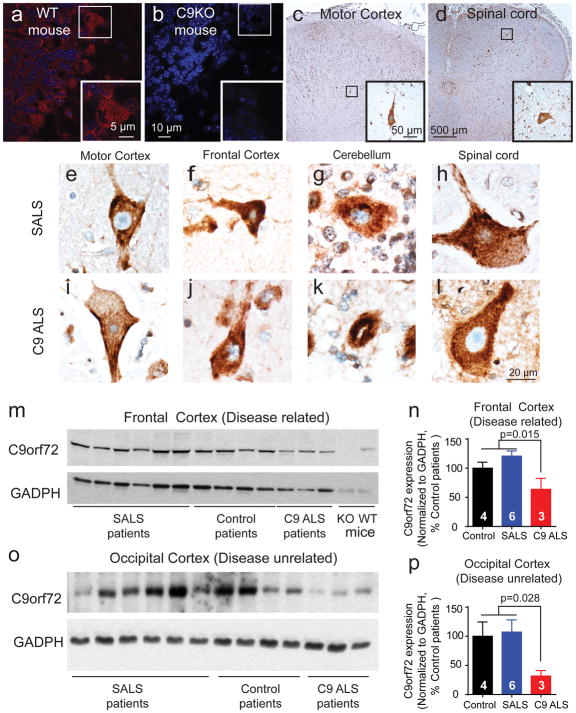
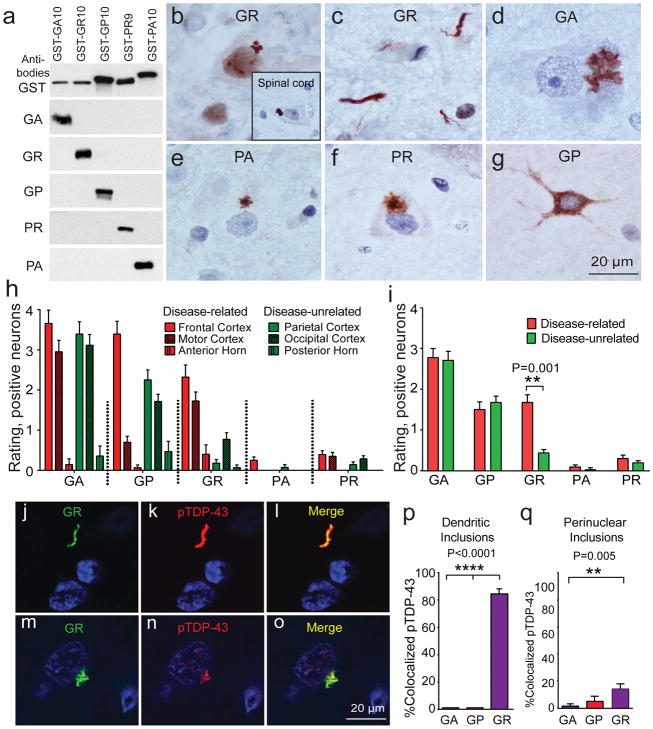
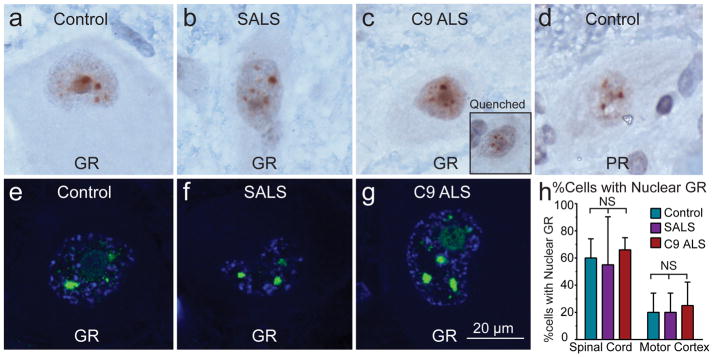
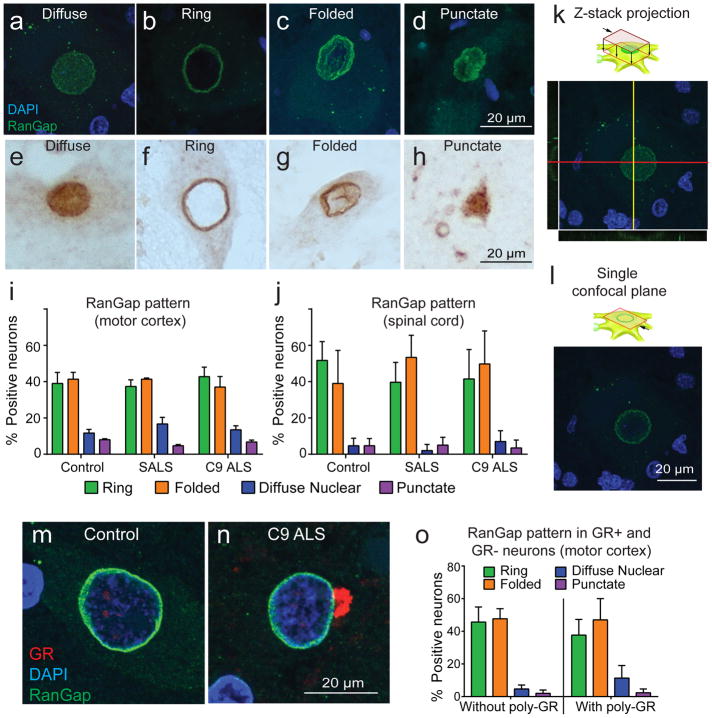
Hexanucleotide repeat expansions in C9orf72 are the most common genetic cause of amyotrophic lateral sclerosis (C9 ALS). The main hypothesized pathogenic mechanisms are C9orf72 haploinsufficiency and/or toxicity from one or more of bi-directionally transcribed repeat RNAs and their dipeptide repeat proteins (DPRs) poly-GP, poly-GA, poly-GR, poly-PR and poly-PA. Recently, nuclear import and/or export defects especially caused by arginine-containing poly-GR or poly-PR have been proposed as significant contributors to pathogenesis based on disease models. We quantitatively studied and compared DPRs, nuclear pore proteins and C9orf72 protein in clinically related and clinically unrelated regions of the central nervous system, and compared them to phosphorylated TDP-43 (pTDP-43), the hallmark protein of ALS. Of the five DPRs, only poly-GR was significantly abundant in clinically related areas compared to unrelated areas (p < 0.001), and formed dendritic-like aggregates in the motor cortex that co-localized with pTDP-43 (p < 0.0001). While most poly-GR dendritic inclusions were pTDP-43 positive, only 4% of pTDP-43 dendritic inclusions were poly-GR positive. Staining for arginine-containing poly-GR and poly-PR in nuclei of neurons produced signals that were not specific to C9 ALS. We could not detect significant differences of nuclear markers RanGap, Lamin B1, and Importin β1 in C9 ALS, although we observed subtle nuclear changes in ALS, both C9 and non-C9, compared to control. The C9orf72 protein itself was diffusely expressed in cytoplasm of large neurons and glia, and nearly 50% reduced, in both clinically related frontal cortex and unrelated occipital cortex, but not in cerebellum. In summary, sense-encoded poly-GR DPR was unique, and localized to dendrites and pTDP43 in motor regions of C9 ALS CNS. This is consistent with new emerging ideas about TDP-43 functions in dendrites.
C9orf72 中的六核苷酸重复扩增是肌萎缩侧索硬化症(C9 ALS)最常见的遗传原因。主要假设的致病机制是 C9orf72 单倍体不足和/或来自一个或多个双向转录重复 RNA 及其二肽重复蛋白(DPR)聚-GP、聚-GA、聚-GR、聚-PR 和聚-PA 的毒性。最近,基于疾病模型,核输入和/或输出缺陷,特别是由含精氨酸的聚-GR 或聚-PR 引起的缺陷,被提出是发病机制的重要贡献者。我们定量研究并比较了中枢神经系统临床相关和临床不相关区域的 DPR、核孔蛋白和 C9orf72 蛋白,并将其与肌萎缩侧索硬化症的标志性蛋白磷酸化 TDP-43(pTDP-43)进行了比较。在这五种 DPR 中,只有聚-GR 在临床相关区域明显比不相关区域丰富(p<0.001),并在运动皮层中形成与 pTDP-43 共定位的树突样聚集体(p<0.0001)。虽然大多数聚-GR 树突状包涵体呈 pTDP-43 阳性,但只有 4%的 pTDP-43 树突状包涵体呈聚-GR 阳性。在神经元核中用含精氨酸的聚-GR 和聚-PR 染色产生的信号不是 C9 ALS 特有的。虽然我们观察到 C9 和非 C9 肌萎缩侧索硬化症与对照组相比,核内存在细微变化,但我们无法检测到 C9 ALS 中核标记 RanGap、核层蛋白 B1 和 Importin β1 的显著差异。C9orf72 蛋白本身在大神经元和神经胶质细胞的细胞质中弥散表达,在临床相关的额皮质和不相关的枕皮质中几乎减少了 50%,但在小脑皮质中没有减少。总之,有意义的聚-GR DPR 是独特的,定位于 C9 ALS CNS 运动区的树突和 pTDP43。这与 TDP-43 在树突中的功能的新出现的观点是一致的。