• 文献检索
  • 文档翻译
  • 深度研究
  • 学术资讯
  • Suppr Zotero 插件Zotero 插件
  • 邀请有礼
  • 套餐&价格
  • 历史记录
应用&插件
Suppr Zotero 插件Zotero 插件浏览器插件Mac 客户端Windows 客户端微信小程序
定价
高级版会员购买积分包购买API积分包
服务
文献检索文档翻译深度研究API 文档MCP 服务
关于我们
关于 Suppr公司介绍联系我们用户协议隐私条款
关注我们

Suppr 超能文献

核心技术专利:CN118964589B侵权必究
粤ICP备2023148730 号-1Suppr @ 2026

文献检索

告别复杂PubMed语法,用中文像聊天一样搜索,搜遍4000万医学文献。AI智能推荐,让科研检索更轻松。

立即免费搜索

文件翻译

保留排版,准确专业,支持PDF/Word/PPT等文件格式,支持 12+语言互译。

免费翻译文档

深度研究

AI帮你快速写综述,25分钟生成高质量综述,智能提取关键信息,辅助科研写作。

立即免费体验

接受机器人套装混合辅助肢体功能训练的亚急性或慢性中枢神经系统损伤患者步态功能改善的相关因素

Factors Leading to Improved Gait Function in Patients with Subacute or Chronic Central Nervous System Impairments Who Receive Functional Training with the Robot Suit Hybrid Assistive Limb.

作者信息

Nishimura Masahiko, Kobayashi Shigetaka, Kinjo Yuki, Hokama Yohei, Sugawara Kenichi, Tsuchida Yukio, Tominaga Daisuke, Ishiuchi Shogo

机构信息

Department of Neurosurgery, Graduate School of Medicine, University of the Ryukyus.

Okinawa Study Center, the Open University of Japan.

出版信息

Neurol Med Chir (Tokyo). 2018 Jan 15;58(1):39-48. doi: 10.2176/nmc.oa.2017-0082. Epub 2017 Dec 1.

DOI:10.2176/nmc.oa.2017-0082
PMID:29199246
原文链接:https://pmc.ncbi.nlm.nih.gov/articles/PMC5785696/
Abstract

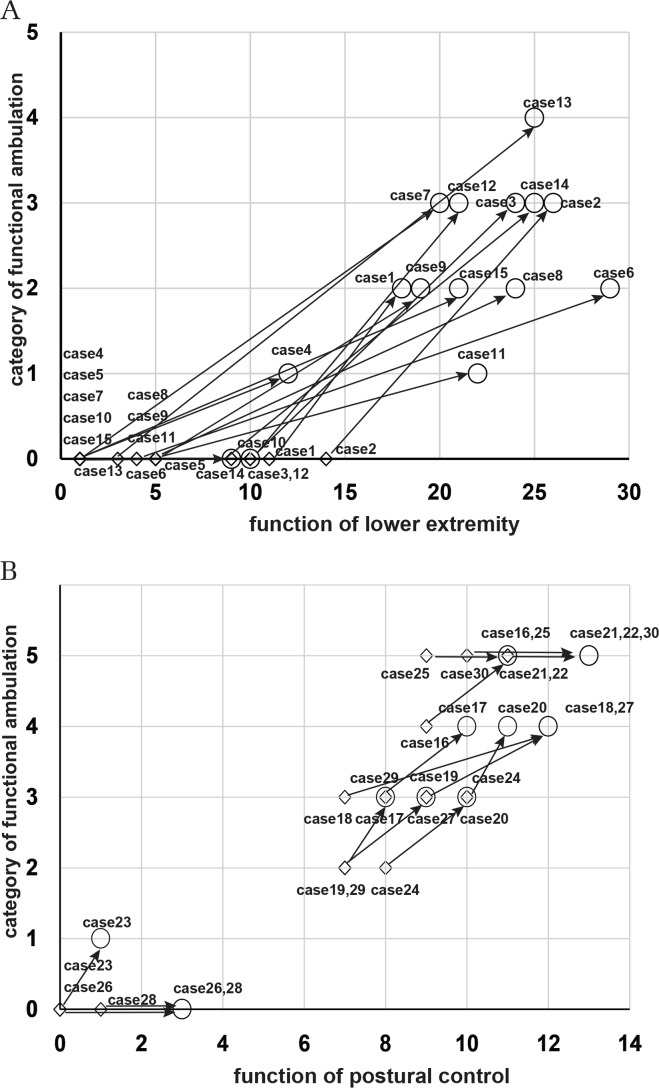
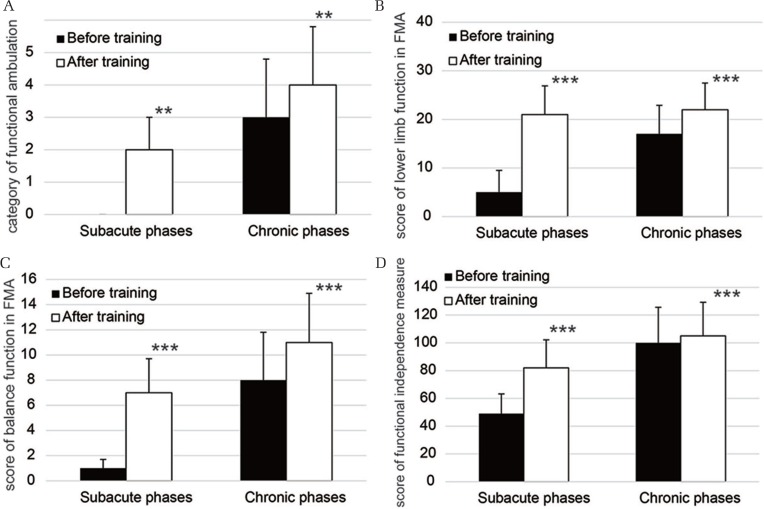
The factors that lead to the improvement of gait function in patients with diseases of the central nervous system (CNS) who use a hybrid assistive limb (HAL) are not yet fully understood. The purpose of the present study was to analyze these factors to determine the prognosis of the patients' gait function. Patients whose CNS disease was within 180 days since onset were designated as the subacute-phase patients, and patients whose disease onset had occurred more than 180 days previously were designated as chronic-phase patients. Fifteen subacute-phase patients and 15 chronic-phase patients were given HAL training. The study analyzed how post-training walking independence in these patients was affected by the following factors: age, disease, lesion area, lower limb function, balance, period until the start of training, number of training sessions, additional rehabilitation, higher-order cognitive dysfunction, HAL model, and the use of a non-weight-bearing walking-aid. In subacute-phase patients, walking independence was related to lower limb function (r = 0.35). In chronic-phase patients, there was a statistically significant correlation between post-training walking independence and balance (r = 0.78). In addition, in patients with a severe motor dysfunction that was accompanied by inattention and global cognitive dysfunction, little improvement occurred, even with double-leg model training, because they had difficulty wearing the device. The results demonstrated that the factors that improved walking independence post HAL training differed between patients with subacute- and chronic-stage CNS diseases. The findings may serve as valuable information for future HAL training of patients with CNS diseases.

摘要

使用混合辅助肢体(HAL)的中枢神经系统(CNS)疾病患者步态功能改善的相关因素尚未完全明确。本研究旨在分析这些因素,以确定患者步态功能的预后情况。将发病180天以内的CNS疾病患者指定为亚急性期患者,发病超过180天的患者指定为慢性期患者。对15例亚急性期患者和15例慢性期患者进行了HAL训练。该研究分析了以下因素如何影响这些患者训练后的步行独立性:年龄、疾病、病变区域、下肢功能、平衡能力、开始训练前的时间、训练次数、额外康复治疗、高阶认知功能障碍、HAL型号以及非负重助行器的使用。在亚急性期患者中,步行独立性与下肢功能相关(r = 0.35)。在慢性期患者中,训练后步行独立性与平衡能力之间存在统计学上的显著相关性(r = 0.78)。此外,对于伴有注意力不集中和整体认知功能障碍的严重运动功能障碍患者,即使进行双腿模型训练,改善也很少,因为他们佩戴设备有困难。结果表明,HAL训练后改善步行独立性的因素在亚急性期和慢性期CNS疾病患者之间存在差异。这些发现可能为未来CNS疾病患者的HAL训练提供有价值的信息。
https://cdn.ncbi.nlm.nih.gov/pmc/blobs/bf4d/5785696/705bcd2d55c2/nmc-58-39-g2.jpg
https://cdn.ncbi.nlm.nih.gov/pmc/blobs/bf4d/5785696/a5eee0af407d/nmc-58-39-g1.jpg
https://cdn.ncbi.nlm.nih.gov/pmc/blobs/bf4d/5785696/705bcd2d55c2/nmc-58-39-g2.jpg
https://cdn.ncbi.nlm.nih.gov/pmc/blobs/bf4d/5785696/a5eee0af407d/nmc-58-39-g1.jpg
https://cdn.ncbi.nlm.nih.gov/pmc/blobs/bf4d/5785696/705bcd2d55c2/nmc-58-39-g2.jpg

相似文献

1
Factors Leading to Improved Gait Function in Patients with Subacute or Chronic Central Nervous System Impairments Who Receive Functional Training with the Robot Suit Hybrid Assistive Limb.接受机器人套装混合辅助肢体功能训练的亚急性或慢性中枢神经系统损伤患者步态功能改善的相关因素
Neurol Med Chir (Tokyo). 2018 Jan 15;58(1):39-48. doi: 10.2176/nmc.oa.2017-0082. Epub 2017 Dec 1.
2
A randomized controlled study incorporating an electromechanical gait machine, the Hybrid Assistive Limb, in gait training of patients with severe limitations in walking in the subacute phase after stroke.一项纳入机电步态机(Hybrid Assistive Limb)的随机对照研究,用于在中风后亚急性期步行严重受限的患者进行步态训练。
PLoS One. 2020 Feb 28;15(2):e0229707. doi: 10.1371/journal.pone.0229707. eCollection 2020.
3
Effects of gait training using the Hybrid Assistive Limb® in recovery-phase stroke patients: A 2-month follow-up, randomized, controlled study.使用混合辅助肢体(HAL)对恢复期脑卒中患者进行步态训练的效果:一项为期2个月的随访、随机、对照研究。
NeuroRehabilitation. 2017;40(3):363-367. doi: 10.3233/NRE-161424.
4
Against the odds: what to expect in rehabilitation of chronic spinal cord injury with a neurologically controlled Hybrid Assistive Limb exoskeleton. A subgroup analysis of 55 patients according to age and lesion level.克服重重困难:使用神经控制的混合辅助肢体外骨骼对慢性脊髓损伤进行康复治疗的预期效果。根据年龄和损伤水平对55例患者进行的亚组分析。
Neurosurg Focus. 2017 May;42(5):E15. doi: 10.3171/2017.2.FOCUS171.
5
Robot-assisted training using Hybrid Assistive Limb® for cerebral palsy.使用混合辅助肢体(HAL)机器人进行的脑瘫辅助训练。
Brain Dev. 2018 Sep;40(8):642-648. doi: 10.1016/j.braindev.2018.04.004. Epub 2018 Jul 14.
6
Gait training of subacute stroke patients using a hybrid assistive limb: a pilot study.使用混合辅助肢体对亚急性中风患者进行步态训练:一项初步研究。
Disabil Rehabil Assist Technol. 2017 Feb;12(2):197-204. doi: 10.3109/17483107.2015.1129455. Epub 2016 Mar 26.
7
Locomotion improvement using a hybrid assistive limb in recovery phase stroke patients: a randomized controlled pilot study.在中风患者康复期使用混合辅助肢体改善运动功能:一项随机对照试验性研究。
Arch Phys Med Rehabil. 2014 Nov;95(11):2006-12. doi: 10.1016/j.apmr.2014.07.002. Epub 2014 Jul 7.
8
The Hybrid Assistive Limb® intervention for a postoperative patient with spinal dural arteriovenous fistula and chronic spinal cord injury: A case study.用于一名患有脊髓硬脊膜动静脉瘘和慢性脊髓损伤的术后患者的混合辅助肢体(HAL)干预:一项病例研究。
J Spinal Cord Med. 2018 Nov;41(6):710-717. doi: 10.1080/10790268.2017.1329916. Epub 2017 May 29.
9
A follow-up study of the effect of training using the Hybrid Assistive Limb on Gait ability in chronic stroke patients.应用 Hybrid Assistive Limb 进行训练对慢性脑卒中患者步态能力的后续研究。
Top Stroke Rehabil. 2019 Oct;26(7):491-496. doi: 10.1080/10749357.2019.1640001. Epub 2019 Jul 18.
10
Efficacy of a hybrid assistive limb in post-stroke hemiplegic patients: a preliminary report.混合辅助肢体在脑卒中偏瘫患者中的疗效:初步报告。
BMC Neurol. 2011 Sep 27;11:116. doi: 10.1186/1471-2377-11-116.

引用本文的文献

1
A Randomized and Controlled Crossover Study Investigating the Improvement of Walking and Posture Functions in Chronic Stroke Patients Using HAL Exoskeleton - The HALESTRO Study (HAL-Exoskeleton STROke Study).一项使用HAL外骨骼研究慢性中风患者步行和姿势功能改善的随机对照交叉研究——HALESTRO研究(HAL外骨骼中风研究)
Front Neurosci. 2019 Mar 29;13:259. doi: 10.3389/fnins.2019.00259. eCollection 2019.

本文引用的文献

1
Gait training with Hybrid Assistive Limb enhances the gait functions in subacute stroke patients: A pilot study.使用混合辅助肢体进行步态训练可增强亚急性中风患者的步态功能:一项初步研究。
NeuroRehabilitation. 2017;40(1):87-97. doi: 10.3233/NRE-161393.
2
Factors Predicting the Effects of Hybrid Assistive Limb Robot Suit during the Acute Phase of Central Nervous System Injury.预测中枢神经系统损伤急性期混合辅助肢体机器人套装效果的因素。
Neurol Med Chir (Tokyo). 2016;56(1):33-7. doi: 10.2176/nmc.oa.2015-0178. Epub 2015 Nov 5.
3
Hybrid Assistive Limb (HAL) Rehabilitation in Patients with Acute Hemorrhagic Stroke.
急性出血性中风患者的混合辅助肢体(HAL)康复治疗
Neurol Med Chir (Tokyo). 2015;55(12):901-6. doi: 10.2176/nmc.oa.2015-0209. Epub 2015 Oct 28.
4
Tailor-made rehabilitation approach using multiple types of hybrid assistive limb robots for acute stroke patients: A pilot study.针对急性中风患者使用多种类型混合辅助肢体机器人的定制康复方法:一项试点研究。
Assist Technol. 2016 Spring;28(1):53-6. doi: 10.1080/10400435.2015.1080768.
5
Cerebellar Contribution to Pattern Separation of Human Hippocampal Memory Circuits.小脑对人类海马体记忆回路模式分离的作用
Cerebellum. 2016 Dec;15(6):645-662. doi: 10.1007/s12311-015-0726-0.
6
HAL® exoskeleton training improves walking parameters and normalizes cortical excitability in primary somatosensory cortex in spinal cord injury patients.HAL®外骨骼训练可改善脊髓损伤患者的行走参数,并使初级体感皮层的皮质兴奋性恢复正常。
J Neuroeng Rehabil. 2015 Aug 20;12:68. doi: 10.1186/s12984-015-0058-9.
7
Feasibility and efficacy of high-speed gait training with a voluntary driven exoskeleton robot for gait and balance dysfunction in patients with chronic stroke: nonrandomized pilot study with concurrent control.使用自主驱动外骨骼机器人进行高速步态训练对慢性卒中患者步态和平衡功能障碍的可行性及疗效:一项设有同期对照的非随机试验研究
Int J Rehabil Res. 2015 Dec;38(4):338-43. doi: 10.1097/MRR.0000000000000132.
8
Effectiveness of Acute Phase Hybrid Assistive Limb Rehabilitation in Stroke Patients Classified by Paralysis Severity.按瘫痪严重程度分类的中风患者急性期混合辅助肢体康复的有效性。
Neurol Med Chir (Tokyo). 2015;55(6):487-92. doi: 10.2176/nmc.oa.2014-0431. Epub 2015 Jun 2.
9
Clinical application of the Hybrid Assistive Limb (HAL) for gait training-a systematic review.混合辅助肢体(HAL)在步态训练中的临床应用——一项系统综述。
Front Syst Neurosci. 2015 Mar 25;9:48. doi: 10.3389/fnsys.2015.00048. eCollection 2015.
10
Effects of Robot-assisted Gait Training Combined with Functional Electrical Stimulation on Recovery of Locomotor Mobility in Chronic Stroke Patients: A Randomized Controlled Trial.机器人辅助步态训练联合功能性电刺激对慢性卒中患者运动功能恢复的影响:一项随机对照试验
J Phys Ther Sci. 2014 Dec;26(12):1949-53. doi: 10.1589/jpts.26.1949. Epub 2014 Dec 25.