Division of Rehabilitation Medicine, Department of Clinical Sciences, Danderyd Hospital, Karolinska Institutet, Stockholm, Sweden.
PLoS One. 2020 Feb 28;15(2):e0229707. doi: 10.1371/journal.pone.0229707. eCollection 2020.
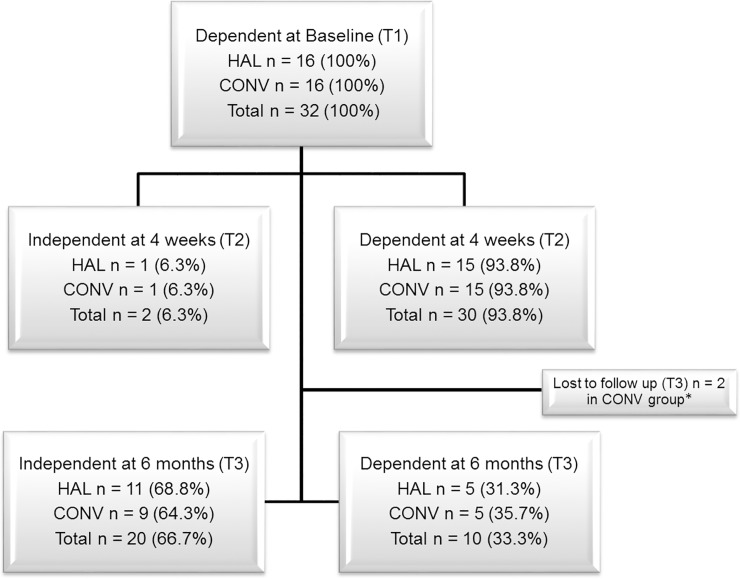
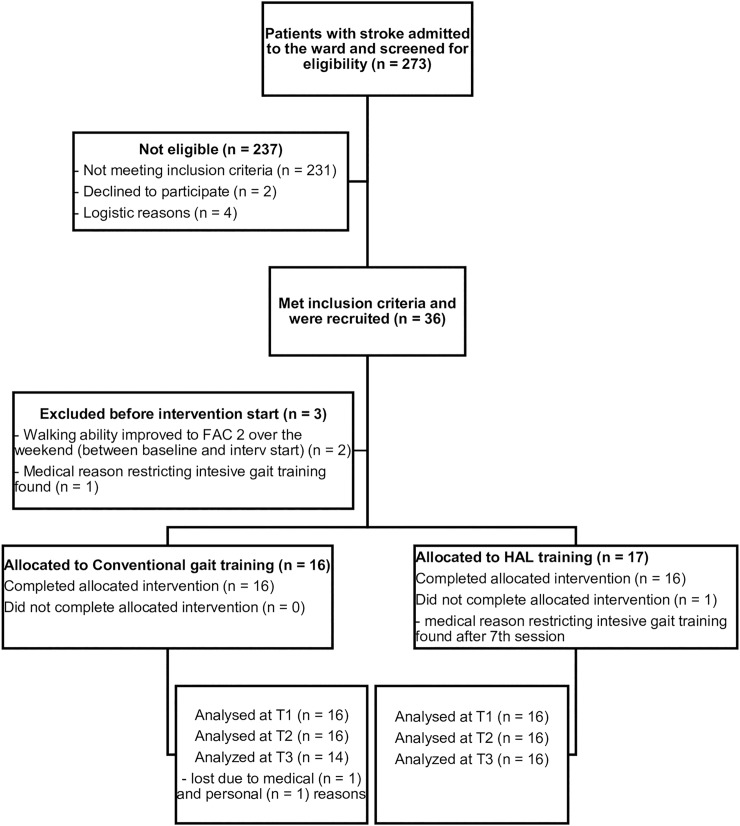
Early onset, intensive and repetitive, gait training may improve outcome after stroke but for patients with severe limitations in walking, rehabilitation is a challenge. The Hybrid Assistive Limb (HAL) is a gait machine that captures voluntary actions and support gait motions. Previous studies of HAL indicate beneficial effects on walking, but these results need to be confirmed in blinded, randomized controlled studies. This study aimed to explore effects of incorporating gait training with HAL as part of an inpatient rehabilitation program after stroke. Thirty-two subacute stroke patients with severe limitations in walking were randomized to incorporated HAL training (4 days/week for 4 weeks) or conventional gait training only. Blinded assessments were carried out at baseline, after the intervention, and at 6 months post stroke. The primary outcome was walking independence according to the Functional Ambulation Categories. Secondary outcomes were the Fugl-Meyer Assessment, 2-Minute Walk Test, Berg Balance Scale, and the Barthel Index. No significant between-group differences were found regarding any primary or secondary outcomes. At 6 months, two thirds of all patients were independent in walking. Prediction of independent walking at 6 months was not influenced by treatment group, but by age (OR 0.848, CI 0.719-0.998, p = 0.048). This study found no difference between groups for any outcomes despite the extra resources required for the HAL training, but highlights the substantial improvements in walking seen when evidence-based rehabilitation is provided to patients, with severe limitations in walking in the subacute stage after stroke. In future studies potential subgroups of patients who will benefit the most from electromechanically-assisted gait training should be explored.
早期、强化和重复的步态训练可能改善中风后的预后,但对于行走严重受限的患者,康复是一项挑战。混合辅助肢体(HAL)是一种步态机器,可以捕捉到自主动作并支持步态运动。HAL 的先前研究表明对行走有有益的影响,但这些结果需要在盲法、随机对照研究中得到证实。本研究旨在探讨将步态训练与 HAL 结合作为中风后住院康复计划的一部分的效果。32 名行走严重受限的亚急性中风患者随机分为接受 HAL 训练组(每周 4 天,共 4 周)或仅接受常规步态训练组。在基线、干预后和中风后 6 个月进行盲法评估。主要结局是根据功能步行分类评估的行走独立性。次要结局是 Fugl-Meyer 评估、2 分钟步行测试、伯格平衡量表和巴氏指数。主要或次要结局均未发现两组间有显著差异。在 6 个月时,所有患者中有三分之二能够独立行走。6 个月时独立行走的预测不受治疗组的影响,但受年龄的影响(OR 0.848,CI 0.719-0.998,p = 0.048)。尽管 HAL 训练需要额外的资源,但本研究发现两组之间在任何结果上都没有差异,但强调了在亚急性期为严重行走受限的中风患者提供基于证据的康复治疗时,行走能力会有显著改善。在未来的研究中,应探索最受益于机电辅助步态训练的患者的潜在亚组。