Iida Shuhei, Kawakita Dai, Fujita Takuya, Uematsu Hirohumi, Kotaki Takahisa, Ikeda Kikuko, Aoki Chikara
Department of Physical Therapy, Faculty of Medical Science for Health, Teikyo Heisei University: 2-51-4 Higashi-Ikebukuro, Toshima-ku, Tokyo 170-8445, Japan.
Graduate School of Science for Health, Teikyo Heisei University, Japan.
J Phys Ther Sci. 2017 Nov;29(11):1920-1924. doi: 10.1589/jpts.29.1920. Epub 2017 Nov 24.
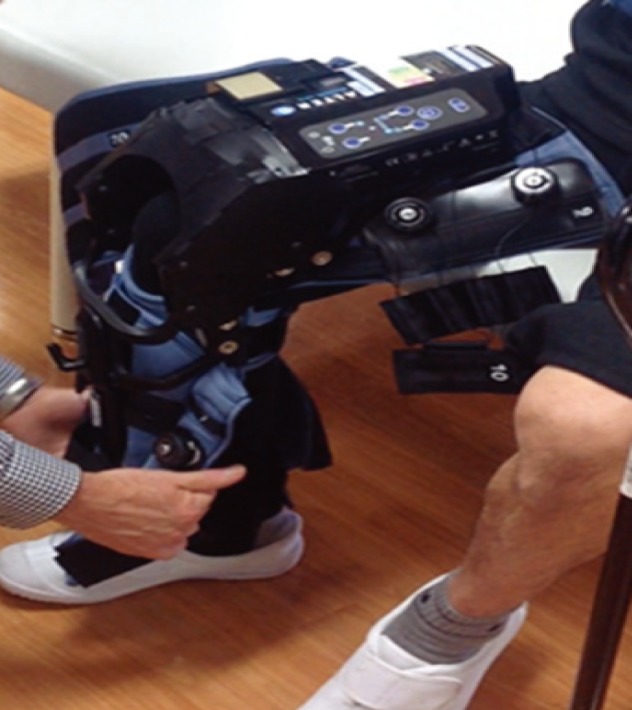
[Purpose] The Robotics Knee Orthosis (RKO) is a knee-ankle-foot orthosis with active robot assisting technology. The purpose of this study is to examine the effects of exercise with the RKO (RKO-exercise) in stroke patients with hemiplegia. [Subjects and Methods] Participants were nine stroke patients with hemiplegia, residing in a convalescent rehabilitation ward. The duration of the RKO-exercise program was 10 days. Participants were evaluated three times prior to intervention, once after intervention, and one month post intervention. Each session consisted of standard-of-care physical therapy for 60 minutes and RKO-exercise for 20 minutes. Dependent variables were 10-meter gait speed, cadence, Berg Balance Scale (BBS) score, stride length, the absolute value of left-right symmetry of the step length, and one-leg support period while walking. Data were analyzed using a one-way repeated measures ANOVA. [Results] Stride length, left-right symmetry of the step length, and one-leg support period while walking changed following the RKO exercise program. 10-meter walking speed, cadence, percentage of one-leg support period (affected side), and BBS changed significantly at one month post treatment time points. [Conclusion] It is expected that RKO-exercise helps recovery process after the stroke. RKO-exercise effectively treats impaired mobility in patient status-post stroke.
[目的] 机器人膝关节矫形器(RKO)是一种具备主动机器人辅助技术的膝-踝-足矫形器。本研究旨在探讨使用RKO进行运动训练(RKO训练)对偏瘫中风患者的影响。[对象与方法] 研究对象为9名居住在康复疗养病房的偏瘫中风患者。RKO训练计划为期10天。在干预前对参与者进行3次评估,干预后进行1次评估,干预后1个月再进行1次评估。每次训练包括60分钟的标准护理物理治疗和20分钟的RKO训练。因变量包括10米步行速度、步频、伯格平衡量表(BBS)评分、步长、步长左右对称性的绝对值以及步行时的单腿支撑期。数据采用单因素重复测量方差分析进行分析。[结果] 步长、步长左右对称性以及步行时的单腿支撑期在RKO训练计划后发生了变化。在治疗后1个月的时间点,10米步行速度、步频、患侧单腿支撑期百分比以及BBS评分有显著变化。[结论] 预计RKO训练有助于中风后的恢复过程。RKO训练能有效治疗中风后患者的运动功能障碍。