School of Sport, Health & Community, University of Winchester, Winchester, UK.
School of Sport & Exercise, University of Gloucestershire, Gloucester, UK.
Clin Rehabil. 2021 Jun;35(6):882-893. doi: 10.1177/0269215520984133. Epub 2020 Dec 27.
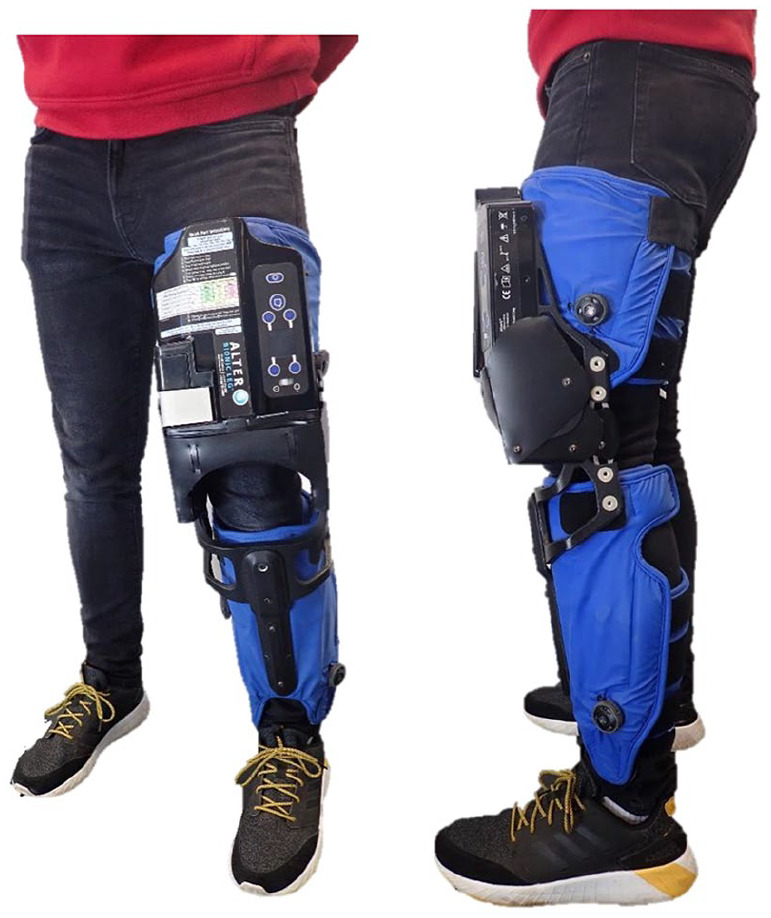
To assess the effect of a home-based over-ground robotic-assisted gait training program using the AlterG Bionic Leg orthosis on clinical functional outcomes in people with chronic stroke.
Randomized controlled trial.
Home.
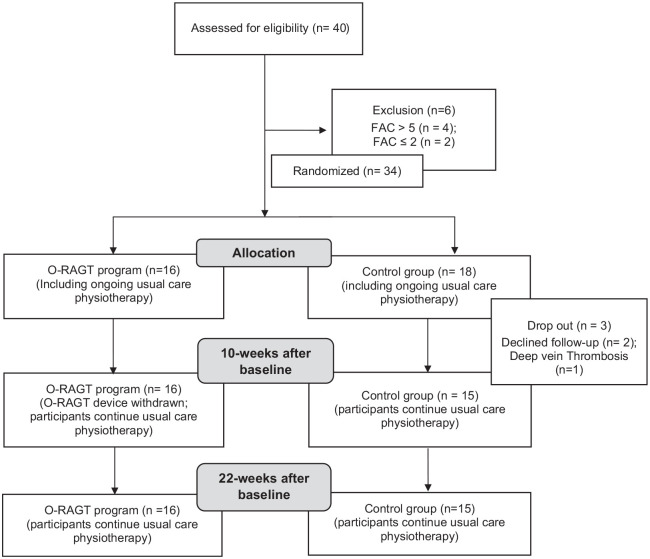
Thirty-four ambulatory chronic stroke patients who recieve usual physiotherapy.
Usual physiotherapy plus either (1)10-week over-ground robotic-assisted gait training program ( = 16), using the device for ⩾30 minutes per day, or (2) control group ( = 18), 30 minutes of physical activity per day.
The primary outcome was the Six-Minute Walk Test. Secondary outcomes included: Timed-Up-and-Go, Functional Ambulation Categories, Dynamic Gait Index and Berg Balance Scale. Physical activity and sedentary time were assessed using accelerometry. All measurements were completed at baseline, 10 and 22 weeks after baseline.
Significant increases in walking distance were observed for the Six-Minute Walk Test between baseline and 10 weeks for over-ground robotic-assisted gait training (135 ± 81 m vs 158 ± 93 m, respectively; ⩽ 0.001) but not for control (122 ± 92 m vs 119 ± 84 m, respectively). Findings were similar for Functional Ambulation Categories, Dynamic Gait Index and Berg Balance Scale (all ⩽ 0.01). For over-ground robotic-assisted gait training, there were increases in time spent stepping, number of steps taken, number of sit-to-stand transitions, and reductions in time spent sitting/supine between baseline and 10 weeks (all < 0.05). The differences observed in all of the aforementioned outcome measures were maintained at 22 weeks, 12 weeks after completing the intervention (all > 0.05).
Over-ground robotic-assisted gait training combined with physiotherapy in chronic stroke patients led to significant improvements in clinical functional outcomes and physical activity compared to the control group. Improvements were maintained at 22 weeks.
评估使用 AlterG Bionic Leg 矫形器进行基于家庭的地面机器人辅助步态训练对慢性脑卒中患者临床功能结局的影响。
随机对照试验。
家庭。
34 名有步行能力的慢性脑卒中患者,接受常规物理治疗。
常规物理治疗加(1)10 周地面机器人辅助步态训练计划(n=16),每天使用设备 ⩾30 分钟,或(2)对照组(n=18),每天 30 分钟体育活动。
主要结局是 6 分钟步行测试。次要结局包括:计时起立行走测试、功能性步行分类、动态步态指数和伯格平衡量表。使用加速度计评估身体活动和久坐时间。所有测量均在基线、10 周和 22 周后进行。
地面机器人辅助步态训练组在 6 分钟步行测试中,与基线相比,10 周时的步行距离显著增加(分别为 135 ⁇ 81m 与 158 ⁇ 93m, ⩽ 0.001),但对照组没有(分别为 122 ⁇ 92m 与 119 ⁇ 84m, ⩽ 0.001)。功能性步行分类、动态步态指数和伯格平衡量表的结果也相似(均为 ⩽ 0.01)。对于地面机器人辅助步态训练组,与基线相比,10 周时的踏步时间、踏步次数、坐站转换次数增加,而坐/仰卧时间减少(均为 ⩽ 0.05)。干预结束后 12 周(22 周)时,所有上述结局指标的差异均保持不变(均为 ⩾ 0.05)。
与对照组相比,慢性脑卒中患者接受物理治疗联合地面机器人辅助步态训练可显著改善临床功能结局和身体活动水平。改善效果在 22 周时仍保持。