Kim Jung-In, Park Ji-Hye, Choi Ju-Yeon, Lee Ga-Young, Kim Won-Serk
Department of Dermatology, Kangbuk Samsung Hospital, Sungkyunkwan University School of Medicine, Seoul, Korea.
Ann Dermatol. 2017 Dec;29(6):768-775. doi: 10.5021/ad.2017.29.6.768. Epub 2017 Oct 30.
Automated analyzer-based nontreponemal serological tests for syphilis (STS) have been used for several decades.
In this study, we evaluated serological responses to treatment and proposed clinical guidelines for automated STS.
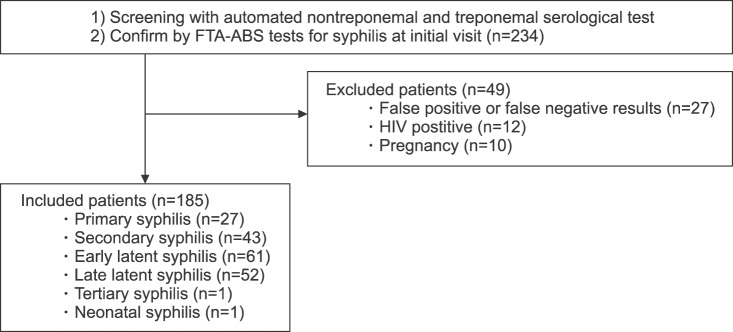
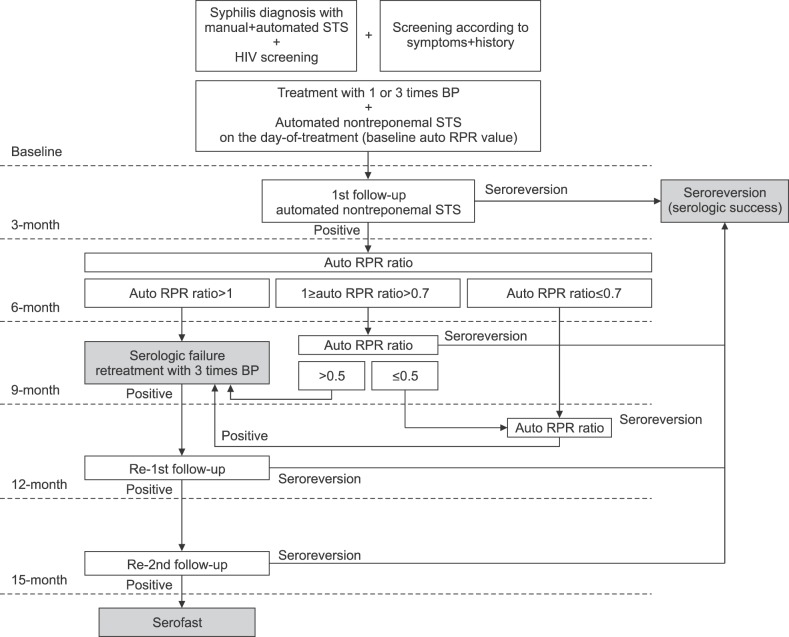
This retrospective cohort study analyzed human immunodeficiency virus-negative syphilis patients who were diagnosed with automated rapid plasma reagin (auto RPR) tests as a nontreponemal STS, and who also received the fluorescent treponemal antibody-absorption test as a confirmatory test. The ratio of auto RPR values after treatment against those at baseline was defined as the auto RPR ratio for the analysis of the serological response to treatment. The cutoff value for reliable seroreversion prediction was assessed with receiver-operating-characteristic curves.
Overall, 89.7% of participants (78/87) seroreverted and 10.3% of participants (9/87) remained serofast during the two-year follow-up period. We were unable to describe trends in the changes among auto RPR values within six months after treatment because of high variation. All of the patients who had an auto RPR ratio ≥1.0 after six months continuously had positive serologic results during their 24-month follow-up and were classified as a serofast group. The receiver-operating-characteristic curves revealed a 25% reduction in auto RPR values nine months after treatment and predicted seroreversion with a sensitivity of 96.2% and a specificity of 100%.
The most important primary checkpoint for syphilis treatment response is an increase in automated nontreponemal STS six months after treatment. Thus, we recommend monitoring the treatment response with an auto RPR.
基于自动分析仪的梅毒非梅毒螺旋体血清学检测(STS)已使用数十年。
在本研究中,我们评估了对治疗的血清学反应,并提出了自动STS的临床指南。
这项回顾性队列研究分析了人类免疫缺陷病毒阴性的梅毒患者,这些患者通过自动快速血浆反应素(auto RPR)检测被诊断为非梅毒螺旋体STS,并且还接受了荧光梅毒螺旋体抗体吸收试验作为确证试验。治疗后auto RPR值与基线值的比值被定义为用于分析治疗血清学反应的auto RPR比值。通过受试者操作特征曲线评估可靠血清学转阴预测的临界值。
总体而言,在两年的随访期内,89.7%的参与者(78/87)血清学转阴,10.3%的参与者(9/87)血清固定。由于变化较大,我们无法描述治疗后六个月内auto RPR值变化的趋势。所有在六个月后auto RPR比值≥1.0的患者在其24个月的随访期间血清学结果持续为阳性,并被归类为血清固定组。受试者操作特征曲线显示治疗九个月后auto RPR值降低了25%,预测血清学转阴的灵敏度为96.2%,特异度为100%。
梅毒治疗反应最重要的主要检查点是治疗后六个月自动非梅毒螺旋体STS升高。因此,我们建议使用auto RPR监测治疗反应。