Feng Shu-De, Mao Ziming, Liu Chunying, Nie Yu-Song, Sun Bin, Guo Minggao, Su Changqing
Department of General Surgery, Jiangsu Armed Police General Hospital, Yangzhou, Jiangsu, China.
Department of Molecular Oncology, Eastern Hepatobiliary Surgical Hospital, National Center of Liver Cancer, Second Military Medical University, Shanghai, China.
Onco Targets Ther. 2017 Nov 23;10:5591-5604. doi: 10.2147/OTT.S149632. eCollection 2017.
Pancreatic adenocarcinoma (PAC) is one of the most fatal cancers due to its high degree of malignancy, increasing incidence, high mortality, and unsatisfactory treatment efficacy. Evidence has suggested that numerous microRNAs (miRNAs), including miR-126 and miR-34a, have potent tumor-suppressing effects on PAC, implicating a possible application of miRNA in tumor therapy. However, the therapeutic effect of a single miRNA on pancreatic cancer is limited.
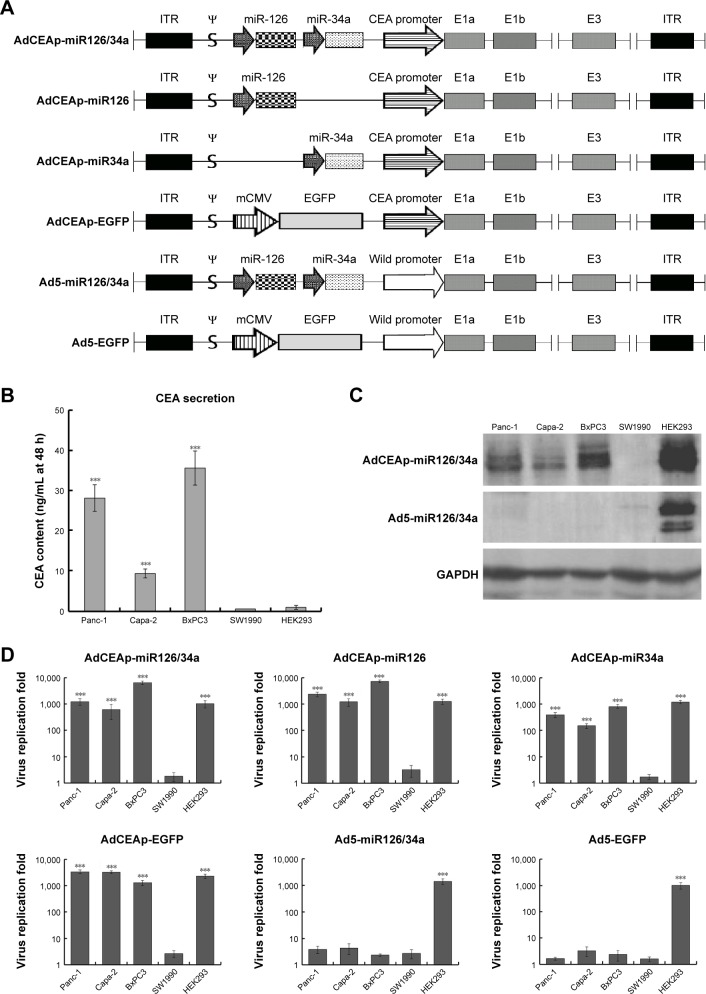
We simultaneously delivered miR-126 and miR-34a into PAC cells by a carcinoembryonic antigen promoter-driven oncolytic adenovirus (AdCEAp-miR126/34a), and examined the antitumor efficacy of the therapeutic system in in vitro and in vivo experiments.
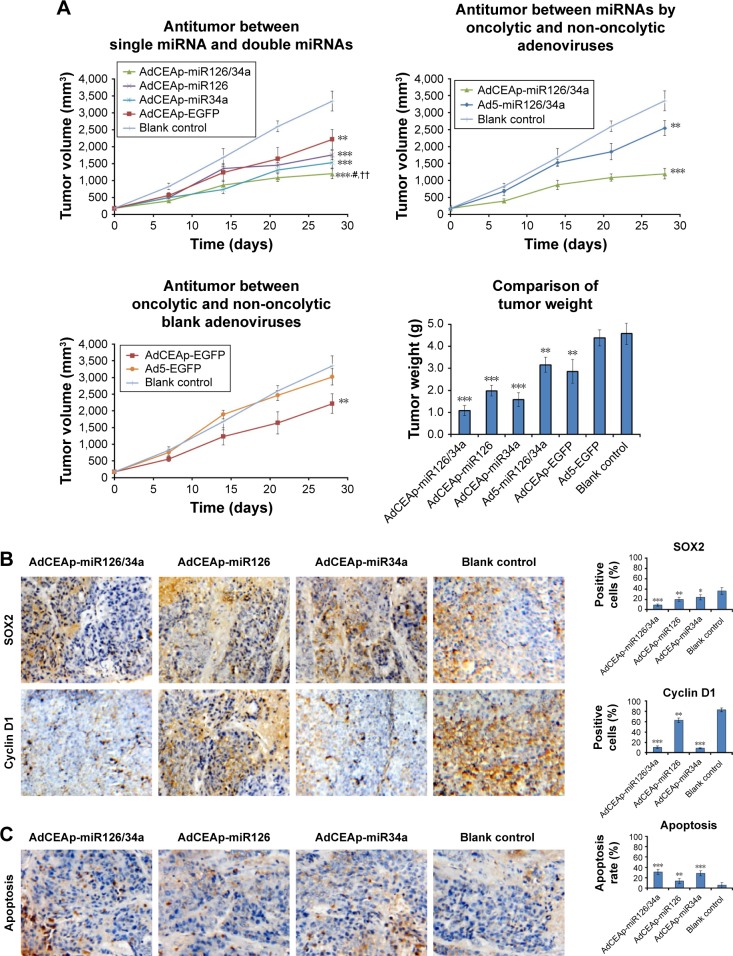
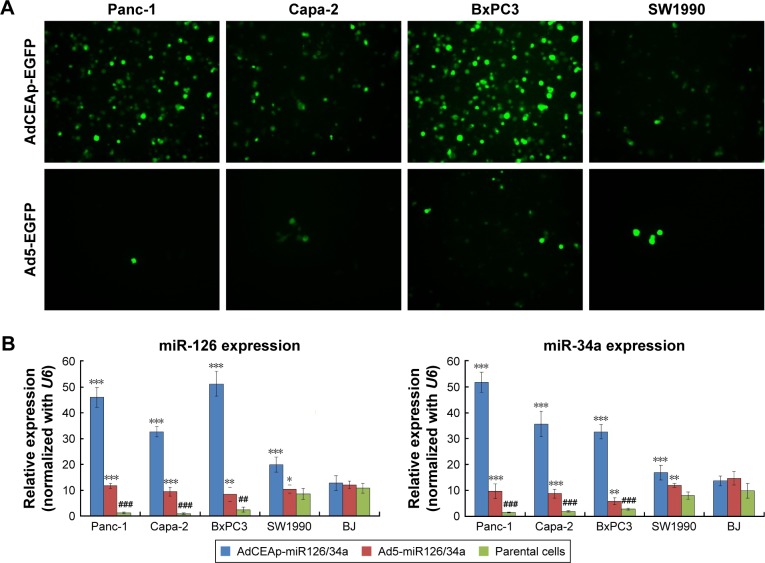
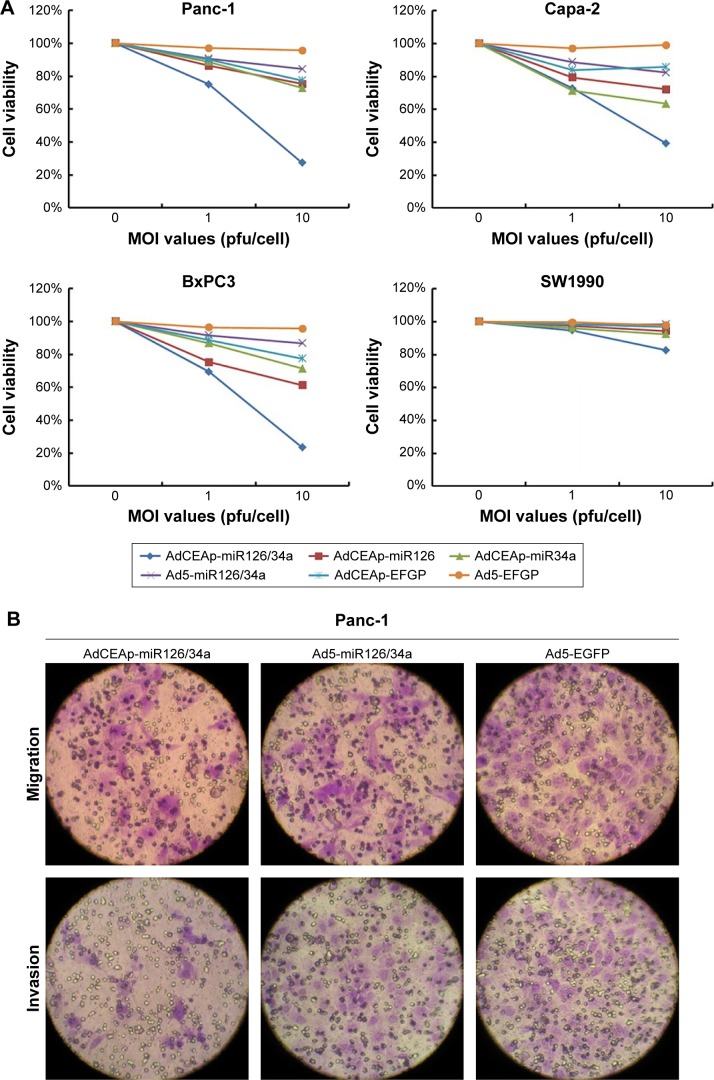
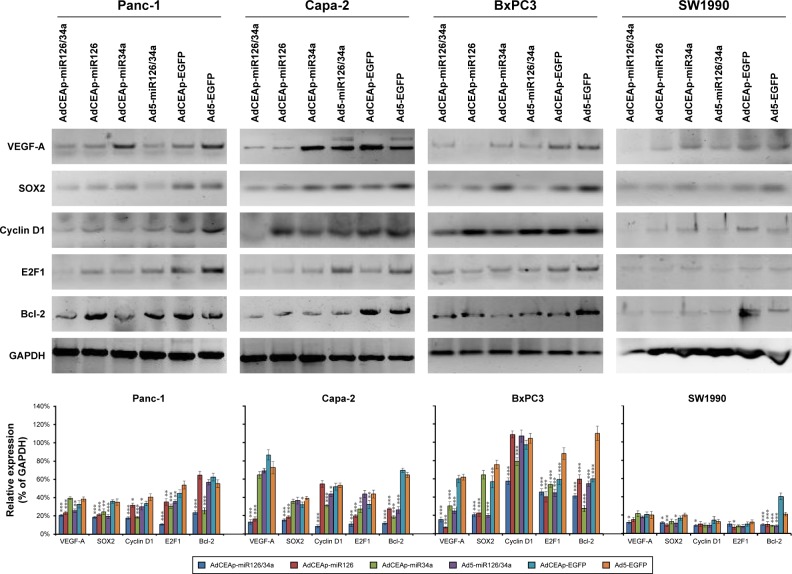
In vitro cytological experiments found that the expression levels of miR-126 and miR-34a were specifically increased in the AdCEAp-miR126/34a-infected PAC cells, and the antitumor efficacy was enhanced in aspects of cancer cell viability, migration, invasion, and apoptosis, by synergistically combining the antitumor effects of overexpressed miR-126 and miR-34a and the oncolytic effect of viral replication specifically in PAC cells. The expression levels of miR-126 target genes ( and ) and miR-34a target genes (, , and ) were markedly decreased in the PAC cells after being infected with AdCEAp-miR126/34a. Notable suppression of the therapeutic system on tumor growth was also proven in established PAC xenograft tumor models in nude mice, which demonstrated that the combination of miR-126 and miR-34a exerts more effective antitumor outcomes than a single miRNA.
The therapeutic system co-expressing miR-126 and miR-34a mediated by oncolytic adenovirus is a promising system for PAC target therapy.
胰腺腺癌(PAC)因其高度恶性、发病率上升、高死亡率及治疗效果不理想,成为最致命的癌症之一。有证据表明,包括miR-126和miR-34a在内的众多微小RNA(miRNA)对PAC具有强大的肿瘤抑制作用,这暗示了miRNA在肿瘤治疗中可能的应用。然而,单一miRNA对胰腺癌的治疗效果有限。
我们通过癌胚抗原启动子驱动的溶瘤腺病毒(AdCEAp-miR126/34a)将miR-126和miR-34a同时导入PAC细胞,并在体外和体内实验中检测该治疗系统的抗肿瘤效果。
体外细胞学实验发现,在AdCEAp-miR126/34a感染的PAC细胞中,miR-126和miR-34a的表达水平特异性升高,通过协同增强过表达的miR-126和miR-34a的抗肿瘤作用以及病毒复制在PAC细胞中的溶瘤作用,在癌细胞活力、迁移、侵袭和凋亡方面增强了抗肿瘤效果。在感染AdCEAp-miR126/34a后的PAC细胞中,miR-126靶基因(和)以及miR-34a靶基因(、和)的表达水平显著降低。在建立的裸鼠PAC异种移植瘤模型中也证实了该治疗系统对肿瘤生长有显著抑制作用,这表明miR-126和miR-34a联合使用比单一miRNA具有更有效的抗肿瘤效果。
溶瘤腺病毒介导的共表达miR-126和miR-34a的治疗系统是一种有前景的PAC靶向治疗系统。