Markowitz Daniel, Ha Grace, Ruggieri Rosamaria, Symons Marc
Hofstra Northwell School of Medicine, Hempstead.
Karches Center for Oncology Research, Feinstein Institute for Medical Research, Manhasset, NY, USA.
Onco Targets Ther. 2017 Nov 24;10:5633-5642. doi: 10.2147/OTT.S143096. eCollection 2017.
The cytotoxic effects of microtubule-targeting agents (MTAs) are often attributed to targeted effects on mitotic cells. In clinical practice, MTAs are combined with DNA-damaging agents such as ionizing radiation (IR) with the rationale that mitotic cells are highly sensitive to DNA damage. In contrast, recent studies suggest that MTAs synergize with IR by interfering with the trafficking of DNA damage response (DDR) proteins during interphase. These studies, however, have yet to demonstrate the functional consequences of interfering with interphase microtubules in the presence of IR. To address this, we combined IR with an established MTA, mebendazole (MBZ), to treat glioma cells exclusively during interphase.
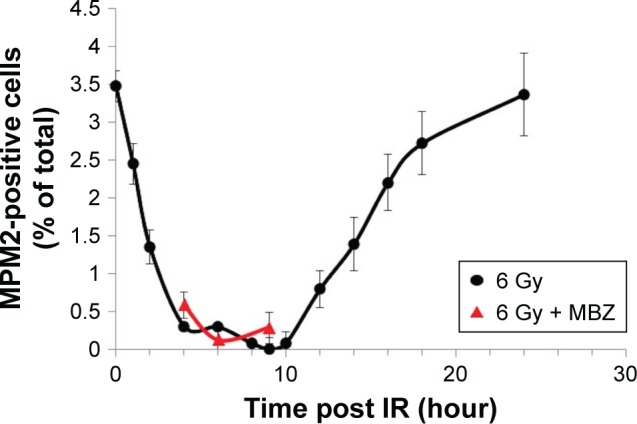
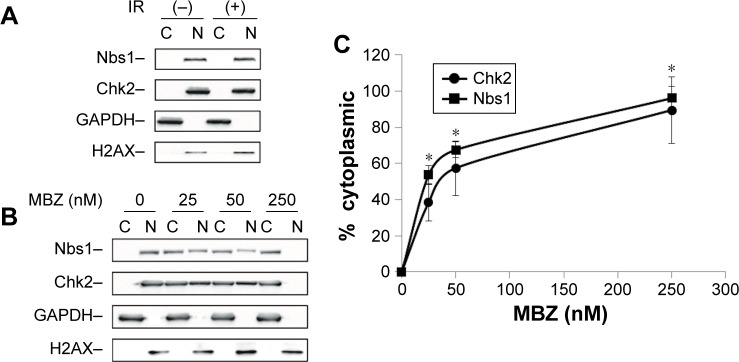
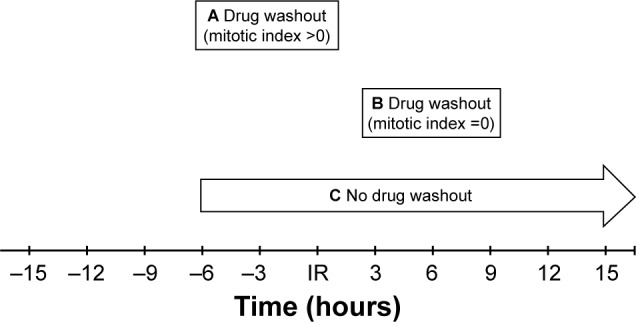
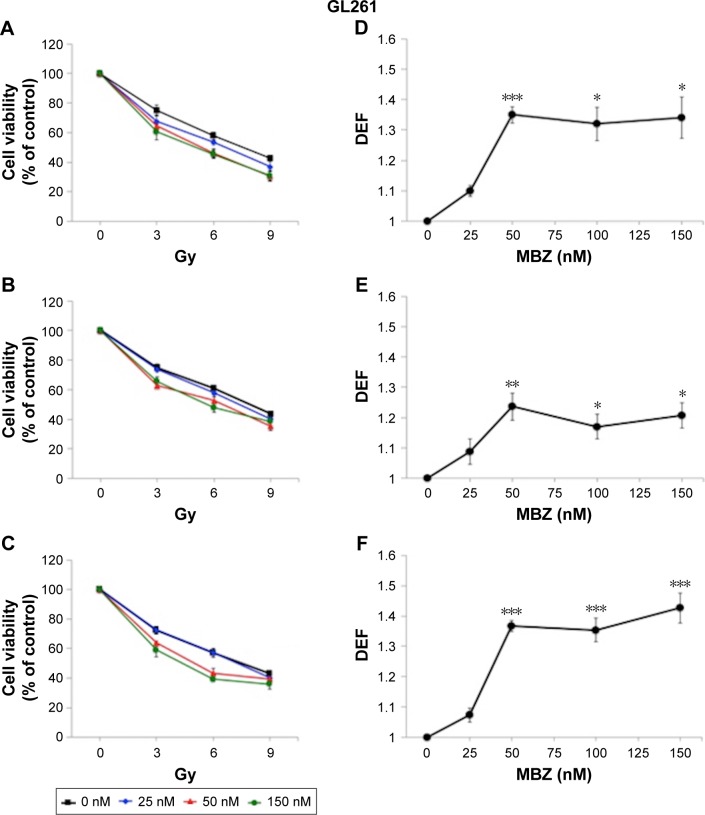
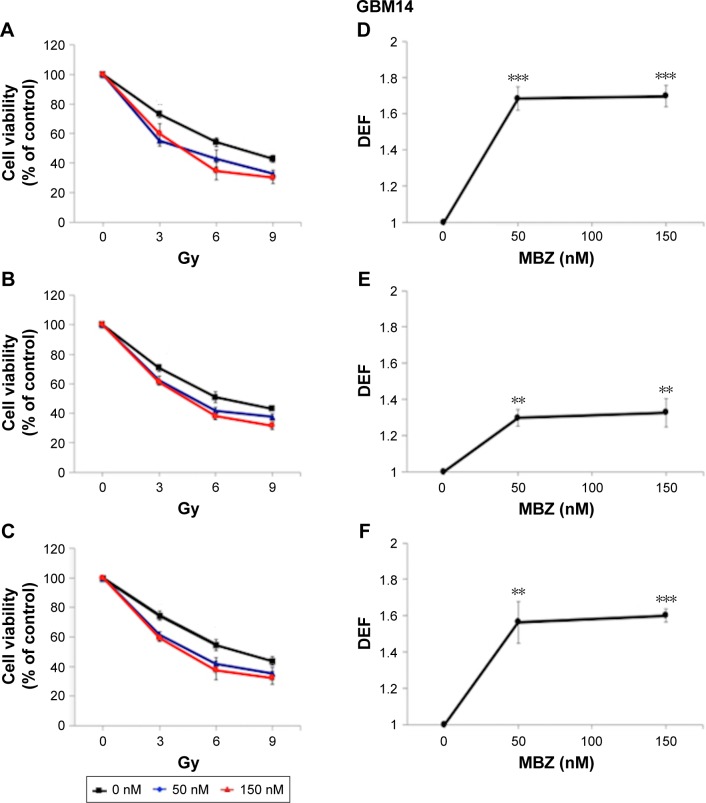
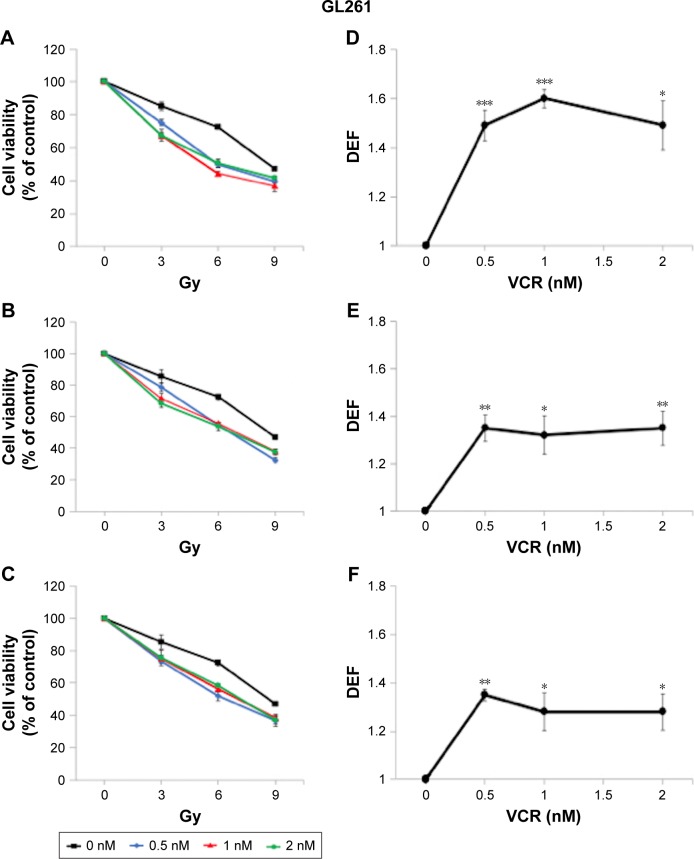
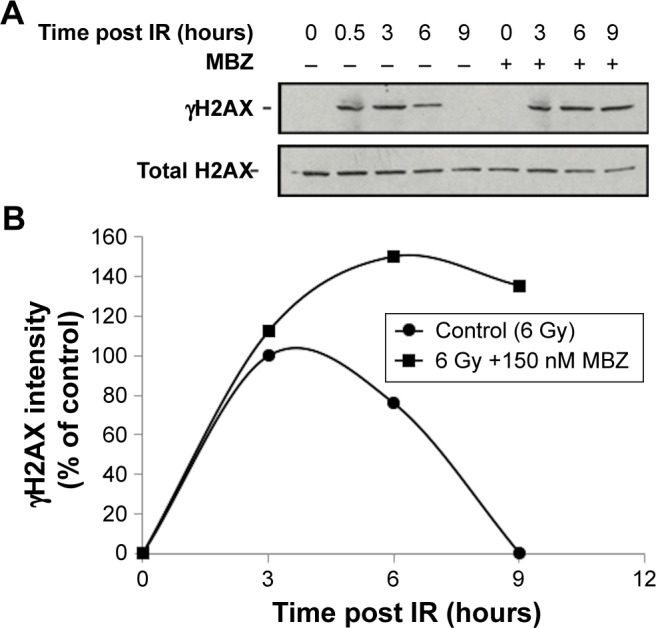
To test whether MTAs can sensitize interphase cells to IR, we treated GL261 and GBM14 glioma cells with MBZ during 3-9 hours post IR (when the mitotic index was 0%). Cell viability was measured using a WST-1 assay, and radiosensitization was quantified using the dose enhancement factor (DEF). The effect of MBZ on the DDR was studied via Western blot analysis of H2AX phosphorylation. To examine the effects of MTAs on intracellular transport of DDR proteins, Nbs1 and Chk2, cytoplasmic and nuclear fractionation studies were conducted following treatment of glioma cells with MBZ.
Treatment with MBZ sensitized interphase cells to the effects of IR, with a maximal DEF of 1.34 in GL261 cells and 1.69 in GBM14 cells. Treatment of interphase cells with MBZ led to more sustained γH2AX levels post IR, indicating a delay in the DDR. Exposure of glioma cells to MBZ resulted in a dose-dependent sequestration of Chk2 and Nbs1 in the cytoplasm.
This study demonstrates that MBZ can sensitize cancer cells to IR independently of the induction of mitotic arrest. In addition, evidence is provided supporting the hypothesis that MTA-induced radiosensitization is mediated by inhibiting DDR protein accumulation into the nucleus.
微管靶向剂(MTA)的细胞毒性作用通常归因于对有丝分裂细胞的靶向作用。在临床实践中,MTA与DNA损伤剂如电离辐射(IR)联合使用,其理论依据是有丝分裂细胞对DNA损伤高度敏感。相比之下,最近的研究表明,MTA通过在间期干扰DNA损伤反应(DDR)蛋白的运输与IR产生协同作用。然而,这些研究尚未证明在存在IR的情况下干扰间期微管的功能后果。为了解决这个问题,我们将IR与一种已确立的MTA甲苯咪唑(MBZ)联合使用,专门在间期处理胶质瘤细胞。
为了测试MTA是否能使间期细胞对IR敏感,我们在IR后3 - 9小时(有丝分裂指数为0%时)用MBZ处理GL261和GBM14胶质瘤细胞。使用WST - 1测定法测量细胞活力,并使用剂量增强因子(DEF)对放射增敏作用进行定量。通过对H2AX磷酸化的蛋白质印迹分析研究MBZ对DDR的影响。为了检查MTA对DDR蛋白细胞内运输的影响,在用MBZ处理胶质瘤细胞后进行Nbs1和Chk2的细胞质和细胞核分级分离研究。
用MBZ处理使间期细胞对IR的作用敏感,在GL261细胞中最大DEF为1.34,在GBM14细胞中为1.69。用MBZ处理间期细胞导致IR后γH2AX水平更持久,表明DDR延迟。胶质瘤细胞暴露于MBZ导致Chk2和Nbs1在细胞质中剂量依赖性隔离。
本研究表明,MBZ可使癌细胞对IR敏感,而与有丝分裂停滞的诱导无关。此外,提供的证据支持以下假设:MTA诱导的放射增敏作用是通过抑制DDR蛋白在细胞核中的积累介导的。