Ashtary-Larky Damoon, Ghanavati Matin, Lamuchi-Deli Nasrin, Payami Seyedeh Arefeh, Alavi-Rad Sara, Boustaninejad Mehdi, Afrisham Reza, Abbasnezhad Amir, Alipour Meysam
Department of Clinical Biochemistry, School of Medicine, Ahvaz Jundishapur University of Medical Sciences, Ahvaz, Iran.
Student Research Committee, Ahvaz Jundishapur University of Medical Sciences, Ahvaz, Iran.
Int J Endocrinol Metab. 2017 May 17;15(3):e13249. doi: 10.5812/ijem.13249. eCollection 2017 Jul.
Achieving weight loss (WL) in a short time regardless of its consequences has always been the focus of many obese and overweight people. In this study, anthropometric and metabolic effects of two diets for rapid and slow WL and their consequences were examined.
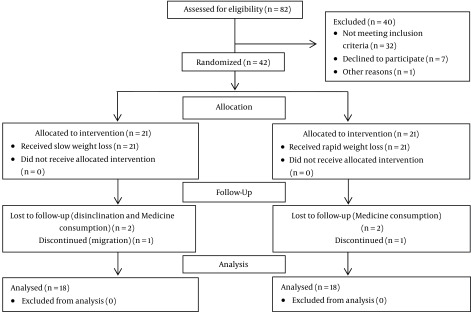
Forty-two obese and overweight individuals were randomly divided to 2 groups; rapid WL (weight loss of at least 5% in 5 weeks) and slow WL (weight loss of at least 5% in 15 weeks). To compare the effects of the rate of WL in 2 groups, the same amount of was achieved with different durations. Anthropometric indices, lipid, and glycemic profiles, and systolic and diastolic blood pressures were evaluated before and after the intervention.
Both protocols of rapid WL and slow WL caused reduction in waist circumference, hip circumference, total body water, body fat mass, lean body mass, and resting metabolic rate (RMR). Further reduction in waist circumference, hip circumference, fat mass, and percentage of body fat was observed in slow WL and decreased total body water, lean body mass, fat free mass, and RMR was observed in rapid WL. Improvement in lipid and glycemic profiles was observed in both groups. Reduction of low-density lipoprotein and fasting blood sugar, improvement of insulin resistance, and sensitivity were more significant in rapid WL in comparison to slow WL.
Weight Loss regardless of its severity could improve anthropometric indicators, although body composition is more favorable following a slow WL. Both diets improved lipid and glycemic profiles. In this context, rapid WL was more effective. (IRCT2016010424699N2).
在短时间内实现体重减轻(WL)而不顾其后果一直是许多肥胖和超重人群关注的焦点。在本研究中,对两种用于快速和缓慢体重减轻的饮食的人体测量学和代谢效应及其后果进行了研究。
42名肥胖和超重个体被随机分为两组;快速体重减轻组(5周内体重减轻至少5%)和缓慢体重减轻组(15周内体重减轻至少5%)。为了比较两组体重减轻速度的影响,通过不同的持续时间实现了相同的减重幅度。在干预前后评估人体测量指标、血脂和血糖谱以及收缩压和舒张压。
快速体重减轻和缓慢体重减轻方案均导致腰围、臀围、总体水、体脂质量、瘦体重和静息代谢率(RMR)降低。在缓慢体重减轻组中观察到腰围、臀围、脂肪量和体脂百分比进一步降低,而在快速体重减轻组中观察到总体水、瘦体重、去脂体重和RMR降低。两组均观察到血脂和血糖谱的改善。与缓慢体重减轻相比,快速体重减轻组中低密度脂蛋白和空腹血糖的降低、胰岛素抵抗和敏感性的改善更为显著。
无论体重减轻的严重程度如何,都可以改善人体测量指标,尽管缓慢体重减轻后身体成分更有利。两种饮食都改善了血脂和血糖谱。在这种情况下,快速体重减轻更有效。(IRCT2016010424699N2)