O'Neill Dan G, Seah Wee Yin, Church David B, Brodbelt Dave C
Pathobiology and Population Sciences, The Royal Veterinary College, Hawkshead Lane, North Mymms, Hatfield, Herts AL9 7TA UK.
Department of Clinical Services, Royal Veterinary College, Hawkshead Lane, Hatfield, Herts AL9 7TA UK.
Canine Genet Epidemiol. 2017 Nov 22;4:13. doi: 10.1186/s40575-017-0051-7. eCollection 2017.
Rottweilers are reportedly predisposed to many disorders but accurate prevalence information relating to the general population are lacking. This study aimed to describe demography, mortality and commonly recorded diseases in Rottweilers under UK veterinary care. Clinical health records within the VetCompass Programme were explored for disorders recorded during 2013.
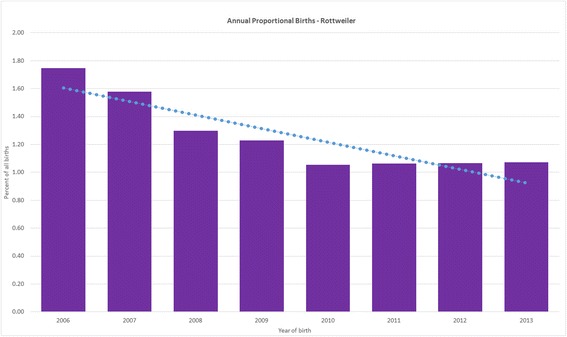
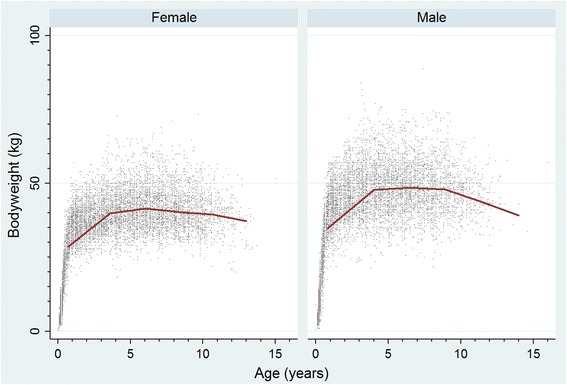
Rottweilers comprised 5321 (1.17%) of 455,557 dogs attending 304 clinics. Annual proportional birth rates dropped from 1.75% in 2006 to 1.07% in 2013. Median adult bodyweight overall was 44.9 kg (IQR 39.55-51.00, range 20.00-88.80). Median male adult bodyweight (48.5 kg, interquartile range [IQR] 43.0-54.0, range 20.0-88.8) was heavier than female (41.5 kg, IQR 37.0-46.4, range 21.1-73.5) ( < 0.001). Median longevity overall was 9.0 years (IQR 7.2-10.5, range 0.0-17.0). Median female longevity (9.5 years, IQR 7.8-11.0) was greater than male (8.7 years, IQR 6.8-10.1) ( = 0.002). The most common causes of death were neoplasia (33.0%), inability to stand (16.0%) and mass-associated disorder (7.1%).At least one disorder was recorded for 60.31% of Rottweilers. The most prevalent specific disorders recorded were aggression (7.46%, 95% CI 6.40-8.64), overweight/obesity (7.06%, 95% CI: 6.02-8.21), otitis externa (6.14%, 95% CI: 5.18-7.23) and degenerative joint disease (4.69%, 95% CI: 3.84-5.66). Male Rottweilers had higher prevalence than females for aggression (9.36% versus 5.47%, = 0.001) and pyotraumatic dermatitis (4.05% versus 1.76%, = 0.001). Aggression was more prevalent in neutered than entire females (7.5% versus 3.1%, = 0.003) but did not differ between neutered and entire males (9.6% versus 9.0%, = 0.773). The most frequent disorder groups were musculoskeletal (12.01%, 95% CI: 10.69-13.45), dermatological (10.96%, 95% CI: 9.69-12.35), gastro-intestinal (195, 8.87%, 95% CI: 7.72-10.14), undesirable behaviour (7.96%, 95% CI: 6.87-9.18) and neoplasia (7.96%, 95% CI: 6.87-9.18).
The current study assists prioritisation of health issues within Rottweilers. Rottweilers are relatively short-lived and neoplasia is a common cause of death. The most common disorders were aggression, overweight/obesity, otitis externa and degenerative joint disease. Males were significantly heavier, shorter-lived and predisposed to aggression than females. These results can alert prospective owners to potential health issues and optimise sex selection decision-making.
据报道,罗威纳犬易患多种疾病,但缺乏与一般犬类种群相关的准确患病率信息。本研究旨在描述在英国接受兽医护理的罗威纳犬的人口统计学特征、死亡率及常见疾病记录情况。对兽医综合诊疗计划(VetCompass Programme)中的临床健康记录进行了探究,以获取2013年期间记录的疾病情况。
在304家诊所就诊的455,557只犬中,罗威纳犬有5321只(占1.17%)。年度比例出生率从2006年的1.75%降至2013年的1.07%。成年犬总体重中位数为44.9千克(四分位间距[IQR]为39.55 - 51.00,范围为20.00 - 88.80)。成年雄性犬体重中位数(48.5千克,四分位间距[IQR]为43.0 - 54.0,范围为20.0 - 88.8)高于成年雌性犬(41.5千克,IQR为37.0 - 46.4,范围为21.1 - 73.5)(P < 0.001)。总体寿命中位数为9.0岁(IQR为7.2 - 10.5,范围为0.0 - 17.0)。成年雌性犬寿命中位数(9.5岁,IQR为7.8 - 11.0)长于成年雄性犬(8.7岁,IQR为6.8 - 10.1)(P = 0.002)。最常见的死亡原因是肿瘤(33.0%)、无法站立(16.0%)和与肿块相关的疾病(7.1%)。60.31%的罗威纳犬至少记录有1种疾病。记录到的最常见特定疾病为攻击性(7.46%,95%置信区间[CI]为6.40 - 8.64)、超重/肥胖(7.06%,95% CI:6.02 - 8.21)、外耳道炎(6.14%,95% CI:5.18 - 7.23)和退行性关节病(4.69%,95% CI:3.84 - 5.66)。雄性罗威纳犬攻击性(9.36%对5.47%,P = 0.001)和脓皮病(4.05%对1.76%,P = 0.001)的患病率高于雌性。绝育雌性犬的攻击性患病率高于未绝育雌性犬(7.5%对3.1%,P = 0.003),但绝育雄性犬和未绝育雄性犬之间无差异(9.6%对9.0%,P = 0.773)。最常见的疾病类别为肌肉骨骼疾病(12.01%,95% CI:10.69 - 13.45)、皮肤病(10.96%,95% CI:9.69 - 12.35)、胃肠道疾病(195例,8.87%,95% CI:7.72 - 10.14)、不良行为(7.96%,95% CI:6.87 - nine.18)和肿瘤(7.96%,95% CI:6.87 - 9.18)。
本研究有助于确定罗威纳犬健康问题的优先次序。罗威纳犬寿命相对较短,肿瘤是常见的死亡原因。最常见的疾病为攻击性、超重/肥胖、外耳道炎和退行性关节病。雄性犬体重显著更重,寿命更短,且比雌性犬更易出现攻击性。这些结果可提醒潜在犬主注意潜在健康问题,并优化性别选择决策。