Summers Jennifer F, O'Neill Dan G, Church David B, Thomson Peter C, McGreevy Paul D, Brodbelt David C
Royal Veterinary College, Hawkshead Lane, Hatfield, Hertfordshire, AL9 7TA UK.
Faculty of Veterinary Science, University of Sydney, New South Wales, 2006 Australia.
Canine Genet Epidemiol. 2015 Apr 18;2:4. doi: 10.1186/s40575-015-0016-7. eCollection 2015.
Concerns have been raised over breed-related health issues in purebred dogs, but reliable prevalence estimates for disorders within specific breeds are sparse. Electronically stored patient health records from primary-care practice are emerging as a useful source of epidemiological data in companion animals. This study used large volumes of health data from UK primary-care practices participating in the VetCompass animal health surveillance project to evaluate in detail the disorders diagnosed in a random selection of over 50% of dogs recorded as Cavalier King Charles Spaniels (CKCSs). Confirmation of breed using available microchip and Kennel Club (KC) registration data was attempted.
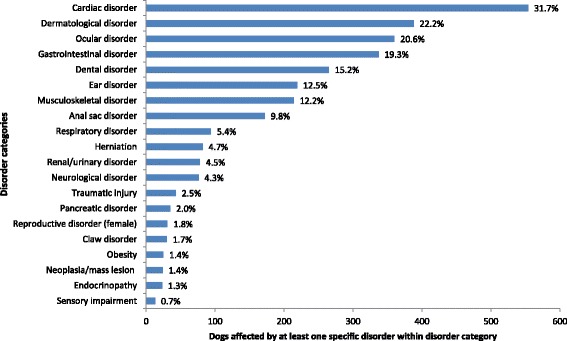
In total, 3624 dogs were recorded as CKCSs within the VetCompass database of which 143 (3.9%) were confirmed as KC-registered via microchip identification linkage of VetCompass to the KC database. 1875 dogs (75 KC registered and 1800 of unknown KC status, 52% of both groups) were randomly sampled for detailed clinical review. Clinical data associated with veterinary care were recorded in 1749 (93.3%) of these dogs. The most common specific disorders recorded during the study period were heart murmur (541 dogs, representing 30.9% of study group), diarrhoea of unspecified cause (193 dogs, 11.0%), dental disease (166 dogs, 9.5%), otitis externa (161, 9.2%), conjunctivitis (131, 7.4%) and anal sac infection (129, 7.4%). The five most common disorder categories were cardiac (affecting 31.7% of dogs), dermatological (22.2%), ocular (20.6%), gastrointestinal (19.3%) and dental/periodontal disorders (15.2%).
Study findings suggest that many of the disorders commonly affecting CKCSs are largely similar to those affecting the general dog population presented for primary veterinary care in the UK. However, cardiac disease (and MVD in particular) continues to be of particular concern in this breed.
This work highlights the value of veterinary practice based breed-specific epidemiological studies to provide targeted and evidence-based health policies. Further studies using electronic patient records in other breeds could highlight their potential disease predispositions.
纯种犬中与品种相关的健康问题引发了人们的关注,但针对特定品种疾病的可靠患病率估计却很少。来自基层医疗实践的电子存储患者健康记录正成为伴侣动物流行病学数据的一个有用来源。本研究使用了参与VetCompass动物健康监测项目的英国基层医疗实践中的大量健康数据,详细评估了从随机抽取的超过50%记录为查理士王小猎犬(CKCS)的犬只中诊断出的疾病。尝试通过可用的微芯片和英国养犬俱乐部(KC)注册数据来确认品种。
在VetCompass数据库中,共有3624只犬被记录为CKCS,其中143只(3.9%)通过VetCompass与KC数据库的微芯片识别链接被确认为KC注册犬。随机抽取了1875只犬(75只KC注册犬和1800只KC状态不明的犬,两组各占52%)进行详细的临床审查。这些犬中有1749只(93.3%)记录了与兽医护理相关的临床数据。研究期间记录的最常见的特定疾病是心脏杂音(541只犬,占研究组的30.9%)、不明原因腹泻(193只犬,11.0%)、牙科疾病(166只犬,9.5%)、外耳炎(161只犬,9.2%)、结膜炎(131只犬,7.4%)和肛门囊感染(129只犬,7.4%)。最常见的五类疾病是心脏疾病(影响31.7%的犬)、皮肤病(22.2%)、眼部疾病(20.6%)、胃肠道疾病(19.3%)和牙科/牙周疾病(15.2%)。
研究结果表明,许多通常影响CKCS的疾病与在英国接受基层兽医护理的一般犬类群体所患疾病基本相似。然而,心脏病(尤其是二尖瓣疾病)在该品种中仍然特别令人担忧。
这项工作突出了基于兽医实践的特定品种流行病学研究对于制定有针对性的循证健康政策的价值。使用其他品种电子病历的进一步研究可能会突出它们潜在的疾病易感性。