Borzée Amaël, Santos Joana L, Sánchez-RamÍrez Santiago, Bae Yoonhyuk, Heo Kyongman, Jang Yikweon, Jowers Michael Joseph
Laboratory of Behavioural Ecology and Evolution, School of Biological Sciences, Seoul National University, Seoul, South Korea.
Department of Life Sciences, Division of EcoScience, Ewha Womans University, Seoul, South Korea.
PeerJ. 2017 Nov 28;5:e4044. doi: 10.7717/peerj.4044. eCollection 2017.
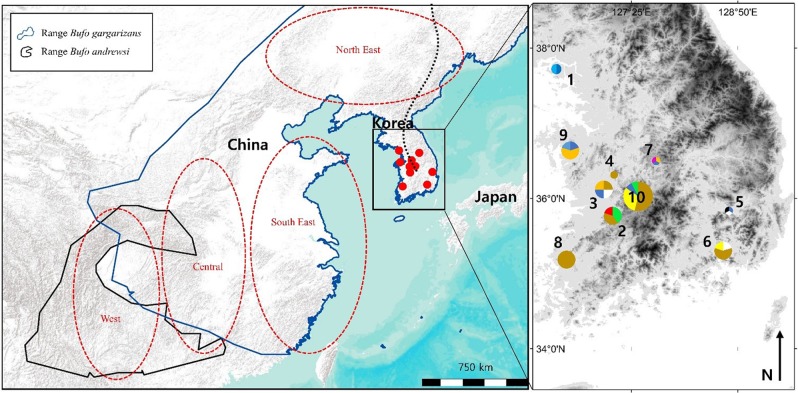
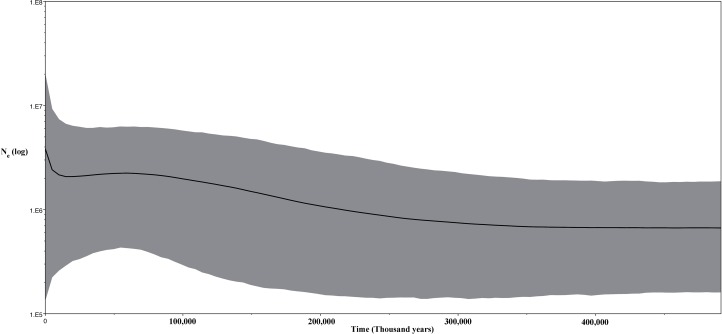
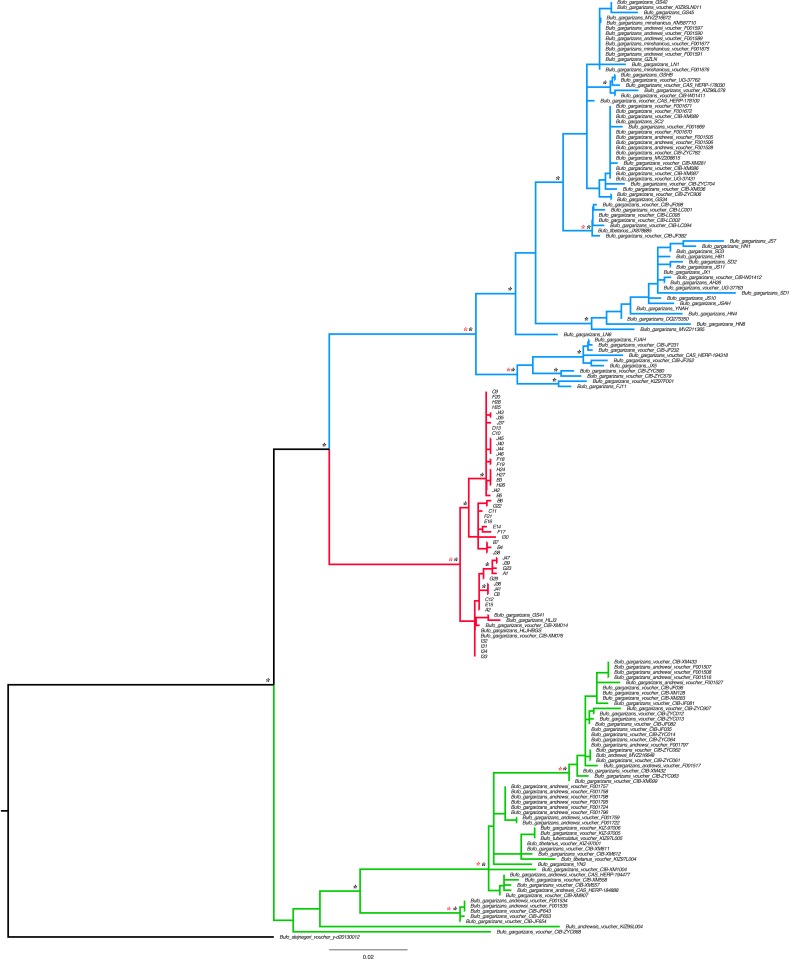
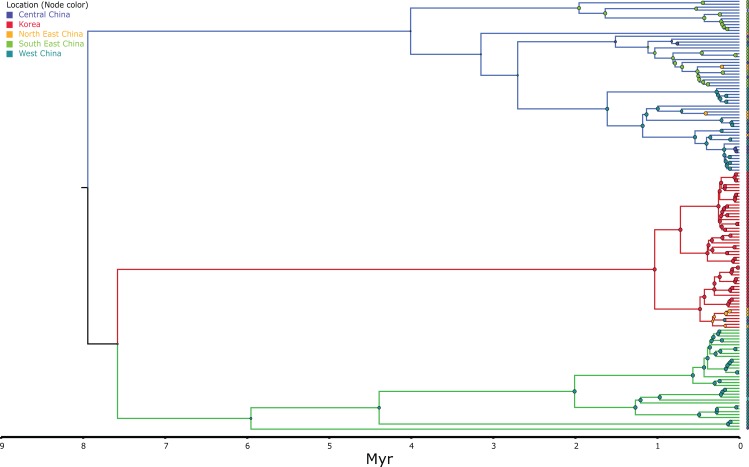
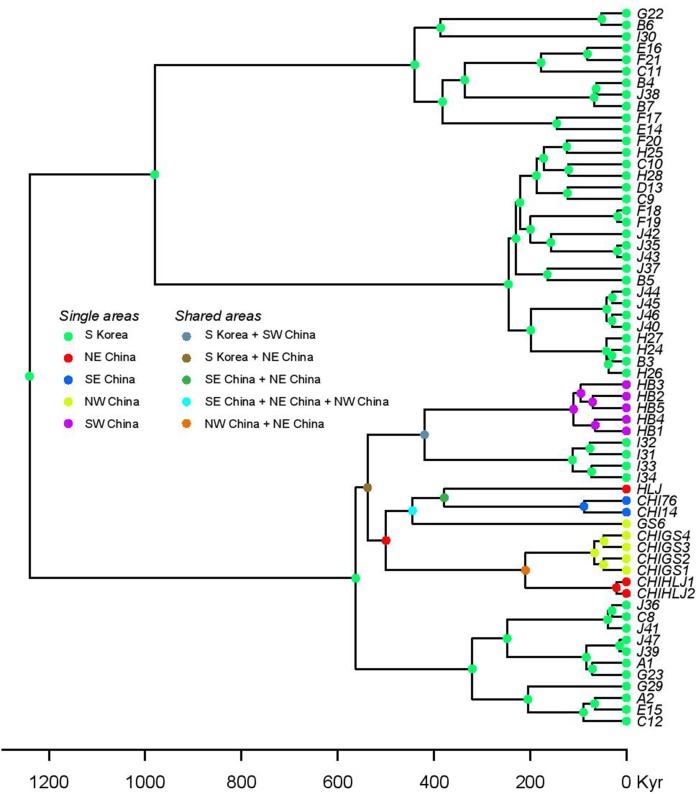
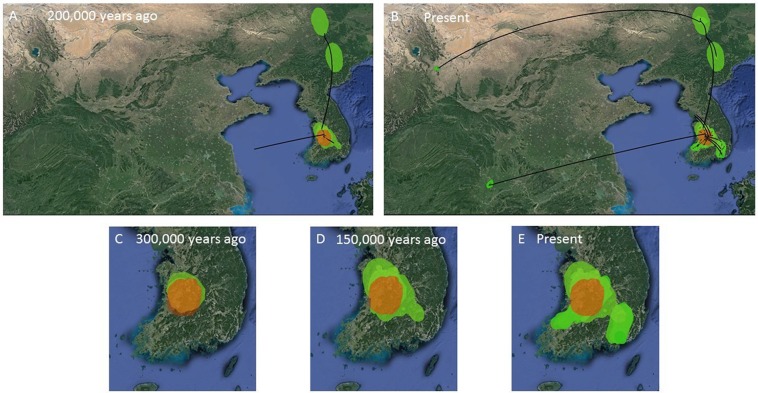
The effects of ice ages on speciation have been well documented for many European and North American taxa. In contrast, very few studies have addressed the consequences of such environmental and topographical changes in North East Asian species. More precisely, the Korean Peninsula offers a unique model to assess patterns and processes of speciation as it hosts the northern- and eastern-most distribution limit of some widespread Asian taxa. Despite this, studies addressing phylogeographic patterns and population genetics in the peninsula and surrounding countries are few and studies for most families are lacking. Here we inferred the phylogenetic relationships of the common toad () from South Korea and their North East Asian counterpart populations, based on mitochondrial data. Korean GenBank BLASTs matched few individuals from nearby China, but the presence of a Korean clade suggests isolation on the Korean Peninsula, previous to the last glacial maximum, linked to sea level resurgence. Molecular clock calibrations within this group were used to date the divergence between clades and their relationship to paleo-climatic events in the area. Lack of genetic structure among South Korean populations and strong homogeneity between the Korean and some Chinese localities suggest weak isolation and recent expansion. Geographical projection of continuous coalescent maximum-clade-credibility trees shows an original Chinese expansion towards the Korean Peninsula through the Yellow Sea circa two million years ago with colonisation events dating circa 800 thousand years ago (K. y. a.). Following this colonisation, the data point to outgoing Korean Peninsula dispersal events throughout different periods, towards the North through land, and West through land bridge formations over the Yellow Sea during sea level falls. In accordance, demographic analyses revealed a population expansion in the Koran Peninsula circa 300 K. y. a., likely attributed to glacial cycle fluctuations.
冰期对物种形成的影响在许多欧洲和北美分类群中已有充分记录。相比之下,很少有研究探讨东北亚物种面临此类环境和地形变化的后果。更确切地说,朝鲜半岛提供了一个独特的模型来评估物种形成的模式和过程,因为它拥有一些广泛分布的亚洲分类群最北和最东的分布界限。尽管如此,针对该半岛及周边国家系统发育地理模式和种群遗传学的研究很少,而且大多数科的研究都很缺乏。在此,我们基于线粒体数据推断了韩国普通蟾蜍( )与其东北亚对应种群之间的系统发育关系。韩国GenBank BLAST比对结果显示,与附近中国的个体匹配度很低,但韩国分支的存在表明在末次盛冰期之前,朝鲜半岛存在隔离现象,这与海平面回升有关。利用该类群内的分子钟校准来确定各分支之间的分歧时间及其与该地区古气候事件的关系。韩国种群之间缺乏遗传结构,以及韩国与一些中国地区之间的高度同质性表明隔离较弱且近期有扩张。连续合并最大分支可信度树的地理投影显示,大约在200万年前,中国有一次通过黄海向朝鲜半岛的原始扩张,殖民事件可追溯到大约80万年前(千年前)。此次殖民之后,数据表明在不同时期有从朝鲜半岛向外扩散的事件,向北通过陆地,向西在海平面下降期间通过黄海形成的陆桥。相应地,人口统计分析显示,大约在30万年前,朝鲜半岛出现了种群扩张,这可能归因于冰川周期波动。