Edwards Jerri D, Xu Huiping, Clark Daniel O, Guey Lin T, Ross Lesley A, Unverzagt Frederick W
Department of Psychiatry and Behavioral Neurosciences, University of South Florida, Tampa, FL, USA.
Department of Biostatistics, The Richard M. Fairbanks School of Public Health and School of Medicine, Indiana University, Indianapolis, IN, USA.
Alzheimers Dement (N Y). 2017 Nov 7;3(4):603-611. doi: 10.1016/j.trci.2017.09.002. eCollection 2017 Nov.
Cognitive training improves cognitive performance and delays functional impairment, but its effects on dementia are not known. We examined whether three different types of cognitive training lowered the risk of dementia across 10 years of follow-up relative to control and if greater number of training sessions attended was associated with lower dementia risk.
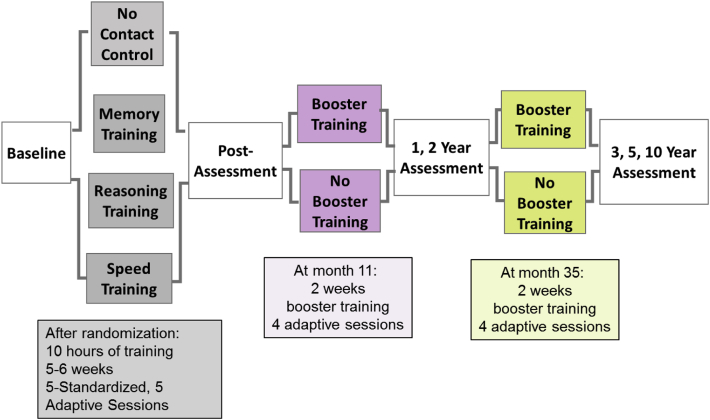
The Advanced Cognitive Training in Vital Elderly (NCT00298558) study was a randomized controlled trial (N = 2802) among initially healthy older adults, which examined the efficacy of three cognitive training programs (memory, reasoning, or speed of processing) relative to a no-contact control condition. Up to 10 training sessions were delivered over 6 weeks with up to four sessions of booster training delivered at 11 months and a second set of up to four booster sessions at 35 months. Outcome assessments were taken immediately after intervention and at intervals over 10 years. Dementia was defined using a combination of interview- and performance-based methods.
A total of 260 cases of dementia were identified during the follow-up. Speed training resulted in reduced risk of dementia (hazard ratio [HR] 0.71, 95% confidence interval [CI] 0.50-0.998, = .049) compared to control, but memory and reasoning training did not (HR 0.79, 95% CI 0.57-1.11, = .177 and HR 0.79, 95% CI 0.56-1.10, = .163, respectively). Each additional speed training session was associated with a 10% lower hazard for dementia (unadjusted HR, 0.90; 95% CI, 0.85-0.95, < .001).
Initially, healthy older adults randomized to speed of processing cognitive training had a 29% reduction in their risk of dementia after 10 years of follow-up compared to the untreated control group.
认知训练可改善认知表现并延缓功能损害,但其对痴呆症的影响尚不清楚。我们研究了三种不同类型的认知训练在10年随访期间相对于对照组是否能降低痴呆症风险,以及参加更多的训练课程是否与较低的痴呆症风险相关。
老年重要认知训练(NCT00298558)研究是一项针对最初健康的老年人的随机对照试验(N = 2802),该研究考察了三种认知训练项目(记忆、推理或处理速度)相对于无接触对照组的疗效。在6周内进行多达10次训练课程,在11个月时进行多达4次强化训练,在35个月时进行第二组多达4次强化训练。干预后立即进行结果评估,并在10年内定期进行。痴呆症采用基于访谈和表现的方法综合定义。
随访期间共确诊260例痴呆症病例。与对照组相比,速度训练使痴呆症风险降低(风险比[HR] 0.71,95%置信区间[CI] 0.50 - 0.998,P = 0.049),但记忆和推理训练未降低(HR分别为0.79,95% CI 0.57 - 1.11,P = 0.177和HR 0.79,95% CI 0.56 - 1.10,P = 0.163)。每增加一次速度训练课程,痴呆症风险降低10%(未调整HR,0.90;95% CI,0.85 - 0.95,P < 0.001)。
最初,随机接受处理速度认知训练的健康老年人在随访10年后,与未治疗的对照组相比,痴呆症风险降低了29%。