Saha Sudeshna, Coleman Bradley I, Dubey Rashmi, Blader Ira J, Gubbels Marc-Jan
Department of Biology, Boston College, Chestnut Hill, Massachusetts, USA.
Department of Microbiology and Immunology, University at Buffalo School of Medicine, Buffalo, New York, USA.
mSphere. 2017 Nov 29;2(6). doi: 10.1128/mSphere.00521-17. eCollection 2017 Nov-Dec.
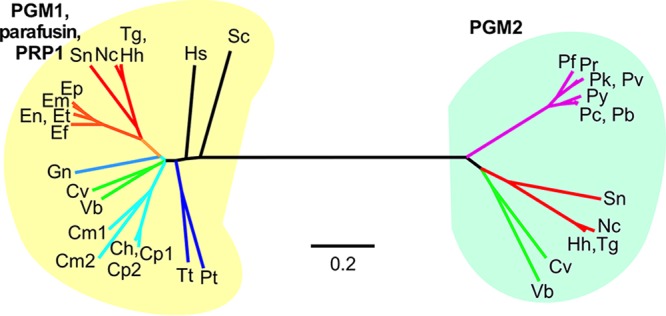
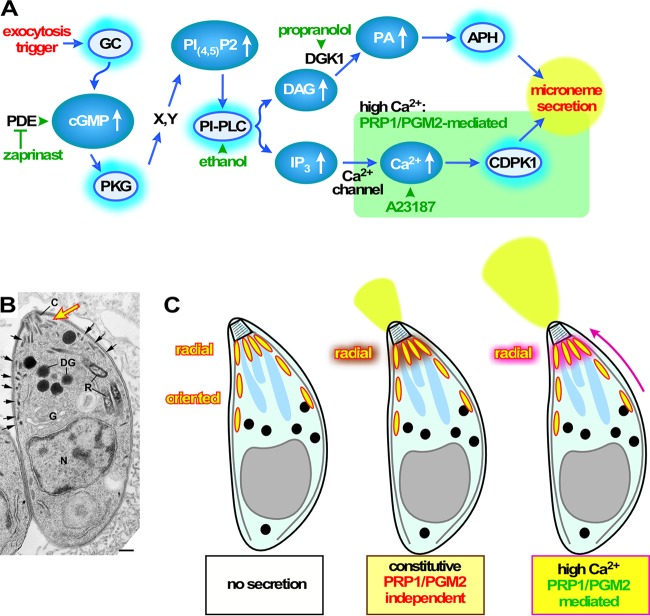
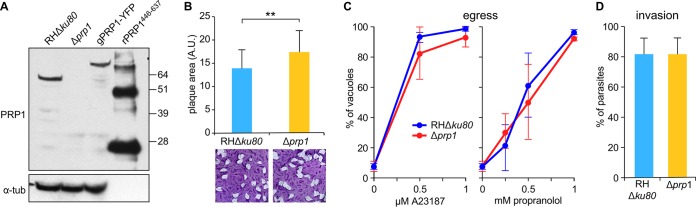
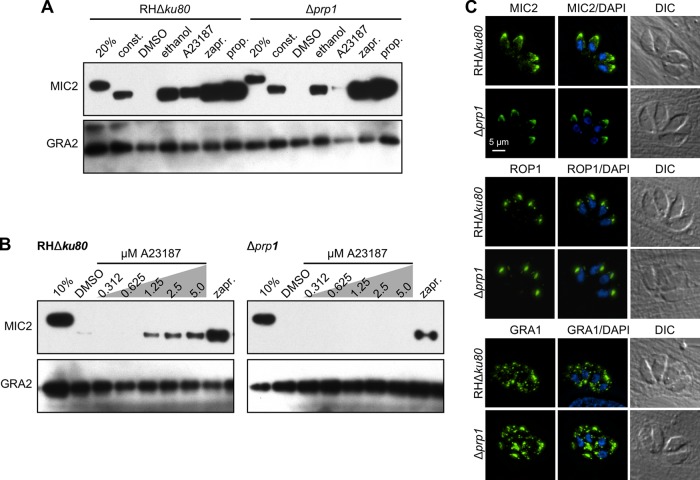
Paralogs of the widely prevalent phosphoglucomutase (PGM) protein called parafusin function in calcium (Ca)-mediated exocytosis across eukaryotes. In , the parafusin-related protein 1 (PRP1) has been associated with Ca-dependent microneme organelle secretion required for essential processes like host cell invasion and egress. Using reverse genetics, we observed PRP1 to be dispensable for completion of the lytic cycle, including host cell invasion and egress by the parasite. However, the absence of the gene affected increased microneme release triggered by A23187, a Ca ionophore used to raise the cytoplasmic Ca concentration mimicking the physiological role of Ca during invasion and egress. The basal levels of constitutive microneme release in extracellular parasites and phosphatidic acid-triggered microneme secretion were unaffected in the mutant. The phenotype of the deletion mutant of the second PGM-encoding gene in , PGM2, was similar to the phenotype of the PRP1 deletion mutant. Furthermore, the ability of the tachyzoites to induce acute infection in the mice remained normal in the absence of both PGM paralogs. Our data thus reveal that the microneme secretion upon high Ca flux is facilitated by the PGM paralogs, PRP1 and PGM2. However, this protein-mediated release is neither essential for lytic cycle completion nor for acute virulence of the parasite. Ca-dependent exocytosis is essential for the life cycle of apicomplexan parasites. harbors a phosphoglucomutase (PGM) ortholog, PRP1, previously associated with Ca-dependent microneme secretion. Here it is shown that genetic deletion of either PRP1, its PGM2 ortholog, or both genes is dispensable for the parasite's lytic cycle, including host cell egress and invasion. Depletion of the proteins abrogated high Ca-mediated microneme secretion induced by the ionophore A23187; however, the constitutive and phosphatidic acid-mediated release remained unaffected. Secretion mediated by the former pathway is not essential for tachyzoite survival or acute infection in the mice.
广泛存在的磷酸葡萄糖变位酶(PGM)蛋白的旁系同源物parafusin在真核生物中参与钙(Ca)介导的胞吐作用。在[具体研究对象]中,parafusin相关蛋白1(PRP1)与宿主细胞入侵和逸出等基本过程所需的Ca依赖性微线体细胞器分泌有关。通过反向遗传学,我们观察到PRP1对于完成裂解周期并非必需,包括寄生虫对宿主细胞的入侵和逸出。然而,该基因的缺失影响了由A23187(一种用于提高细胞质Ca浓度以模拟入侵和逸出过程中Ca的生理作用的Ca离子载体)引发的微线体释放增加。细胞外寄生虫中组成型微线体释放的基础水平以及磷脂酸触发的微线体分泌在突变体中未受影响。[具体研究对象]中第二个编码PGM的基因PGM2的缺失突变体表型与PRP1缺失突变体的表型相似。此外,在没有这两个PGM旁系同源物的情况下,速殖子在小鼠中诱导急性感染的能力仍保持正常。因此,我们的数据表明,高Ca通量时的微线体分泌由PGM旁系同源物PRP1和PGM2促进。然而,这种蛋白质介导的释放对于裂解周期的完成以及寄生虫的急性毒力均非必需。Ca依赖性胞吐作用对于顶复门寄生虫的生命周期至关重要。[具体研究对象]含有一种磷酸葡萄糖变位酶(PGM)直系同源物PRP1,其先前与Ca依赖性微线体分泌有关。此处表明,PRP1、其PGM2直系同源物或这两个基因的基因缺失对于寄生虫的裂解周期(包括宿主细胞逸出和入侵)并非必需。这些蛋白质的缺失消除了由离子载体A23187诱导的高Ca介导的微线体分泌;然而,组成型和磷脂酸介导的释放仍未受影响。前一种途径介导的分泌对于速殖子的存活或在小鼠中的急性感染并非必需。