Wandro Stephen, Carmody Lisa, Gallagher Tara, LiPuma John J, Whiteson Katrine
Department of Molecular Biology and Biochemistry, University of California, Irvine, California, USA.
Department of Pediatrics and Communicable Diseases, University of Michigan Medical School, Ann Arbor, Michigan, USA.
mSystems. 2017 Nov 28;2(6). doi: 10.1128/mSystems.00100-17. eCollection 2017 Nov-Dec.
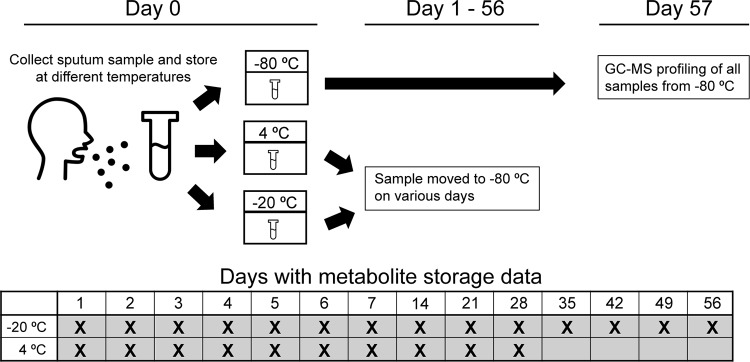
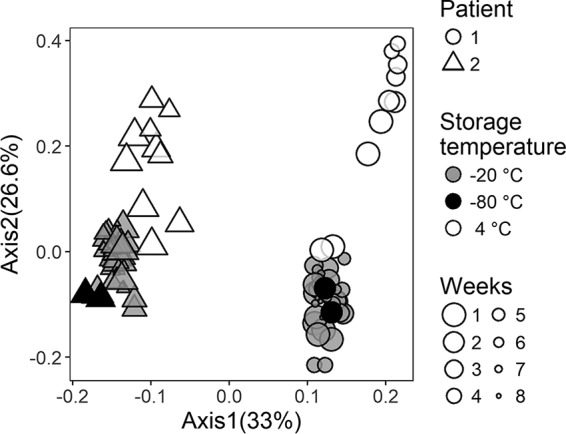
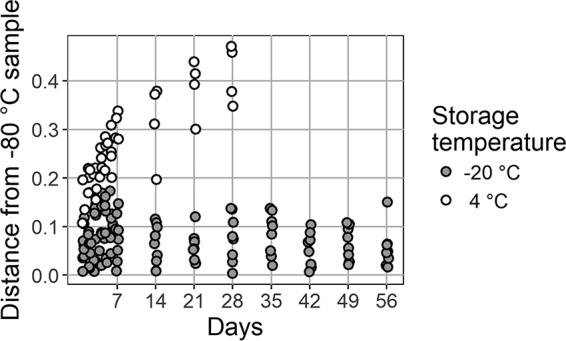
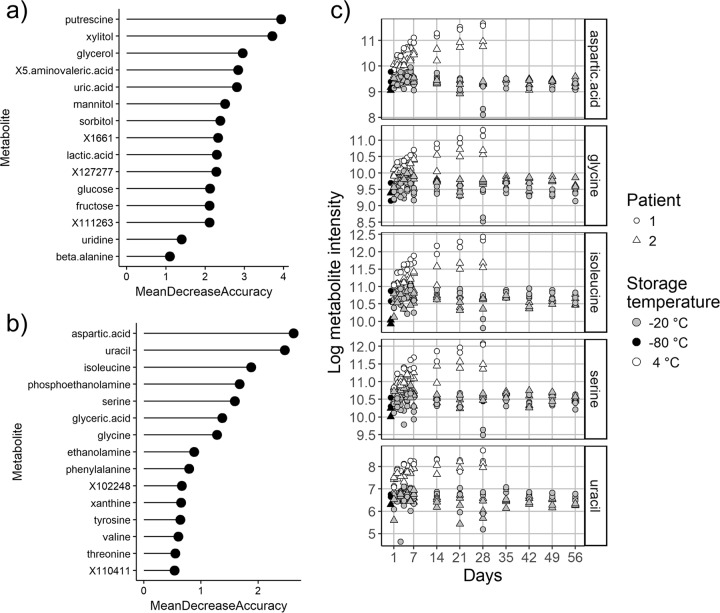
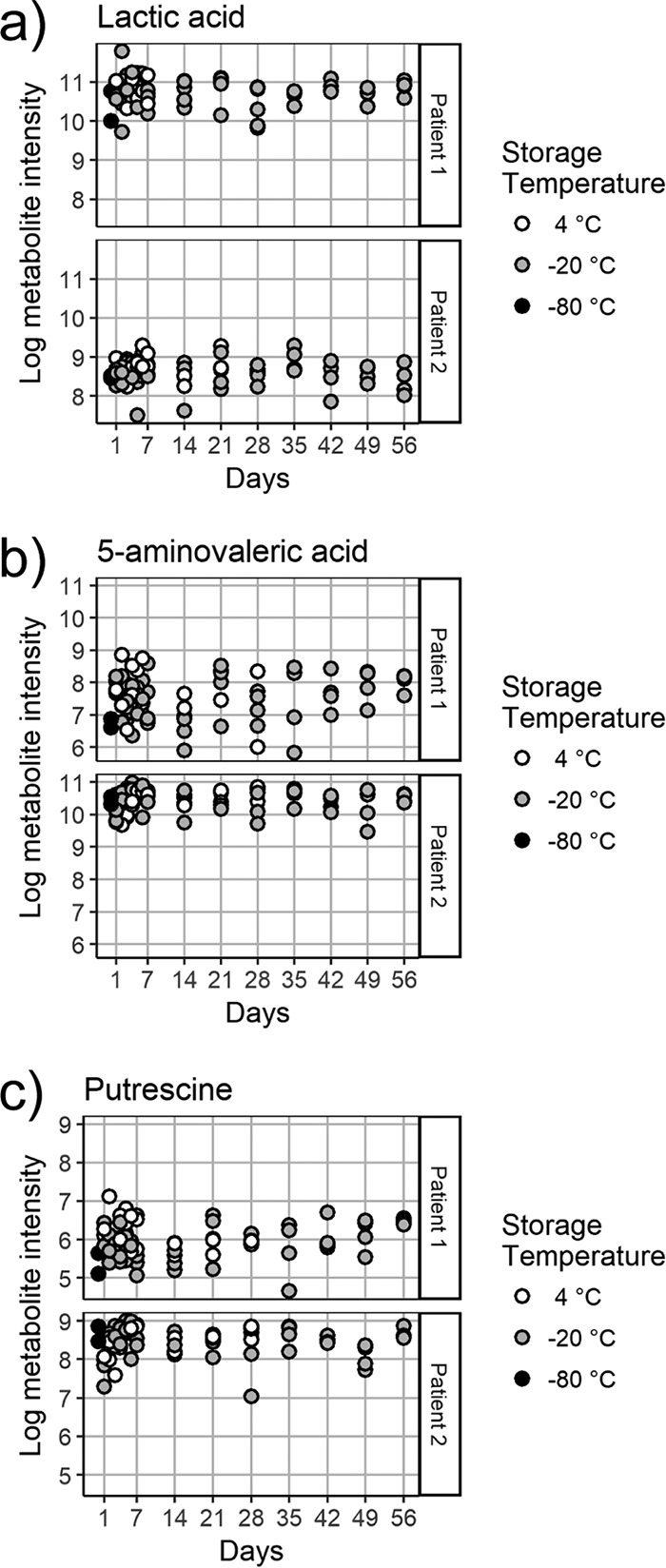
Metabolites of human or microbial origin have the potential to be important biomarkers of the disease state in cystic fibrosis (CF). Clinical sample collection and storage conditions may impact metabolite abundances with clinical relevance. We measured the change in metabolite composition based on untargeted gas chromatography-mass spectrometry (GC-MS) when CF sputum samples were stored at 4°C, -20°C, or -80°C with one or two freeze-thaw cycles. Daily measurements were taken for 1 week and then weekly for 4 weeks (4°C) and 8 weeks (-20°C). The metabolites in samples stored at -20°C maintained abundances similar to those found at-80°C over the course of 8 weeks (average change in Bray-Curtis distance, 0.06 ± 0.04) and were also stable after one or two freeze-thaw cycles. However, the metabolite profiles of samples stored at 4°C shifted after 1 day and continued to change over the course of 4 weeks (average change in Bray-Curtis distance, 0.31 ± 0.12). The abundances of several amino acids and other metabolites increased with time of storage at 4°C but remained constant at -20°C. Storage temperature was a significant factor driving the metabolite composition (permutational multivariate analysis of variance: = 0.32 to 0.49, < 0.001). CF sputum samples stored at -20°C at the time of sampling maintain a relatively stable untargeted GC-MS profile. Samples should be frozen on the day of collection, as more than 1 day at 4°C impacts the global composition of the metabolites in the sample. Metabolomics has great potential for uncovering biomarkers of the disease state in CF and many other contexts. However, sample storage timing and temperature may alter the abundance of clinically relevant metabolites. To assess whether existing samples are stable and to direct future study design, we conducted untargeted GC-MS metabolomic analysis of CF sputum samples after one or two freeze-thaw cycles and storage at 4°C and -20°C for 4 to 8 weeks. Overall, storage at -20°C and freeze-thaw cycles had little impact on metabolite profiles; however, storage at 4°C shifted metabolite abundances significantly. GC-MS profiling will aid in our understanding of the CF lung, but care should be taken in studies using sputum samples to ensure that samples are properly stored.
源自人类或微生物的代谢产物有可能成为囊性纤维化(CF)疾病状态的重要生物标志物。临床样本的采集和储存条件可能会影响具有临床相关性的代谢产物丰度。我们采用非靶向气相色谱 - 质谱联用(GC - MS)技术,测定了CF痰液样本在4°C、-20°C或-80°C下储存,并经历一或两个冻融循环时代谢产物组成的变化。每天测量一次,持续1周,然后在4周(4°C)和8周(-20°C)内每周测量一次。在-20°C储存的样本中的代谢产物在8周内保持与-80°C时相似的丰度(Bray - Curtis距离的平均变化为0.06±0.04),并且在经历一或两个冻融循环后也保持稳定。然而,在4°C储存的样本的代谢产物谱在1天后就发生了变化,并在4周内持续变化(Bray - Curtis距离的平均变化为0.31±0.12)。几种氨基酸和其他代谢产物的丰度随在4°C下储存时间的延长而增加,但在-20°C下保持恒定。储存温度是驱动代谢产物组成的一个重要因素(置换多元方差分析: = 0.32至0.49, < 0.001)。在采样时储存在-20°C的CF痰液样本保持相对稳定的非靶向GC - MS谱。样本应在采集当天冷冻,因为在4°C下放置超过1天会影响样本中代谢产物的整体组成。代谢组学在揭示CF及许多其他情况下疾病状态的生物标志物方面具有巨大潜力。然而,样本储存时间和温度可能会改变具有临床相关性的代谢产物的丰度。为了评估现有样本是否稳定并指导未来的研究设计,我们对CF痰液样本在经历一或两个冻融循环以及在4°C和-20°C下储存4至8周后进行了非靶向GC - MS代谢组学分析。总体而言,在-20°C储存和冻融循环对代谢产物谱影响不大;然而,在4°C储存会显著改变代谢产物丰度。GC - MS分析将有助于我们了解CF肺部情况,但在使用痰液样本的研究中应注意确保样本妥善储存。