Xu Yunan, Chen Xinguang
University of Florida, Gainesville, Florida USA.
Wuhan University Global Health Institute, Wuhan, China.
Glob Health Res Policy. 2016 Jun 15;1:3. doi: 10.1186/s41256-016-0004-9. eCollection 2016.
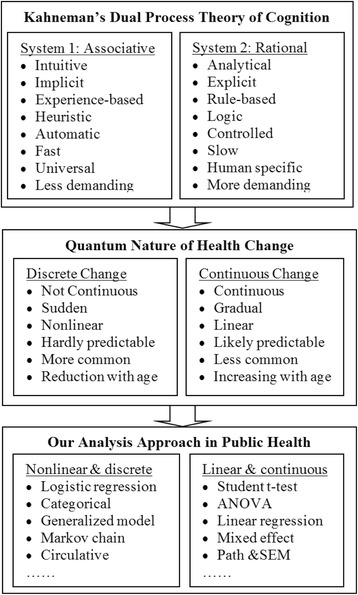
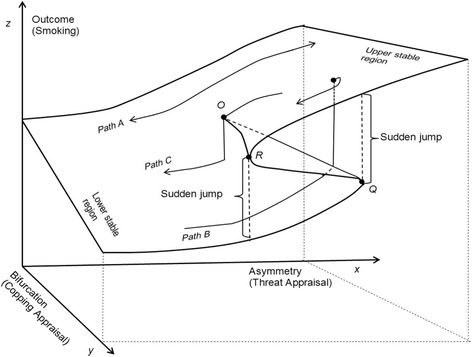
Tobacco use is one of the greatest public health problems worldwide and the hazards of cigarette smoking to public health call for better recognition of cigarette smoking behaviors to guide evidence-based policy. Protection motivation theory (PMT) provides a conceptual framework to investigate tobacco use. Evidence from diverse sources implies that the dynamics of smoking behavior may be quantum in nature, consisting of an intuition and an analytical process, challenging the traditional linear continuous analytical approach. In this study, we used cusp catastrophe, a nonlinear analytical approach to test the dual-process hypothesis of cigarette smoking.
Data were collected from a random sample of vocational high school students in China ( = 528). The multivariate stochastic cusp modeling was used and executed with the in R. The PMT-based Threat Appraisal and Coping Appraisal were used as the two control variables and the frequency of cigarette smoking (daily, weekly, occasional, and never) in the past month was used as the outcome variable.
Consistent with PMT, the Threat Appraisal (asymmetry, α = 0.1987, < 0.001) and Coping Appraisal (bifurcation, β = 0.1760, < 0.05) significantly predicted the smoking behavior after controlling for covariates. Furthermore, the cusp model performed better than the alternative linear and logistic regression models with regard to higher (0.82 for cusp, but 0.21 for linear and 0.25 for logistic) and smaller AIC and BIC.
Study findings support the conclusion that cigarette smoking in adolescents is a quantum process and PMT is relevant to guide studies to understand smoking behavior for smoking prevention and cessation.
烟草使用是全球最严重的公共卫生问题之一,吸烟对公众健康的危害要求更好地认识吸烟行为,以指导循证政策。保护动机理论(PMT)提供了一个研究烟草使用的概念框架。来自不同来源的证据表明,吸烟行为的动态可能本质上是量子性的,由直觉和分析过程组成,这对传统的线性连续分析方法提出了挑战。在本研究中,我们使用尖点突变这一非线性分析方法来检验吸烟的双过程假说。
数据来自中国职业高中学生的随机样本(n = 528)。使用多元随机尖点模型并在R中用MASS包执行。基于PMT的威胁评估和应对评估作为两个控制变量,过去一个月的吸烟频率(每天、每周、偶尔和从不)作为结果变量。
与PMT一致,在控制协变量后,威胁评估(不对称性,α = 0.1987,p < 0.001)和应对评估(分歧,β = 0.1760,p < 0.05)显著预测了吸烟行为。此外,尖点模型在更高的R²(尖点模型为0.82,线性模型为0.21,逻辑回归模型为0.25)以及更小的AIC和BIC方面比替代的线性和逻辑回归模型表现更好。
研究结果支持以下结论,即青少年吸烟是一个量子过程,并且PMT对于指导理解吸烟行为以预防和戒烟的研究具有相关性。