Kaur Bhupinder, Ranawana Viren, Teh Ai-Ling, Henry C Jeya K
Clinical Nutrition Research Centre, Singapore Institute for Clinical Sciences, 14 Medical Drive, Singapore 117599, Singapore.
Singapore Institute for Clinical Sciences, 30 Medical Drive, Singapore 117609, Singapore.
J Clin Transl Endocrinol. 2015 Jun 11;2(3):92-98. doi: 10.1016/j.jcte.2015.05.002. eCollection 2015 Sep.
Low glycemic index (GI) foods have been suggested to minimize large fluctuations in blood glucose levels and reduce food intake. However, the majority of studies have been conducted on Caucasian populations with limited data on Asians. The objective of this study was to investigate how the provision of a low GI breakfast and afternoon snack affected daily blood glucose profiles and food intake.
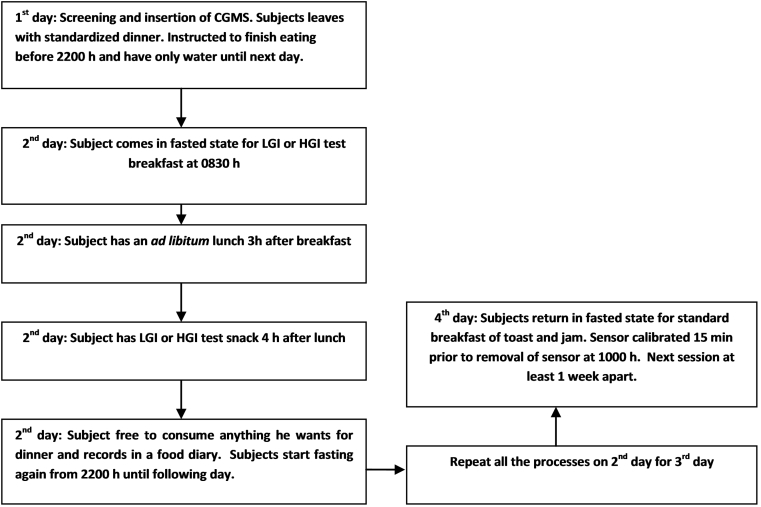
In a randomized, controlled crossover non blind design, 11 healthy Chinese male adults (body mass index 22.4 ± 1.3 kg m) attended two sessions where they consumed either a high or low GI breakfast and afternoon snack, and a standardized buffet lunch. Daily changes in glycemic response (GR) were measured using the Medtronic MiniMed (Northridge, CA) iPro™2 continuous glucose monitoring system (CGMS). The GR was further calculated to obtain the incremental area under the curve (IAUC). Glycemic variability was calculated as mean amplitude of glycemic excursion (MAGE) and energy intake (kcal) was measured quantitatively at the buffet lunch.
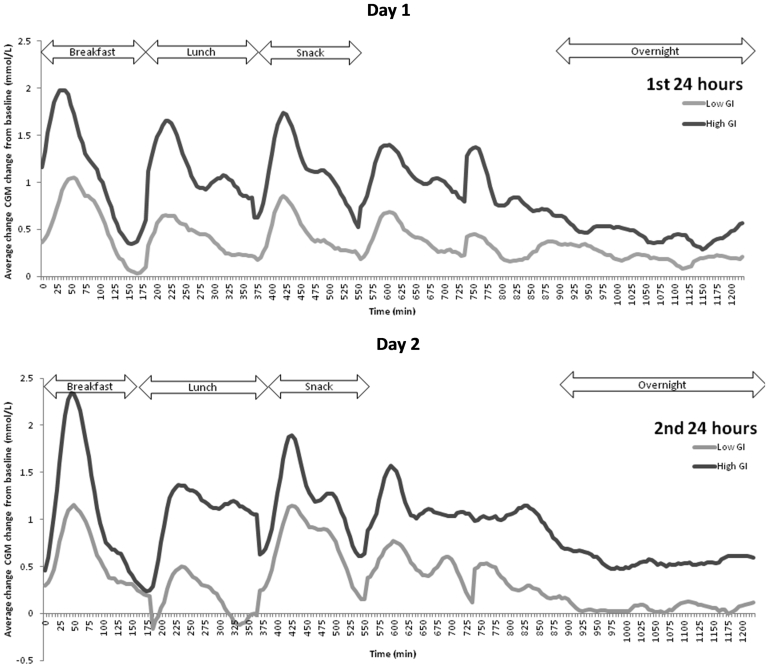
Compared to the high GI intervention, the low GI intervention significantly reduced the GR following breakfast ( = 0.02), lunch ( = 0.02) and dinner ( = 0.05). The low GI treatment showed a reduction in daily AUC ( = 0.03). There was a significant reduction in IAUC after a low GI breakfast compared to the high GI breakfast ( = 0.03). The low GI breakfast resulted in a significantly lower food intake at lunch and a resulting decreased energy intake of 285 kcal ( = 0.02). The MAGE was significantly lower during the entire low GI treatment ( = 0.03).
Consumption of a low GI breakfast and afternoon snack was capable of attenuating 24-h blood glucose profiles, minimize glycemic excursions and reduce food intake in healthy Asian males. This simple dietary intervention may be an acceptable approach in improving overall glycemia and energy balance in Asians.
NCT02340507.
低升糖指数(GI)食物被认为可最大程度减少血糖水平的大幅波动并减少食物摄入量。然而,大多数研究是在白种人群中进行的,针对亚洲人的数据有限。本研究的目的是调查提供低GI早餐和下午点心如何影响每日血糖曲线和食物摄入量。
在一项随机、对照、交叉非盲设计中,11名健康的中国成年男性(体重指数22.4±1.3 kg/m)参加了两个阶段,他们分别食用了高GI或低GI早餐、下午点心以及一份标准化自助午餐。使用美敦力MiniMed(加利福尼亚州北岭)iPro™2连续血糖监测系统(CGMS)测量血糖反应(GR)的每日变化。进一步计算GR以获得曲线下增量面积(IAUC)。血糖变异性计算为血糖波动平均幅度(MAGE),并在自助午餐时定量测量能量摄入量(千卡)。
与高GI干预相比,低GI干预显著降低了早餐后(P = 0.02)、午餐后(P = 0.02)和晚餐后(P = 0.05)的GR。低GI治疗使每日AUC降低(P = 0.03)。与高GI早餐相比,低GI早餐后的IAUC显著降低(P = 0.03)。低GI早餐导致午餐时食物摄入量显著降低,能量摄入量减少285千卡(P = 0.02)。在整个低GI治疗期间,MAGE显著降低(P = 0.03)。
食用低GI早餐和下午点心能够减弱24小时血糖曲线,最小化血糖波动并减少健康亚洲男性的食物摄入量。这种简单的饮食干预可能是改善亚洲人整体血糖和能量平衡的一种可接受方法。
NCT02340507。