Gabrial Shreef G N, Shakib Marie-Christine R, Gabrial Gamal N
National Research Centre, Nutrition and Food Science Department, El Buhouth St., Dokki, Cairo 12311, Egypt.
Open Access Maced J Med Sci. 2016 Dec 15;4(4):565-573. doi: 10.3889/oamjms.2016.115. Epub 2016 Oct 5.
Many studies have indicated that the incidence of serious diabetic complications may be reduced through strict glycemic control. A low glycemic index diet is one tool to improve insulin resistance and improve glycemic control in type 2 diabetes mellitus (T2DM).
The objective was to study the effect of pseudocereals-based breakfasts (quinoa and buckwheat) on glucose variations at first meal (breakfast) and second meal (standardised lunch) in healthy and diabetic subjects.
Twelve healthy subjects and 12 patients with Type 2 DM (not- insulin dependent) were recruited in the study. Subjects were provided with quinoa and buckwheat breakfast meals. A standardised lunch was provided 4 h after breakfast. Postprandial blood glucose response after breakfast and the second meal effect was measured in healthy and diabetic subjects. Incremental area under the curve (IAUC) values for glucose was measured in response to the breakfast and lunch. The glycemic index of the 2 pseudocereals-based test breakfasts was determined. A white wheat bread (WWB) was served as a reference breakfast meal.
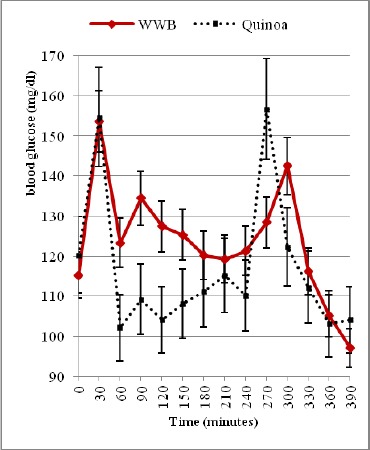
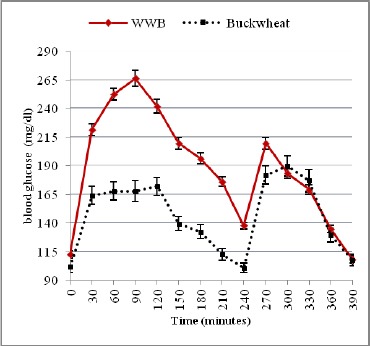
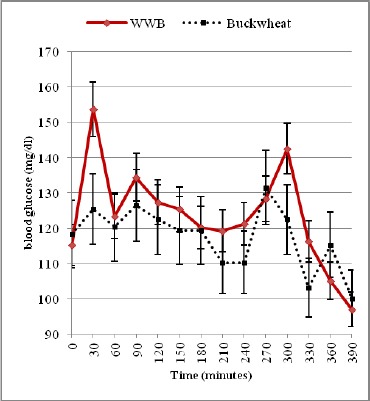
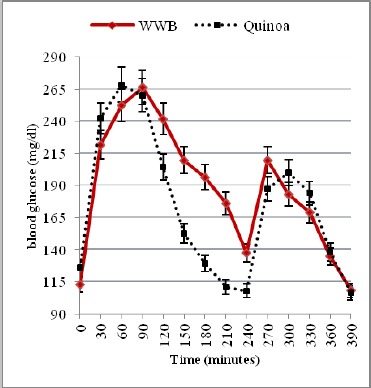
In post-breakfast analyses, healthy subjects showed that buckwheat meal had significantly lower IAUC values for blood glucose compared to WWB reference meal (P < 0.001) while quinoa meal showed no significance. In diabetic subjects, buckwheat and quinoa meals had significantly lower IAUC values for blood glucose compared to WWB reference meal (P < 0.001 and P < 0.05 respectively). Blood glucose concentrations started to decline gradually for the quinoa and buckwheat but not for WWB in all healthy and diabetic subjects and returned to near-fasting baseline levels by 210 min. Post-lunch analyses indicated higher IAUC for the two breakfast types in healthy and diabetic subjects. In addition, the quinoa and buckwheat breakfast meals were followed by a significantly flatter blood glucose response to the second meal for the period between 270 and 330 min. At the end of the second meal period, values were below or near-fasting baseline levels in the breakfast period. The blood glucose concentration after consuming quinoa meal showed a high peak at 30 min similar to that of WWB reference meal. This peak resulted in a high glycemic index (GI) for quinoa (89.4). The GI of buckwheat recorded a low value (26.8).
The two studied pseudocereals; quinoa and buckwheat have high potential to improve glucose tolerance at the first and second meal (lunch) and are recommended to be introduced in our daily diet for healthy and diabetic subjects.
许多研究表明,通过严格控制血糖可降低严重糖尿病并发症的发生率。低血糖指数饮食是改善2型糖尿病(T2DM)患者胰岛素抵抗和控制血糖的一种方法。
研究以伪谷物(藜麦和荞麦)为基础的早餐对健康受试者和糖尿病患者第一餐(早餐)和第二餐(标准化午餐)血糖变化的影响。
本研究招募了12名健康受试者和12名2型糖尿病(非胰岛素依赖型)患者。为受试者提供藜麦和荞麦早餐。早餐后4小时提供标准化午餐。测量健康受试者和糖尿病患者早餐及第二餐餐后血糖反应。测量早餐和午餐后葡萄糖的曲线下增量面积(IAUC)值。测定两种以伪谷物为基础的试验早餐的血糖指数。以白面包(WWB)作为参考早餐。
早餐后分析显示,与WWB参考餐相比,健康受试者中荞麦餐的血糖IAUC值显著更低(P < 0.001),而藜麦餐无显著差异。在糖尿病受试者中,与WWB参考餐相比,荞麦餐和藜麦餐的血糖IAUC值显著更低(分别为P < 0.001和P < 0.05)。在所有健康受试者和糖尿病患者中,藜麦和荞麦餐后血糖浓度开始逐渐下降,而WWB餐后血糖浓度未下降,到210分钟时恢复到接近空腹的基线水平。午餐后分析表明,健康受试者和糖尿病患者中两种早餐类型的IAUC更高。此外,在270至330分钟期间,藜麦和荞麦早餐后第二餐的血糖反应明显更平缓。在第二餐结束时,血糖值低于或接近早餐时段的空腹基线水平。食用藜麦餐后30分钟血糖浓度出现与WWB参考餐相似的高峰。这个高峰导致藜麦的血糖指数(GI)较高(89.4)。荞麦的GI值较低(26.8)。
所研究的两种伪谷物——藜麦和荞麦在改善第一餐和第二餐(午餐)的葡萄糖耐量方面具有很大潜力,建议健康受试者和糖尿病患者将其纳入日常饮食。