Carslake David, Davey Smith George, Gunnell David, Davies Neil, Nilsen Tom I L, Romundstad Pål
MRC Integrative Epidemiology Unit at the University of Bristol, Bristol, UK.
Population Health Sciences, University of Bristol, Bristol UK.
Int J Epidemiol. 2018 Jun 1;47(3):760-770. doi: 10.1093/ije/dyx246.
The observational association between mortality and body mass index (BMI) is U-shaped, leading to highly publicized suggestions that moderate overweight is beneficial to health. However, it is unclear whether elevated mortality is caused by low BMI or if the association is confounded, for example by concurrent ill health.
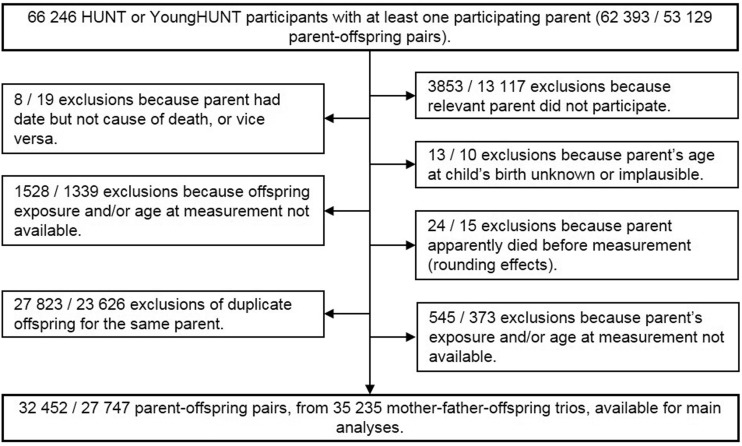
Using HUNT, a Norwegian prospective study, 32 452 mother-offspring and 27 747 father-offspring pairs were followed up to 2009. Conventional hazard ratios for parental mortality per standard deviation of BMI were estimated using Cox regression adjusted for behavioural and socioeconomic factors. To estimate hazard ratios with reduced susceptibility to confounding, particularly from concurrent ill health, the BMI of parents' offspring was used as an instrumental variable for parents' own BMI. The shape of mortality-BMI associations was assessed using cubic splines.
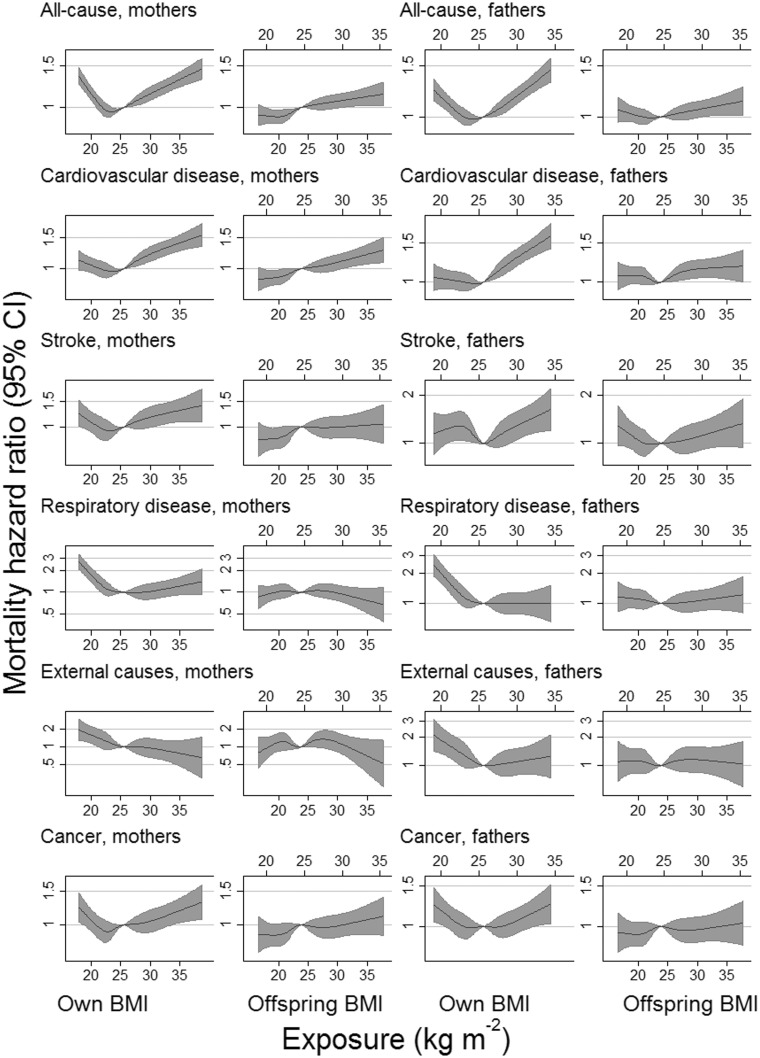
There were 18 365 parental deaths during follow-up. Conventional associations of mortality from all-causes, cardiovascular disease and cancer with parents' own BMI were substantially nonlinear, with elevated mortality at both extremes and minima at 21-25 kg m-2. Equivalent associations with offspring BMI were positive and there was no evidence of elevated parental mortality at low offspring BMI. The linear instrumental variable hazard ratio for all-cause mortality per standard deviation increase in BMI was 1.18 (95% confidence interval: 1.10, 1.26), compared with 1.05 (1.03, 1.06) in the conventional analysis.
Elevated mortality rates at high BMI appear causal, whereas excess mortality at low BMI is likely exaggerated by confounding by factors including concurrent ill health. Conventional studies probably underestimate the adverse population health consequences of overweight.
死亡率与体重指数(BMI)之间的观察性关联呈U形,这引发了大量备受关注的观点,即适度超重对健康有益。然而,目前尚不清楚死亡率升高是由低BMI导致的,还是这种关联存在混杂因素,例如同时存在的健康问题。
利用挪威的一项前瞻性研究HUNT,对32452对母婴和27747对父子进行了随访,直至2009年。使用Cox回归估计了经行为和社会经济因素调整后的BMI每增加一个标准差时父母死亡率的传统风险比。为了估计对混杂因素(特别是同时存在的健康问题)敏感性较低的风险比,将父母后代的BMI用作父母自身BMI的工具变量。使用三次样条评估死亡率与BMI关联的形状。
随访期间有18365例父母死亡。全因、心血管疾病和癌症死亡率与父母自身BMI的传统关联基本上是非线性的,两端死亡率升高,21 - 25kg/m²时死亡率最低。与后代BMI的等效关联为正,且没有证据表明低后代BMI时父母死亡率升高。BMI每增加一个标准差时全因死亡率的线性工具变量风险比为1.18(95%置信区间:1.10,1.26),而传统分析中的风险比为1.05(1.03,1.06)。
高BMI时死亡率升高似乎具有因果关系,而低BMI时的额外死亡率可能因包括同时存在的健康问题等因素的混杂作用而被夸大。传统研究可能低估了超重对人群健康的不良后果。