Husain Muhammed Omair, Chaudhry Imran B, Mehmood Nasir, Rehman Raza Ur, Kazmi Ajmal, Hamirani Munir, Kiran Tayyeba, Bukhsh Ameer, Bassett Paul, Husain Muhammad Ishrat, Naeem Farooq, Husain Nusrat
Faculty of Medical and Human Sciences, University of Manchester, Room G.907, Stopford Building, Oxford Road, Manchester, M13 9PT, UK.
Pakistan Institute of Learning and Living, Karachi, Pakistan.
BMC Health Serv Res. 2017 Dec 6;17(1):808. doi: 10.1186/s12913-017-2740-z.
Evidence for efficacy of cognitive-behavioural therapy (CBT) in treatment of schizophrenia is growing. CBT is effective and cost efficient in treating positive and negative symptoms. To effectively meet the needs of diverse cultural groups, CBT needs to be adapted to the linguistic, cultural and socioeconomic context. We aimed to assess the feasibility, efficacy and acceptability of a culturally adapted CBT for treatment of psychosis (CaCBTp) in a low-income country.
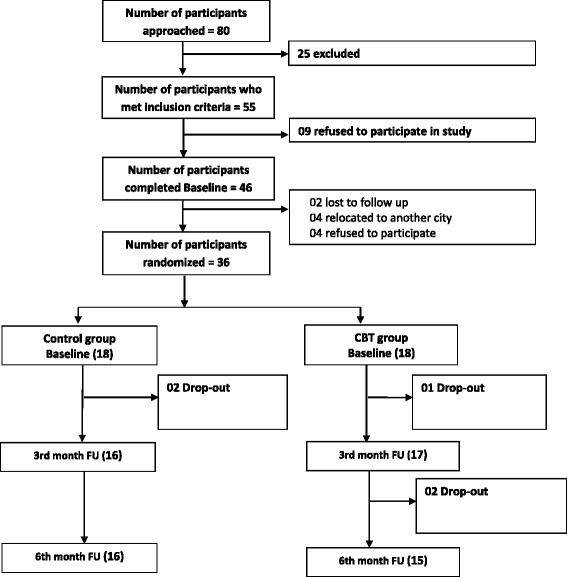
Rater-blind, randomised, controlled trial of the use of standard duration CBT in patients with psychosis from a low-income country. Participants with a ICD-10 diagnosis of psychosis were assessed using Positive and Negative Syndrome Scale for Schizophrenia (PANSS), Psychotic Symptom Rating Scales (PSYRATS), and the Schedule for Assessment of Insight (SAI) (baseline, 3 months and 6 months). They were randomized into the intervention group (n = 18) and Treatment As Usual (TAU) group (n = 18). The intervention group received 12 weekly sessions of CaCBTp.
The CaCBTp group had significantly lower scores on PANSS Positive (p = 0.02), PANSS Negative (p = 0.045), PANSS General Psychopathology (p = 0.008) and Total PANSS (p = 0.05) when compared to TAU at three months. They also had low scores on Delusion Severity Total (p = 0.02) and Hallucination Severity Total (p = 0.04) of PSYRATS, as well as higher scores on SAI (p = 0.01) at the same time point. At six months only the improvement in PANSS positive scores (p = 0.045) met statistical significance..
It is feasible to offer CaCBTp as an adjunct to TAU in patients with psychosis, presenting to services in a lower middle-income country.
Clinicaltrials.gov identifier NCT02202694 (Retrospectively registered).
认知行为疗法(CBT)治疗精神分裂症疗效的证据越来越多。CBT在治疗阳性和阴性症状方面有效且具有成本效益。为了有效满足不同文化群体的需求,CBT需要根据语言、文化和社会经济背景进行调整。我们旨在评估在低收入国家,一种文化适应型CBT治疗精神病(CaCBTp)的可行性、疗效和可接受性。
对来自低收入国家的精神病患者使用标准时长CBT进行双盲、随机对照试验。使用精神分裂症阳性和阴性症状量表(PANSS)、精神病症状评定量表(PSYRATS)和洞察力评估量表(SAI)(基线、3个月和6个月)对国际疾病分类第10版(ICD-10)诊断为精神病的参与者进行评估。他们被随机分为干预组(n = 18)和常规治疗(TAU)组(n = 18)。干预组接受为期12周的CaCBTp治疗。
与TAU组相比,CaCBTp组在3个月时PANSS阳性量表(p = 0.02)、PANSS阴性量表(p = 0.045)、PANSS总体精神病理学量表(p = 0.008)和PANSS总量表(p = 0.05)得分显著更低。在同一时间点,他们在PSYRATS的妄想严重程度总分(p = 0.02)和幻觉严重程度总分(p = 0.04)上得分也较低,而在SAI上得分较高(p = 0.01)。在6个月时,只有PANSS阳性得分的改善(p = 0.045)具有统计学意义。
在低收入中等收入国家,为精神病患者提供CaCBTp作为TAU的辅助治疗是可行的。
Clinicaltrials.gov标识符NCT02202694(追溯注册)。