Yeo Jinseok, Jung Hoon, Lee Hyerim
Department of Anesthesiology and Pain Medicine, Chilgok Hospital, School of Medicine, Kyungpook National University, Daegu, Republic of Korea.
Pain Res Manag. 2017;2017:7394626. doi: 10.1155/2017/7394626. Epub 2017 Oct 25.
The chronic postischemia pain (CPIP) model is an animal model using ischemia/reperfusion injury that mimics the symptoms of complex regional pain syndrome type I. Glutathione (GSH) prevents ischemia/reperfusion injury by scavenging free radicals. We conducted this study to investigate the protective effect of GSH in CPIP rats via changes of mechanical allodynia and phospholyration of the N-methyl-D-aspartate receptor subunit GluN1.
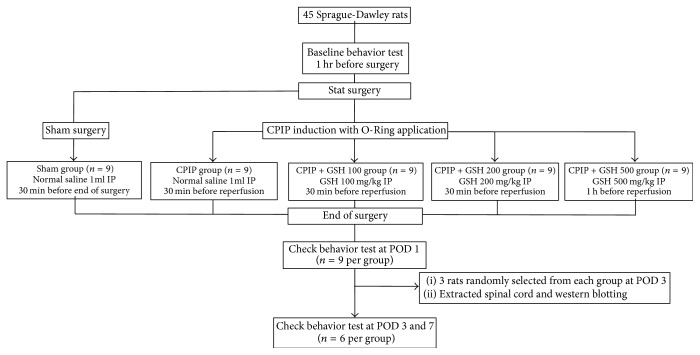
We divided 45 rats into 5 groups: sham, CPIP, CPIP + GSH 100 mg/kg, CPIP + GSH 200 mg/kg, and CPIP + GSH 500 mg/kg. Rats in the sham and CPIP groups received normal saline and rats in the other groups received GSH at the designated doses thirty minutes prior to reperfusion. Withdrawal thresholds were evaluated before sugery as well as 1, 3, and 7 days after surgery. pGluN1 level in the spinal cord was also measured.
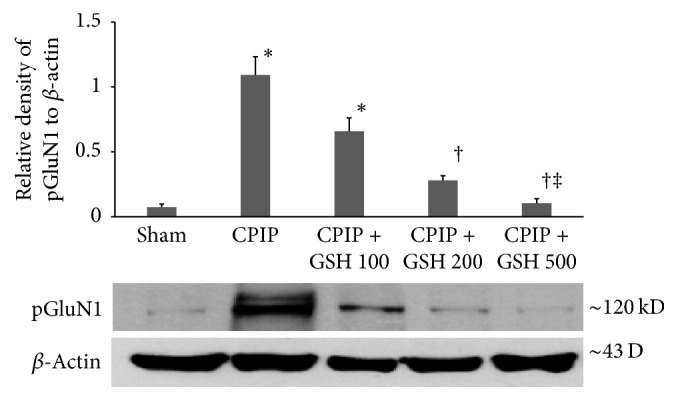
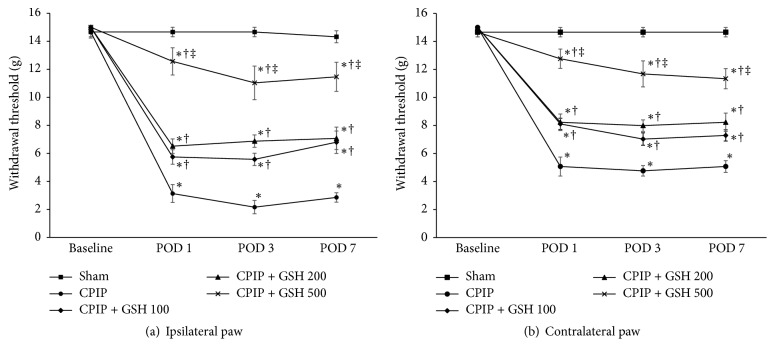
GSH treated rats show a significant increase in the withdrawal thresholds of both hind paws as compared with the CPIP group dose-dependently. The expression of pGluN1 in the GSH treated rats significantly decreased as compared to the CPIP group (all < 0.05).
These findings suggest that GSH inhibited the development of mechanical allodynia and central sensitization in CPIP rats.
慢性缺血后疼痛(CPIP)模型是一种利用缺血/再灌注损伤的动物模型,可模拟I型复杂性区域疼痛综合征的症状。谷胱甘肽(GSH)通过清除自由基来预防缺血/再灌注损伤。我们进行这项研究,旨在通过机械性异常性疼痛的变化以及N-甲基-D-天冬氨酸受体亚基GluN1的磷酸化来研究GSH对CPIP大鼠的保护作用。
我们将45只大鼠分为5组:假手术组、CPIP组、CPIP + 100 mg/kg GSH组、CPIP + 200 mg/kg GSH组和CPIP + 500 mg/kg GSH组。假手术组和CPIP组大鼠接受生理盐水,其他组大鼠在再灌注前30分钟接受指定剂量的GSH。在手术前以及手术后1、3和7天评估撤药阈值。还测量了脊髓中pGluN1的水平。
与CPIP组相比,GSH处理的大鼠双后爪的撤药阈值剂量依赖性地显著增加。与CPIP组相比,GSH处理的大鼠中pGluN1的表达显著降低(均P<0.05)。
这些发现表明,GSH可抑制CPIP大鼠机械性异常性疼痛的发展和中枢敏化。